
Headlines
Stakeholders endorse hybrid governance model for Nigeria’s tourism, hospitality industry at NIHOTOUR forum

Funso OLOJO, Editor
Leading academics, industry practitioners, professional bodies, regulators and other stakeholders have called for the adoption of a hybrid professional governance framework that combines statutory regulation with professional recognition to strengthen Nigeria’s tourism and hospitality workforce.
The recommendation emerged at the NIHOTOUR Stakeholder Engagement Forum held on Wednesday, July 15th, 2026, where participants agreed that closer collaboration between regulators, professional associations and academic institutions is essential to building a globally competitive tourism industry.
Welcoming participants, the Director-General of the National Institute for Hospitality and Tourism (NIHOTOUR), Aare Abisoye Fagade, stressed that developing a world-class workforce requires strong partnerships among government, academia and the private sector.
The forum featured a keynote presentation by Professor Wasiu Babalola, Professor of Hotel Management and Tourism at Atiba University, Oyo, legal practitioner and PhD candidate at the Faculty of Law, Lead City University, Ibadan.
His paper, titled “Strategic Roles of Industry Associations and Professional Bodies in Workforce Registration, Certification, Licensing and Sustainable Human Capital Development,” drew from his ongoing doctoral research, “Professional Recognition by Professional Practice: A Viable Alternative for Nigerian Tourism and Hospitality Professional Stability.”
Professor Babalola argued that although the NIHOTOUR Act 2022 represents a significant milestone in the professionalisation of Nigeria’s tourism and hospitality sector, legislation alone cannot guarantee long-term professional stability.
According to him, sustainable growth can only be achieved through effective collaboration between statutory institutions and recognised professional bodies operating within clearly defined responsibilities.
He observed that the industry continues to grapple with fragmented regulation, overlapping institutional mandates, inconsistent certification processes, weak professional identity and inadequate workforce data.
Rather than fostering competition among institutions, he said these challenges require a collaborative governance structure that clearly assigns responsibilities while promoting synergy.
Drawing lessons from established professions such as law, medicine, engineering, architecture and accounting, Professor Babalola explained that successful professional systems operate on a dual model in which government regulators establish minimum standards while professional bodies drive competency development, ethical conduct, continuing professional education and peer recognition.
A major highlight of the presentation was the introduction of the Hybrid Professional Governance Framework, built around the Professional Recognition by Professional Practice (PRPP) model.
Under the proposal, recognised professional bodies would be formally empowered under the NIHOTOUR Act to oversee continuing professional development, ethical standards, practitioner engagement and specialised competency development. NIHOTOUR, on the other hand, would retain responsibility for statutory regulation, licensing, certification, standards enforcement and maintenance of the national workforce register.
Professor Babalola outlined several key recommendations to support the framework, including the formal recognition of credible professional bodies through the PRPP model, clear delineation of professional practice areas within the tourism and hospitality industry, development of Standard Operating Procedures (SOPs) and operational manuals for recognised professional bodies, enhancement of a national digital tourism and hospitality workforce register, competency-based certification under NIHOTOUR, mandatory continuing professional development through accredited professional associations, stronger collaboration among government, industry and academia, and alignment with international best practices in tourism workforce development.
He further noted that Section 4 of the NIHOTOUR Act 2022 already provides sufficient legal backing for collaboration between NIHOTOUR and professional bodies in areas such as training, certification, capacity development and other statutory responsibilities, making partnership a more practical approach than institutional rivalry.
Stakeholders at the forum endorsed the proposal, describing it as a practical framework capable of improving institutional cooperation, eliminating duplication of functions, strengthening workforce quality and enhancing Nigeria’s competitiveness in the global tourism and hospitality market.
They also urged NIHOTOUR to sustain stakeholder consultations on the proposal in order to develop a governance model that enjoys broad industry acceptance and reflects the collective aspirations of all relevant stakeholders.
Concluding his presentation, Professor Babalola said: “Professionalisation is strongest when statutory authority and professional recognition work together, not in competition, but in partnership.”
He also acknowledged the academic support and research environment provided by the Faculty of Law, Lead City University, Ibadan, noting that presenting his doctoral research before national and international audiences demonstrates the university’s commitment to academic excellence, globally relevant research and bridging the gap between academia and industry.

Commentaries
Beyond Shiny Tech: Why Africa’s smart ports must build plumbing before AI
Monday Discourse with Ibrahim Nasiru
At the African Ports Conference (COPAF 2026) in Casablanca, Morocco, the Managing Director of the Nigerian Ports Authority (NPA), Dr. Abubakar Dantsoho, dropped a piece of unvarnished realism that should govern all future maritime discourse on the continent.
Speaking on the theme of artificial intelligence and cybersecurity, Dantsoho issued a vital warning: African ports must establish effective, uncompromised digital foundations before they rush to deploy artificial intelligence (AI).
In an era where public officials routinely weaponize trendy buzzwords like “AI,” “Big Data,” and “Smart Governance” to perform administrative progress, Dantsoho’s perspective is a refreshing return to structural logic.
Smart ports, he rightly argued, must be measured by tangible operational realities—faster vessel turnaround times, shorter cargo dwell times, lower costs, and watertight revenue accounting—not by the sheer volume of technology purchases.
The numbers coming out of Nigeria’s maritime sector suggest that getting the basic digital foundations right yields immediate economic dividends.
The deployment of foundational tools like the “Eto” truck call-up system, alongside initial frameworks for the Port Community System, catalyzed a staggering 24.8 per cent increase in Nigeria’s cargo throughput.
This foundational digitisation is precisely why the World Bank’s Container Port Performance Index recently recorded strong upward trajectory rankings for both the Tin Can Island and Apapa Ports.
But as Nigeria embarks on its massive $1 billion Lagos ports modernization program, we must face the hard, structural truth that lies beneath these celebratory statistics.
Digitisation is not merely about software procurement; it is about political will and institutional harmonization.
For over a decade, Nigeria’s biggest maritime bottleneck has not been a lack of computers, but the fierce, territorial resistance from various state agencies refusing to plug into a single, unified data ledger.
A “Smart Port” cannot exist in a vacuum where customs, immigration, terminal operators, and security agencies run isolated, analogue silos designed to preserve bureaucratic fiefdoms and rent-seeking opportunities.
If the $1 billion modernization fund is spent buying sophisticated AI predictive maintenance tools and automated vessel planning systems while the National Single Window remains structurally sabotaged by agency politics, we will simply end up with a highly automated system that accelerates corruption and bottlenecks.
You cannot run a predictive AI algorithm on data that is manually altered or hidden by a human clearing agent at the wharf.
Dantsoho is entirely correct: we must build the digital plumbing before we chase the AI crown.
Going into 2027, the yardstick for evaluating the NPA’s modernization program must not be the number of smart cameras or automated gates installed.
The true metric of success will be the complete, legally enforced integration of all port stakeholders into a single data ecosystem.
Until the data flows seamlessly and transparently from the vessel to the final exit gate without human friction, any talk of an “AI-driven smart port” is mere window dressing.
We must fix the foundations first, or watch a billion dollars clear out into the ocean of unfulfilled potential.
Ibrahim Nasiru, a public affairs analyst, writes from Abuja.
Headlines
Dredgers association disowns extortion allegations against Lagos commissioner

Funso OLOJO, Editor
The Dredgers Association of Nigeria (DAN) has disowned a media report alleging extortion, harassment and intimidation of dredgers and tipper operators by the Lagos State Commissioner for Waterfront Infrastructure Development, Hon. Ekundayo Alebiosu and Mr. Cardozo.
The association, in a disclaimer issued on Friday, October 23, 2026, said the report, published by Linda Ikeji’s Blog and other online platforms under the headline “Dredgers Association Appeals to Sanwo-Olu Over Alleged Extortion, Urges Governor to Call Alebiosu, Cardozo to Order,” did not originate from its national leadership or any authorised organ of the association.
DAN stated categorically that it neither authorised nor approved any petition or press release accusing the commissioner and Cardozo of harassment, intimidation or extortion.
It also denied having any record of the alleged impounding of trucks and the purported demand for ₦500,000, which featured in the publication.
The association, therefore, distanced itself entirely from the allegations, urging the public and relevant stakeholders not to regard the report as an official statement of its position.
Reaffirming its relationship with the Lagos State Government under Governor Babajide Sanwo-Olu, DAN described its engagements with the government and the Ministry of Waterfront Infrastructure Development as cordial and collaborative.
According to the association, issues concerning dredging regulations and the interpretation of Supreme Court judgments on shoreline authority are being addressed through appropriate institutional channels and dialogue with relevant federal and state authorities.
It stressed that such matters were being handled through established processes rather than media confrontations.
DAN consequently urged the Lagos State Government, Alebiosu and other stakeholders to disregard the publication in its entirety, insisting that it did not represent the association’s official position.
The association also expressed regret over any embarrassment, inconvenience or reputational damage the report might have caused the Lagos State Government, the commissioner and other officials mentioned.
Reaffirming its commitment to responsible industry engagement, DAN said it remained dedicated to promoting lawful and sustainable dredging operations across Nigeria through constructive collaboration with relevant authorities and stakeholders.
The disclaimer was signed by the association’s National President, Batare Akpomejero, and National Secretary, Richard Ntan.
Customs
Customs intercepts five live Pangolins in Ogun, goes after wildlife traffickers
Funso OLOJO, Editor
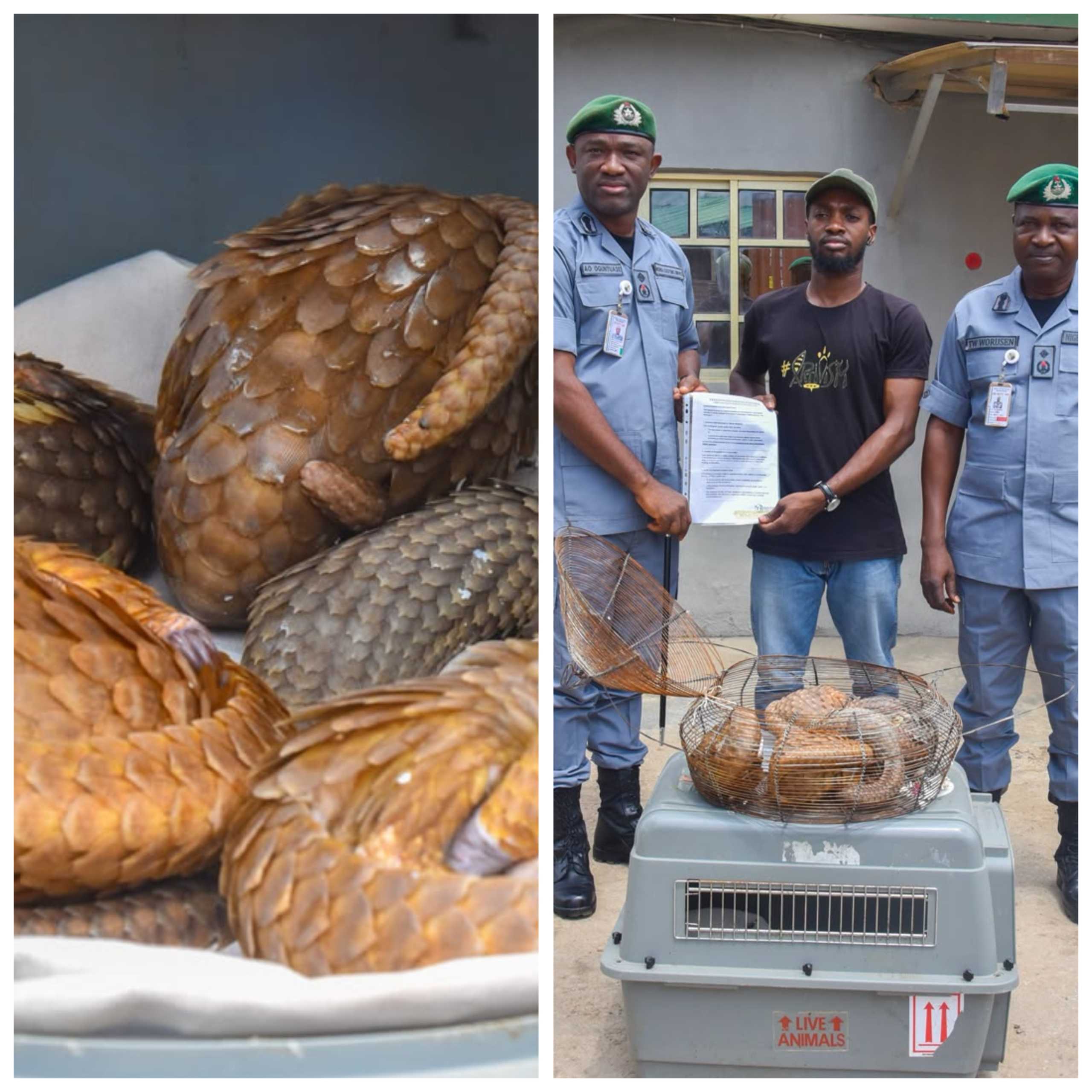
The Nigeria Customs Service (NCS), Federal Operations Unit (FOU) Zone ‘A’, has rescued five more live pangolins in Ogun State, intensifying its crackdown on the illegal wildlife trade and raising fresh concerns about the activities of endangered-species trafficking syndicates.
The latest interception, carried out at about 1:18 a.m. on Friday, October 23, 2026, along the Igbo-Ora/Imeko-Afon axis of Ogun State, followed intelligence reports on the suspected movement of endangered wildlife.
Acting on the intelligence, Customs officers intercepted the five pangolins confined in wire-mesh cages and concealed in a manner suspected to have been designed to evade detection.
The suspected traffickers reportedly abandoned the animals and fled upon sighting the patrol team.
The rescue marks another intervention by the Unit against wildlife trafficking within approximately seven days, prompting calls for an extensive investigation to identify and dismantle the criminal networks behind the illicit trade.
In line with its commitment to wildlife protection, FOU Zone ‘A’ formally handed over the rescued animals to the Greenfingers Wildlife Initiative Centre for safekeeping, rehabilitation and eventual release into a protected habitat.
The handover was conducted by the Deputy Comptroller in charge of Enforcement, Oluwaseun Oguntuase, on behalf of the Acting Controller of the Unit, Deputy Comptroller Oladapo Afeni.
Speaking at the handover ceremony, Oguntuase said the interception of multiple wildlife consignments within a short period underscored the need for sustained investigations and stronger enforcement measures against those involved in the illegal capture, transportation and trafficking of endangered species.
He reaffirmed the Service’s commitment to combating wildlife trafficking, protecting endangered animals and enforcing Nigeria’s obligations under the Convention on International Trade in Endangered Species of Wild Fauna and Flora (CITES), alongside relevant national legislation.
“Pangolins are among the world’s most trafficked mammals. This seizure is another clear warning to those involved in the illegal wildlife trade that Nigeria’s borders and transport corridors remain under active surveillance,” Oguntuase said.
Pangolins are listed under Appendix I of CITES, which generally prohibits international commercial trade in wild-caught specimens and their derivatives, subject to the Convention’s applicable provisions.
Nigeria’s Endangered Species (Control of International Trade and Traffic) Act also provides a legal framework for protecting endangered wildlife and regulating activities involving listed species.
Oguntuase said FOU Zone ‘A’ would sustain intelligence-led operations, deepen collaboration with conservation organisations and other relevant stakeholders, and ensure that rescued animals receive appropriate care.
He warned that individuals involved in wildlife trafficking would face the full weight of the law.
“Those who engage in wildlife trafficking will be made to face the full weight of the law,” he declared.
Receiving the rescued pangolins, Dr. Austin Tochukwu of the Greenfingers Wildlife Initiative Centre commended the Nigeria Customs Service for its vigilance and prompt intervention.
He assured the Service that the organisation would provide the animals with the necessary care and undertake efforts towards their rehabilitation and eventual release into a safe, protected environment.
The latest rescue underscores the importance of collaboration between law enforcement agencies and wildlife conservation organisations in confronting the illegal wildlife trade.
The Nigeria Customs Service reiterated that protecting the country’s biodiversity is a shared national responsibility requiring sustained cooperation among government institutions, conservation partners and citizens.
As enforcement operations continue, attention is expected to focus on identifying the individuals and networks responsible for the movement of endangered wildlife through Nigeria’s transport corridors.

 Headlines2 months ago
Oyetola presents three-year score card as blue economy industry revenue hits ₦1.83trn
 Customs2 months ago
Apapa Customs sets new single-day revenue record with ₦28.1bn collection
 Customs2 months ago
Apapa Customs sets new record of monthly revenue haul with ₦323bn collection in July
 Customs3 months ago
NCS intercepts container concealing pump-action rifle parts, seizes ₦373.8m worth of cannabis products at Tincan Port
 Customs3 months ago
FG exempts CNG, electric vehicles from Customs duty, VAT
 Customs4 weeks ago
FOU Zone ‘A’: Aliyu retires after ₦3.19bn revenue recovery, Afeni takes over