Features
Beyond Lagos ports: Why NPA should position Eastern ports for global recognition

Monday Discourse with Ibrahim Nasiru focuses on why government should look beyond Lagos ports and position Eastern ports for global recognition.
Our feature last week on the World Bank Top 20 ranking for Tin Can and Apapa Ports sparked an intense industry debate.
The biggest question raised: What about the rest of Nigeria’s coastlines?
Dropping tomorrow morning, June 29th, 2026,we go beyond the Lagos headlines to break down the hidden operational realities of Nigeria’s Eastern Ports.
Don’t miss “Beyond Lagos: The Untold Realities of Nigeria’s Eastern Corridor Seaports”






Customs
How Afeni is repositioning Idiroko trans- border trade route for economic prosperity, smugglers nightmare

Funso OLOJO, Editor
For decades, the Idiroko border corridor has existed at the intersection of legitimate commerce and the informal economy, serving simultaneously as a gateway for legitimate trans-border trade and a lucrative passage for smugglers exploiting Nigeria’s long and porous western frontier.
But that business environment appears to be undergoing a gradual transformation.
At the centre of the emerging change is the Ogun I Area Command of the Nigeria Customs Service, where the Acting Customs Area Controller, Deputy Comptroller Olukayode Afeni, has adopted a more aggressive intelligence-led enforcement strategy aimed at altering the risk-reward equation that has historically sustained illicit commerce along the corridor.
Afeni’s philosophy is relatively straightforward: legitimate trade should be facilitated, but smuggling, drug trafficking and other forms of economic sabotage must become increasingly difficult, expensive and dangerous.
The latest operational scorecard presented by the Command on Thursday, August 13th, 2026 provides an insight into the scale of that campaign.
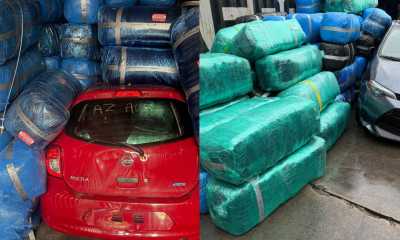
The Command paraded seizures with a combined Duty Paid Value of N3.574 billion, covering agricultural products, petroleum products, textiles, consumer goods and narcotics.
Among the intercepted items were 2,339 bags of foreign parboiled rice, 70 cartons of basmati rice, 6,035 parcels of Ghana Loud/Indica, 30 bags of foreign sugar, 11,450 litres of PMS in kegs, 1,750 litres of PMS in drums, 30 kegs of diesel, 100 bags of fertilizer and 67 bales of second-hand clothing.
The seizure list also included thousands of pieces of new clothing, drinks, cosmetics, hair accessories, fire extinguishers, purses and other consumer products.
But the significance of the figures does not lie merely in their monetary value. They provide an indication of the variety of commercial activities that the Command is now confronting along the border—and of the extent to which enforcement is beginning to influence the operating environment for both legitimate traders and illicit networks.
The Idiroko corridor has never been simply a Customs enforcement zone. It is a commercial ecosystem connecting communities and businesses on both sides of the Nigeria-Benin frontier.
For legitimate traders, the border provides access to markets, goods and opportunities for cross-border commerce.
For smugglers, however, the same geography presents opportunities to bypass formal import procedures and exploit differences in prices, taxes, restrictions and market demand between the two countries.
That is where Afeni’s intervention becomes significant.
Rather than viewing seizures as isolated enforcement events, the current strategy increasingly appears designed to disrupt the underlying business model of smuggling.
Every intercepted truck, vehicle, petroleum consignment, rice shipment or narcotics parcel represents not only a seizure but a potential interruption of a supply chain.
The objective is to make illegal trade less predictable and less profitable.
Rice and the economics of local production
Foreign parboiled rice remains one of the most visible commodities in the border enforcement equation.
The interception of more than 2,300 bags in the latest operation reinforces the persistent pressure on domestic rice production from illicit imports.
Afeni’s argument is that smuggling should be viewed through the prism of economic protection rather than merely customs prohibition.
When imported rice enters Nigeria outside the approved channels, it competes directly with Nigerian farmers, millers and distributors without necessarily bearing the same regulatory and fiscal obligations.
For a government attempting to strengthen domestic agricultural production, such competition can undermine investment and discourage farmers from expanding production.
The Ogun I campaign therefore places border enforcement within the broader question of Nigeria’s food-security strategy.
In Afeni’s formulation, protecting the border is also protecting the farmer.
The narcotics economy
If rice represents the agricultural dimension of the border challenge, narcotics represent its darker security dimension.
The Command’s interception of 6,035 parcels of Ghana Loud/Indica in the latest operation is significant, but the larger figure disclosed by Afeni is even more revealing.
From January to date, he said, Ogun I has handed over 32,412 parcels of hard drugs and 92 sacks of raw Cannabis sativa to the NDLEA Idiroko Special Command.
That figure places narcotics enforcement firmly among the Command’s major operational priorities.
It also demonstrates why border security increasingly requires agencies to work beyond traditional institutional boundaries.
Customs officers may intercept the shipment, but the investigation, drug intelligence and prosecution process require the specialised capabilities of the NDLEA and other security agencies.
The formal handover of the seized narcotics during Thursday’s event therefore symbolised the growing importance of inter-agency collaboration in securing the corridor.
The border as an export gateway
Perhaps one of the less discussed aspects of the Ogun I story is the Command’s export performance.
While considerable attention is naturally attracted by seizures, the Command also recorded 10,110 metric tonnes of exports, with a Free On Board value of N2.594 billion.
White talc, crushed thermal coal and CNG were identified as the principal drivers of the export volume.
That statistic is important because it challenges the perception of Idiroko principally as a route for imported goods.
The corridor is also capable of serving as a platform for Nigerian exports.
This creates a potentially important policy distinction. The objective of effective border management should not be to suppress cross-border commerce; rather, it should be to differentiate legitimate commerce from illicit trade and create an environment where compliant businesses can operate with greater certainty.
For Customs, that means enforcement and trade facilitation must move together.
Revenue from the corridor
The Command’s fiscal contribution also offers another measure of its economic relevance.
In July alone, Ogun I collected N90.066 million from baggage assessments, auctions of perishable items, PMS and other charges.
Although the figure is modest when compared with the revenue generated by Nigeria’s major seaport commands, it illustrates the multiple revenue streams available within the border environment.
More importantly, it demonstrates that the border economy extends beyond the conventional importation of goods.
A new risk calculation for smugglers
The central question surrounding Afeni’s tenure may therefore not be how many seizures the Command records in a particular month.
It may be whether the enforcement campaign is succeeding in changing the underlying calculation made by those who contemplate using the Idiroko corridor for illegal trade.
For years, smuggling has survived because its potential returns could outweigh the risks of interception.
That equation changes when intelligence improves, surveillance becomes more effective, inter-agency coordination becomes stronger and seized goods are followed by investigation and prosecution.
Afeni’s repeated warning that the Command intends to make Ogun I “hostile” to smugglers is therefore more than rhetoric.
It represents an attempt to change the commercial environment in which illicit operators make their decisions.
But legitimate trade must remain protected
There is, however, another side to the equation. Idiroko’s importance cannot be measured only by the volume of contraband intercepted.
Thousands of Nigerians depend on legitimate cross-border commercial activity, while manufacturers, exporters, transporters, farmers and traders require an efficient and predictable border environment.
This makes Afeni’s appeal to the media to distinguish legitimate trade from illicit activity particularly important.
An aggressive enforcement regime that succeeds in deterring smuggling but inadvertently discourages legitimate commerce would produce an incomplete outcome.
The real measure of success would be a corridor where legitimate traders face greater certainty while smugglers face greater uncertainty.
That distinction will be critical to the long-term economic impact of the current enforcement drive.
From border enforcement to economic protection
Afeni’s presentation ultimately places the Ogun I Command at the intersection of three major national priorities: security, economic protection and trade facilitation.
The seizure of foreign rice speaks to agricultural protection.
The interception of narcotics speaks to public safety and national security.
The export figures point towards the untapped commercial potential of the corridor.
The revenue figures demonstrate its fiscal relevance.
Taken together, the figures suggest that what is happening at Ogun I is bigger than a succession of seizure announcements.
It is a contest over the character of the Idiroko border economy itself.
Whether the emerging model can permanently shift the corridor from an environment where illicit commerce flourishes to one where legitimate trans-border trade becomes the dominant business model will depend on the sustainability of enforcement, the efficiency of Customs procedures, infrastructure, inter-agency cooperation and the willingness of border communities to support lawful commerce.
For now, however, Afeni appears determined to push the equation in one direction.
Make legitimate trade easier to identify and protect—and make smuggling increasingly difficult to sustain.
That could ultimately prove to be the most consequential change taking place along the Idiroko corridor.
Economy
Nigeria’s Oil exports face threat as US- Israel attack on Iran escalates, Strait of Hormuz blockade imminent

It links the Arabian/Persian Gulf, or just the Gulf, with the Gulf of Oman and the Arabian Sea beyond.
It is 33km (21 miles) wide at its narrowest point, with the shipping lane just 3km (2 miles) wide in either direction, making it vulnerable to attack.
Despite its narrow width, the channel accommodates the world’s largest crude carriers.
According to the US Energy Information Administration (EIA), about 20 million barrels of oil, worth about $500bn in annual global energy trade, transited through the Strait of Hormuz each day in 2024.The crude oil passing through the strait originates from Iran, Iraq, Kuwait, Qatar, Saudi Arabia and the UAE.
The strait also plays a critical role in the liquefied natural gas (LNG) trade.
On Saturday, February 28th, 2026, an official from the European Union told the Reuters news agency that vessels crossing the strait have been receiving very high frequency (VHF) transmissions from Iran’s elite Islamic Revolutionary Guard Corps (IRGC), saying “no ship is allowed to pass the Strait of Hormuz”.However, the EU official added, Iran has not officially closed the strait.
“Our ships will stay put for several days,” a top executive at a major trading desk told Reuters on condition of anonymity. Countries like Greece have also advised their vessels to avoid transiting through the waterway.
Any instability in this important maritime route could rattle economic stability worldwide.
The strait handles both oil and gas exports and imports.
Kuwait and the UAE import supplies sourced outside the Gulf, including shipments from the United States and West Africa.
The EIA estimated that in 2024, 84 percent of crude oil and condensate shipments transiting the strait headed to Asian markets.
A similar pattern appears in the gas trade, with 83 percent of LNG volumes moving through the Strait of Hormuz destined for Asian destinations.
China, India, Japan and South Korea accounted for a combined 69 percent intake of all crude oil and condensate flows through the strait last year. Their factories, transport networks and power grids depend on uninterrupted Gulf energy.
A spike in oil prices will impact countries such as China, India and several Southeast Asian nations.
How would the Strait’s closure impact oil prices?
According to Iranian state media, the country’s Supreme National Security Council must make the final decision to close the strait, and it has to be ratified by the government.But energy traders have been on high alert in recent weeks amid escalating tensions in the region – home to one of the largest reserves of oil and gas in the world.
Muyu Xu, senior crude oil analyst at Kpler, told reporters that since the war began on Saturday, there has been a sharp drop in vessel traffic through the strait.
“At the same time, the number of vessels idling on either side – in the Gulf of Oman and the Gulf – has surged, as shipowners grow increasingly concerned about maritime security risks following Tehran’s warning of a potential navigation closure,” he said.
“The Strait of Hormuz is critical to the global energy market, as roughly 30 percent of the world’s seaborne crude oil transits the waterway.
” In addition, nearly 20 percent of global jet fuel and about 16 percent of gasoline and naphtha flows also pass through the Strait,” Muyu said.
“On Sunday, March 1st, 2026, an oil tanker was struck off the coast of Oman, signalling a clear escalation of the conflict and a shift in targets from purely military facilities to energy assets.”
Shipping data showed that at least 150 tankers, including crude oil and liquefied natural gas vessels, have dropped anchor in open Gulf waters beyond the Strait of Hormuz.
The tankers were clustered in open waters off the coasts of major Gulf oil producers, including Iraq and Saudi Arabia, as well as LNG giant Qatar, according to the Reuters news agency estimates based on ship-tracking data from the MarineTraffic platform.
Moreover, on Sunday, March 1st, 2026,the United Kingdom Maritime Trade Operations (UKMTO) said it is aware of “significant military activity” in the Strait and said it has received a report of an incident two nautical miles north of Oman’s Kumzar, located in the Strait of Hormuz.
Muyu from Kpler said a broad range of energy infrastructure is now under threat. “This is expected to sharply intensify the oil price rally and could keep prices elevated for a sustained period, potentially longer than during last June’s conflict.”
Ali Vaez, director of the Iran project at the International Crisis Group, told Al Jazeera, “Closure of the Strait of Hormuz would disrupt roughly a fifth of globally traded oil overnight – and prices wouldn’t just spike, they would gap violently upward on fear alone.”
“The shock would reverberate far beyond energy markets, tightening financial conditions, fuelling inflation, and pushing fragile economies closer to recession in a matter of weeks,” he added.
When the US and Israel bombed Iran last June, there was no direct disruption to maritime activity in the region.
What does it mean for the global economy?
Any disruption to energy flows through Hormuz will also impact the global economy, driving up fuel and factory costs.Hamad Hussain, a climate and commodities economist at the United Kingdom-based firm Capital Economics, said that for the global economy, a sustained rise in oil prices would add upward pressure to inflation.
“If crude oil prices were to rise to $100 per barrel and remain at those levels for a while, that could add 0.6-0.7 percent to global inflation,” he said, noting that this would also lead to an increase in natural gas prices.
“This could slow the pace of monetary easing by major central banks, particularly in emerging markets, where policymakers tend to be more sensitive to swings in commodity prices,” he added.
Features
Oxford-trained tech wizkid, Prince Nnamdi Ekeh shines in London with Forbes and EuroKnowledge award



 Customs2 months ago
Customs releases final recruitment list for ASC II, ends nearly one-year wait for applicants
- Headlines3 months ago
As NRC recovers ₦200m stolen railway assets, Opeifa vows diligent prosecution of suspects
- Customs3 months ago
Customs launches MIS file tracker at PTML in fresh digitalisation drive
- Customs2 months ago
Apapa Customs sets new record of monthly revenue haul with ₦323bn collection in July
- Customs2 months ago
Apapa Customs sets new single-day revenue record with ₦28.1bn collection
- Customs3 months ago
Apapa Customs intercepts ₦26.57bn cannabis hidden in imported vehicles