Connect with us

Aviation

FAAN, freight forwarders in stand- off over new tariff regime at Lagos Airport

Funso Olojo 
The Federal Airport Authority of Nigeria(FAAN) is currently in an eye- ball to eye- ball confrontation with the Customs Clearing Agents at the Lagos Airport.
The stand- off is over the decision of FAAN, an agency of government which is the landlord at the airport, to increase rents on its properties being occupied by the freight forwarders at one of its office properties located Hajji camp.
Trouble started when FAAN notified the freight forwarders( tenants) on Monday , February 2nd, 2026 of its intention to implement the new tariff regime which the agency had earlier announced.
Our correspondent gathered that the  occupants of the FAAN facility namely, the Association of Nigerian Licensed Customs Agents(ANLCA), National Association of Government Approved Freight Forwarders(NAGAFF) and others ignored the directive and failed to comply with the new increase in tariff, claiming that the margin of increase is too much while accusing the airport authority of unilaterally hiking the rents without proper consultation with the occupiers.
As a result, the associations who occupy these facilities stayed put, an action which an insider said angered the Airport Authority which regarded them as having an “entitlement mentality”
This development, our reporter learnt, led to the notice by FAAN to its tenants of its intention to implement the new tariff regime and take possession of its properties.
“The Authority directed that you vacate the premises currently occupied by you. You have failed to comply with the directive.
“Accordingly, by this notice, you are required to vacate the said premises with immediate effect, failing which the Authority shall proceed to enforce compliance without further notice.
” Ensure all persons and personal belongings are removed without delay.”FAAN declared in its quit notice to the occupiers.
Both parties in the dispute are now trading blames.
While the evicted associations, which have now congregated under the name
“United Freight Forwarders” accused FAAN of high handedness and unilateral action steeped in “institutional blackmail,” FAAN accused the aggrieved evicted associations of having an  “entitlement mentality”.
” FAAN will not succumb to their blackmail and give in to their entitlement mentality syndrome which they have perfected in all areas of their operations”
” These  arm- twisting tactics they normally use at the seaports where they feel they are bigger than the law will not be tolerated at the Airport”,  an insider in FAAN told our reporter under the condition of annonimity.
However, as both estranged partners have stuck to their hardline positions, stakeholders expressed fears of disruption of  air cargos clearance at the airport.
Continue Reading
Click to comment

Leave a Reply

Your email address will not be published. Required fields are marked *

Aviation

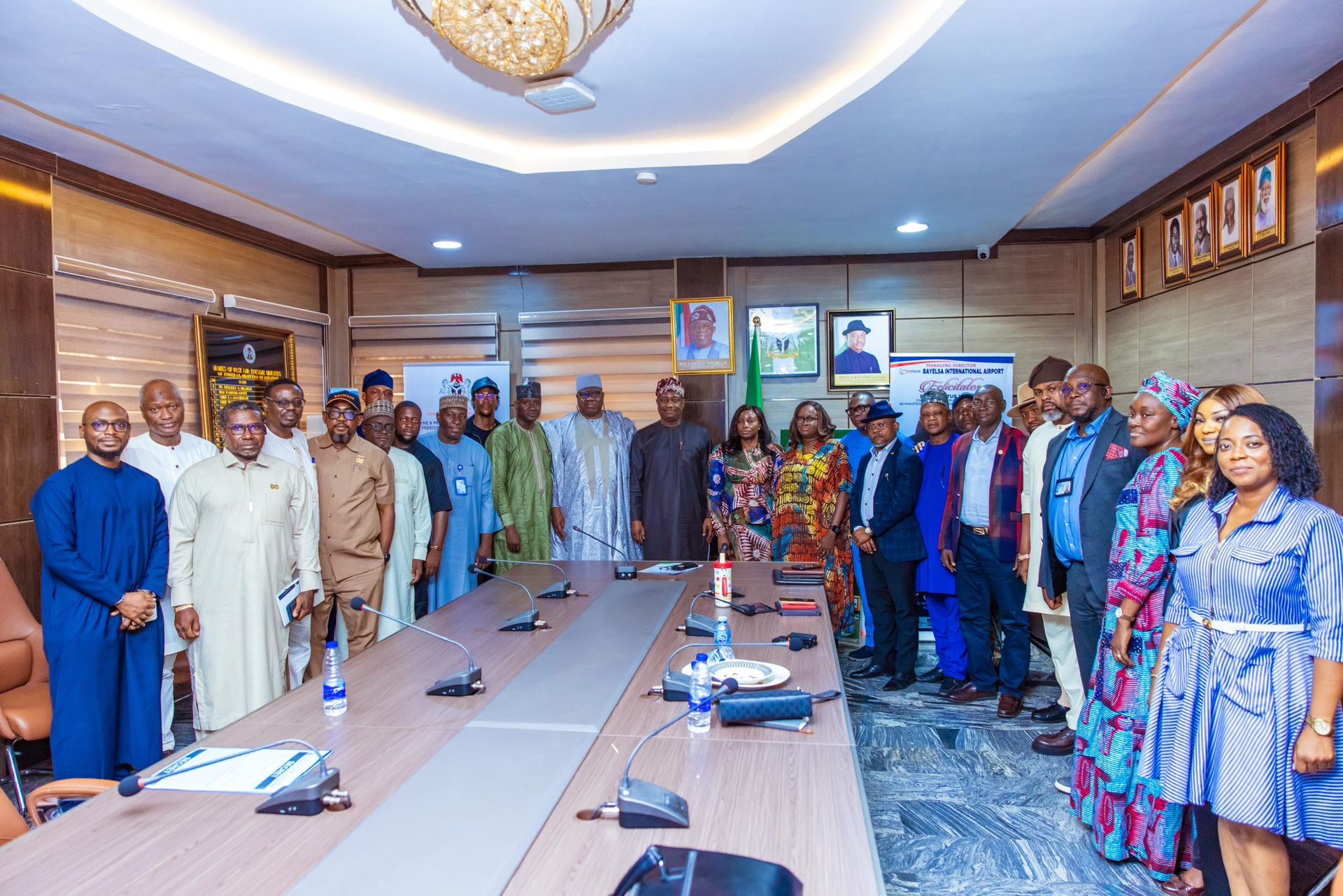
FAAN resumes toll collection at Airports, adopts hybrid payment method 
Gloria Odion, Reporter
The Federal Airports Authority of Nigeria(FAAN) have resumed collection of toll at all its toll plazas located at the airports in the country, including Murtalar Mohammed International Airport, Lagos.
The toll suspension arose from the chaos which the new cashless payment method introduced by FAAN recently generated which resulted in long queues of motorists at these facilities.
This development has raised public outcry which necessitated the intervention of President Bola Ahmed Tinubu who directed the suspension of the cashless payment system.
However, the Minister of Aviation and Aerospace Development, Festus Keyamo, has directed the resumption of toll collection at all these plazas.
In a press statement by his Special Adviser on Media and Communications, Tunde Moshood, the Minister declared that a hybrid access gate payment should be adopted by FAAN at the toll gates located at the Airports in the country.
“Following the earlier suspension of the full cashless Access Gate payment system as directed by the President of the Federal Republic of Nigeria, President Bola Ahmed Tinubu due to the traffic gridlock it created, the Minister of Aviation and Aerospace Development met with officials of the Federal Airports Authority of Nigeria (FAAN) and senior officials of the Ministry.
“After reviewing the initial implementation and the operational challenges observed, the following decisions were reached:
” The Ministry has resolved to engage concessionaires in order to introduce a fully automated or electronic system at all access gates at our airports in order to fully and eventually eliminate cash payments.
” In the meantime, a hybrid payment system that accommodates both cash and card payments will resume at all airport access gates with effect from Friday, March 13, 2026.
” Motorists who already possess FAAN Go Cashless Cards may continue to use them until further notice.
“Other electronic payment options, including POS terminals and other approved digital channels, will also remain available.
“Members of the public and road users are encouraged to obtain and use the FAAN Go Cashless Card as the Authority continues to enhance and fully optimise the cashless payment system.
“This directive restores the previous access  gate payment arrangement whilst the Ministry continues to work on the fully automated or electronic system” the statement concluded.
Continue Reading

Aviation

Tension de-escalates at Lagos Airport as FAAN, Cargo agents reach truce over new tariff

Funso OLOJO, Editor
The brewing crisis over the new cargo tariff introduced by the Federal Airports Authority of Nigeria( FAAN) may have been de- escalated  as the Airport Authority and the aggrieved Customs Licensed Cargo Agents have reached a compromise over the controversial tariff.
It could be recalled the new tariff regime of N20 per kilogram introduced by FAAN has sparked off a row between the airport authority and the cargo agents who vowed to resist the increase from the initial N7 per kilogram.
Tension has heightened when the two warring parties stuck to their gun with FAAN issuing a quit notice to the residents cargo agents and a threat to demolish their associations’ Secretariat.
However sanity prevailed after about one week of stand- off between the two gladiators as they both met for dialogue on Monday February 9th, 2026.
According to the statement issued by FAAN, the two sides have reached an agreement on the proposed review of cargo port charges.
“The agreement was achieved at a stakeholders meeting held on Monday February 9th, 2026,at the MMIA Terminal 2 conference room chaired by the Director of Cargo Development and Services, Mr Lekan Thomas.
“After constructive deliberation, both parties agreed on a revised port charges of N15.00 per kilogram, representing a compromise from the earlier proposed N20.00kg and an upward review of the existing #N7.00kg.
“The outcome reflects the spirit of dialogue, partnership and  shared responsibility.
“FAAN believes the resolution will enhance ease of doing business at MMIA while supporting sustainable airport and cargo infrastructure development.
“The Authority reaffirms it’s commitment to continuous stakeholders engagement,the SEDI(safety, efficiency, development and innovation) principles and the ongoing modernization of cargo terminal facilities.
“FAAN appreciates the cooperation of the customs Licensed cargo Agents and looks forward to sustained collaboration in advancing Nigeria’s air cargo sector” the Airport Authority stated.
Dr Segun Musa, the Vice- President of the National Association of Government Approved Freight Forwarders (NAGAFF) and one of the leaders of the warring associations at the Cargo Airport, confirmed the truce.
” Yes, we met yesterday, Monday (February 9th 2026) and we agreed on N15 per Kilogram.
“We agreed with FAAN in the interest of the economy, so that work could go on.
“The situation is now normalized” Musa declared.
Continue Reading

Aviation

Why we increased cargo tariff at Airports– FAAN

.
.
Funso OLOJO: 
The Federal Airports Authority of Nigeria(FAAN), has come out to defend its controversial tariff increase at the Airport. It could be recalled that this tariff hike has sparked off an outrage among the freight forwarders plying their trade at the FAAN facilities, who have accused FAAN of mischief and “institutional blackmail”

The leadership of the angry customs licensed agents associations such as the Association of Nigeria Licensed Customs Agents (ANLCA), National Association of Government Approved Freight Forwarders(NAGAFF), APFFLON and NAFFAC, have all jointly condemned the new tariff regime, describing it as illegal, double taxation and unilaterally imposed by the Airport Authority without consultation with the relevant stakeholders.
However, the management of FAAN, in its  reaction to these plethora of allegations, has issued a statement, clarifying the rationale behind the increase and refuting the allegations of extortion and unilateral action made by the angry stakeholders.

FAAN stated it’s own side of the story thus


Why we increase the tariff?

FAAN has increased tariffs after careful consideration of current economic realities.
Our tariffs have remained static since 2008. Over the past 18 years, Nigeria has experienced significant inflation (approximately 287%) and a drastic depreciation of the Naira.

This adjustment is essential to sustain and upgrade critical airport infrastructure, which has become financially unsustainable under the old rates.

The tariff is increasing from ₦7 to ₦20. Isn’t this a huge jump?

While the percentage increase appears large, it is important to view it in the context of time and inflation.
Based on data from the National Bureau of Statistics (NBS), a service that cost ₦7 in 2008 should cost about ₦27.09 today just to have the same value.

The new tariff of ₦20 is actually below this inflation-adjusted benchmark. This demonstrates FAAN’s commitment to sharing the burden and not passing the full cost onto operators.

How does the foreign exchange (FX) rate affect airport charges?

A significant portion of the equipment and materials needed for airport infrastructure—such as runway asphalt, aerodrome lighting, and fire truck parts—are imported.
In 2008, the exchange rate was about ₦118/$1. Today, it is about ₦1,500/$1.

This means the cost of these essential items has increased by over 1,000%. The tariff review is crucial to generate the necessary revenue in Naira to meet these dollar-denominated costs.

How does Nigeria’s new cargo tariff compare to other countries in West Africa?

Our analysis shows that even with this adjustment, Nigeria’s cargo charges will remain competitive. Prior to this review, our charges were lower than those at major regional hubs like Kotoka International Airport (Ghana) and Cotonou Airport (Benin).

This move aligns us closer to regional standards while ensuring we remain an attractive destination for air cargo operators and investors.

Is this not a form of double taxation on top of what the concessionaires charge?

No, this is not double taxation. There is a clear distinction between the two charges:”FAAN Port Charge: This covers the use of shared airport infrastructure that everyone benefits from, such as runways, taxiways, perimeter fencing, security, access roads, and airfield lighting.

It is like a toll for using the airport’s common facilities.
Concessionaire’s Handling Fee: This fee is charged by the private warehouse operators for specific services they provide within their terminals, such as cargo handling, storage, and documentation.
Will this tariff increase lead to higher prices for goods and services for the average consumer?
FAAN expects the impact on consumer prices to be minimal. The Port Charge is a very small component of the total cost of air freight.

The significant benefits of improved infrastructure—such as faster turnaround times and reduced delays—will ultimately lead to greater efficiency and could help stabilize or even lower logistics costs in the long run.

What specific projects will the revenue from this tariff increase be used for?

The additional revenue will be reinvested directly into critical cargo infrastructure projects, including:”Rehabilitation of aprons and access roads to cargo terminals.

Enhanced perimeter security and access control systems.
Implementation of a Cargo Community System (CCS) for digital documentation.
Installation of a Truck Call-Up System to reduce congestion at the Premier Cargo Terminal (PCT).
Upgrades to airfield lighting and other essential facilities.
Development of domestic cargo infrastructure.
Was there any consultation with stakeholders before this decision was made?
“Yes. FAAN is committed to transparent stakeholder engagement. Formal communication has been sent to all cargo operators and industry players.
Furthermore, stakeholder consultations are ongoing and will continue as a permanent exercise.

This ensures that all relevant parties are informed about cargo initiatives and can provide feedback.

What is the long-term goal of this tariff adjustment?

This is not merely a revenue-generation measure. It is a strategic investment in the future of Nigeria’s air cargo sector.

The goal is to build a resilient, efficient, and future-ready cargo ecosystem that is globally competitive, enhances security, and supports economic growth”

Continue Reading

Trending