
Customs
Customs commences use of spot rate for goods assessment as duty exchange rate again crashes to N1,440,121 per dollar

The Eyewitness Reporter
For the second consecutive times in 72 hours, the Central bank has reduced the Customs duty exchange rate from N1,488.896 per dollar to N1,440.121 per dollar even as the Nigeria Customs Service, Monday, February 26th, 2024 kick-started the use of spot rate for the assessment of import duties as prescribed by the Central Bank of Nigeria (CBN).
The drop in quick succession of the rate by the CBN may not be unconnected with the intervention of the Nigeria Customs Service to dissipate the burgeoning crisis that the soaring and unpredictable rate has generated in the industry.
It could be recalled that the apex bank, last week Saturday, February 24th, 2024, instructed the NCS to henceforth, starting Monday adopt a spot rate to determine the assessment of import duty.
In its circular issued last week Saturday, the CBN explained that the spot rate principle will apply where the closing rate of the forex will be used to determine the customs duty exchange rate which will terminate at the end of the importation and clearance of that particular goods.
“Following the liberalization of the FX market on the Willing Buyer – Willing Seller trading principle, the Central Bank of Nigeria has noted the concerns of Importers of goods and services in the irregular changes in the Import Duty Assessment levies applied by the Nigeria Customs Service.
“These developments have further built uncertainties around the pricing structure of goods services in the economy and created abnormal increases in the final sale prices of items, which is largely driven by uncertainties, rather than traditional market fundamentals, with implications to near-term inflation trend.
“To this effect, the Central Bank of Nigeria wishes to advise that the Nigeria Customs Service and other related Parties adopt the closing FX rate on the date of opening Form M for importation of goods, as the FX rate to be used for Import Duty Assessment.
“This rate remains valid until the date of termination of the importations and clearance of goods by importers.
“This would enable the Nigeria Customs Service and the importers to effectively plan appropriately and reduce the uncertainties around varying daily exchange rates in determining their revenue or cost structure, respectively.
“Therefore, effective 26th, February 2024, the closing rate on the date of opening of Form M for the importation of goods and services would be the rates that would apply for the assessment of import duty”
Therefore, the spot rate as captured on the Customs portal as of Monday, February 26th, 2026 stands at N1, 488.896 by which the import duty will be determined from the beginning of the import business when the importer opens form M and the close of the transaction when he takes delivery of his consignment.
The prevailing rate of N1,488.896 per dollar was a drop from the N1,488.896 recorded last week Friday, February 23rd, 2024 when it was announced by the CBN on the customs portal when it crashed the rate from the initial N1,605.82 per dollar.
This was a clear departure from the previous occurrences when the rate was being reviewed upward almost 12 hours at short intervals.
The customs brokers have expressed satisfaction at the adoption of the principle of spot rate to determine Customs duty as, according to them, the method will stabilize the import business, infuse confidence into the system and allow for planning and predictability.




Customs
Kaila, Seme Customs CAC, seeks collaboration with stakeholders to achieve seemless trade along border corridor

Funso OLOJO, Editor
The new Area Controller of the Seme Command of the Nigeria Customs Service, Comptroller Abdullahi Kaila, has reached out to traditional rulers and sister agencies at the border communities to ensure the achievement of his mandate of detection, determent of smuggling, revenue generation and trade facilitation along the border corridor.
To achieve these objectives, Comptroller Kaila went on tour of the communities within the border corridor where he met and sought for the support and cooperation of major critical stakeholders, including the traditional rulers and sister agencies.
According to him, his objective was to eradicate trade hindrances affecting free movement of goods and services along the Lagos-Abidjan business corridor.
Speaking at the Palace of Oba Akran of Badagry Kingdom, the Customs Area Controller condoled with the royal family and entire people of Badagry kingdom on the passing away of HRM De Wheno Aholu Menu Toyi I who was a well recognized traditional ruler across the border communities.
“”The purpose of my visit is to introduce myself as the Area Controller of Seme Command and to equally seek your royal blessing and support to achieve the core mandate of the service.
“Our priority remains to generate revenue, facilitate trade, and suppress smuggling.
“And we in the Customs believe that without due support and co-operation from traditional rulers, we can not have effective performance of our functions as Customs officers” he said
The King Regent, Chief Abel Ogunbiyi, who described Kaila as the son of the soil, added that “We have listened to your request.
” Know that Badagry is a very peaceful town, and we will keep collaborating with you in safeguarding our borders and in promoting legitimate trade, ” he stated.
Comptroller Kaila also visited the Onibereko of Ibereko Awori-Kingdom, where the monarch, Oba Israel Okoya, signifies his commitment to fostering the service relationship with residents living within the border communities
“I welcome you to Badagry and be rest assured that I will always talk to my people whenever the need is required.
” In our town, our youth does not engage in illegalities as I have no other choice than to assist you in achieving the government mandate, ” he mentioned
While at the Palace of Alapa of Apa Kingdom, the king HRM Oba Oyekan Ajose Ilufemiloye commended and described the CAC, Comptroller Kaila as a professional, seasoned and well respected officer as described by indigenes of border communities.
“I promise you that I will always assist you in my area for anything that you need.
“Our border here has been peaceful because our youth always listen to the elders, and I know with your presence here, things will change for the better, ” he said
In his efforts to consolidate on existing synergy between sister security agencies, Kaila also visited Headquarters of 653 Nigerian Air force base, Ahanve-Badagry.
The Commanding Officer, Group Captain Hungruy Medugu,expressed the readiness of the formation to always support the command in achieving its mandate.
“Our collaboration has been key to various successes we have recorded in our area of responsibility.
” Your presence here strengthens existing bonds of inter-agency collaboration between both Services, and we will not take it for granted ,” he said
The Area Controller then ended his familirisation tour with seeking for mutual cooperation with a visit to the Republic of Benin Police office, showing his readiness to eradicate hindrances affecting the free movement of goods and services across the border.
Customs
SIFAX Group sponsors Customs feature film “Novara”

– a story- telling movie on the sacrifices, resilience of customs officers in safeguarding Nigeria’s borders
Gloria Odion, Maritime reporter
In a landmark evening that brought together the worlds of commerce, security, and storytelling, SIFAX Group was prominently recognised as a major sponsor at the star-studded premiere of ‘Novara’, the Nigeria Customs Service’s (NCS) debut feature film, held on Saturday, April 25, 2026, at the Viva Cinemas, Jara Mall, Ikeja, Lagos.
The high-profile event, which drew senior customs officials, industry leaders, members of the diplomatic community, and entertainment figures, marked an unprecedented moment in Nigeria’s institutional storytelling, with the NCS leveraging the power of cinema to illuminate the bravery and sacrifices of its officers in the relentless fight against smuggling.
Representing SIFAX Group at the event was Mrs Ololade Dawodu, Head of Clearing and Forwarding at SIFAX Shipping, who delivered an address that drew a direct line between the film’s narrative and the realities of maritime operations at Nigeria’s ports.
She noted that the story resonates strongly with real-life operations at Tin Can Island Port, one of Nigeria’s busiest commercial gateways and a critical hub within SIFAX Group’s operational landscape.
“For those of us in the industry, the sight of cargo ships and port operations is familiar but this film takes us beyond the surface, revealing the high-stakes reality that underpins global logistics.” she said.
Dawodu emphasised that the story goes beyond entertainment, serving as a tribute to the courage and resilience of officers who protect the nation’s economic lifelines.
She pointed to the film’s portrayal of loss and sacrifice as a sobering reminder of the human cost tied to security enforcement.
“At SIFAX Group, we believe that a secure maritime sector is the backbone of a thriving economy. Without security, trade cannot flourish.” she stated.
SIFAX Group’s partnership with the initiative did not go unnoticed.
The film’s producer, Agozie Ugwu, and the Superintendent of Customs 1, Mr Okpanachi Adejoh, both publicly commended SIFAX Group’s contributions to the project’s success, describing the Group’s sponsorship as instrumental in bringing the story to the screen at the scale it deserved.
The premiere concluded on a reflective note, with guests commending both the storytelling and the collaboration between the creative industry and key institutions.
For SIFAX Group, the evening reinforced a clear message: sustainable growth in trade and logistics depends not only on infrastructure and expertise, but also on unwavering commitment to security.
About ‘Novara’
Directed by acclaimed filmmaker Agozie Ugwu and featuring veteran Nollywood actors Francis Duru and Ray Adeka, Novara tells the story of a dedicated customs officer navigating the dangers of undercover operations, while also shedding light on the personal sacrifices made by law enforcement personnel.
Through its narrative, the film highlights the often-unseen risks involved in safeguarding Nigeria’s borders.
The film follows Superintendent Panshak Asiya, an undercover Customs officer who risks everything, including the safety of his family, to dismantle one of the country’s most dangerous smuggling syndicates.
Beyond its gripping action sequences, the film explores themes of love, faith, sacrifice, and the unseen human cost of law enforcement.
Customs
Customs seeks strong commitment to war against narcotics trafficking in Nigeria
Funso OLOJO, Editor
–renews partnership with NDLEA for effective operations
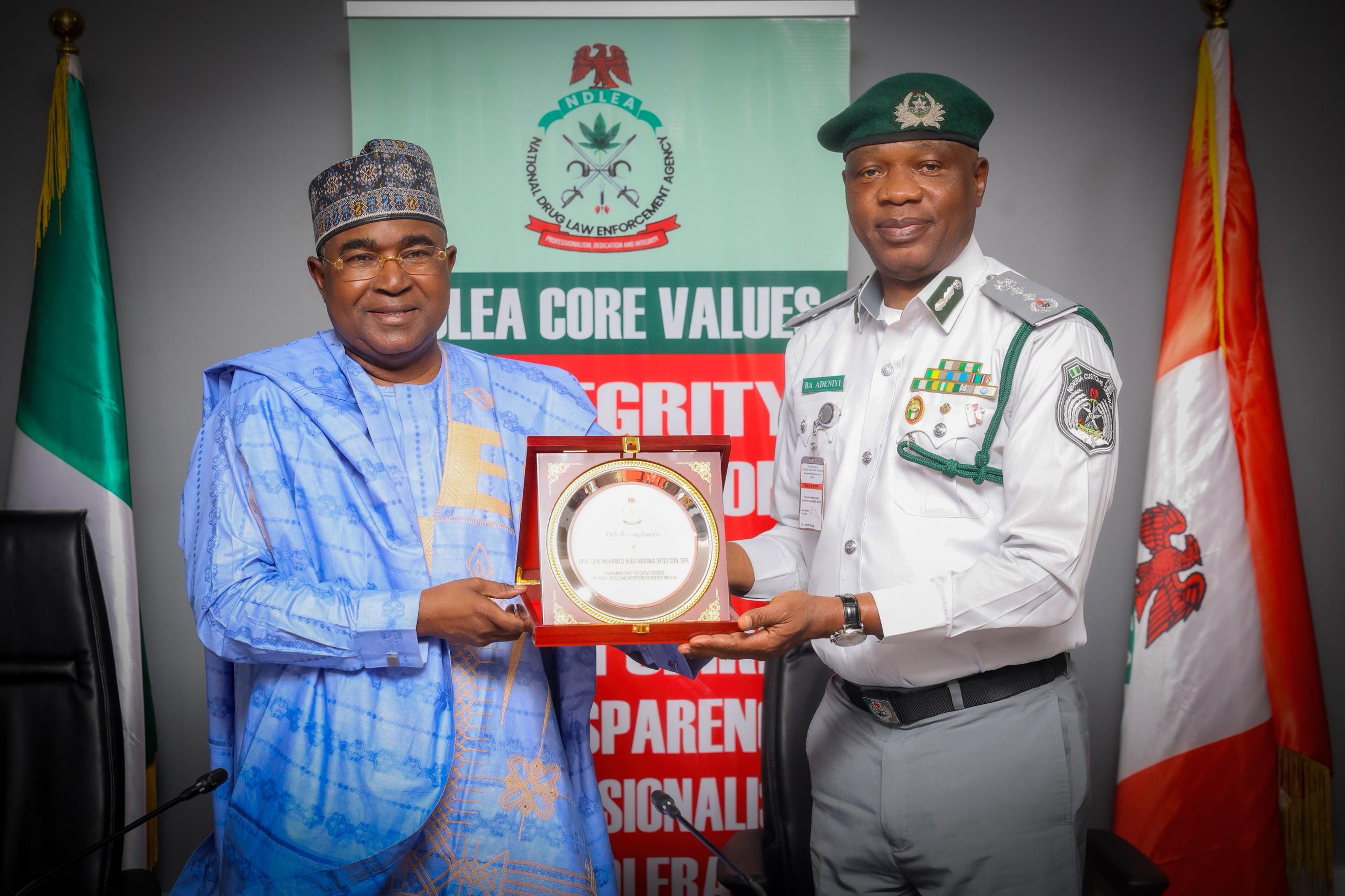
The Comptroller- General of the Nigeria Customs Service, Adewale Adeniyi, has warned that weak and uncoordinated institutional fight against drug trafficking may undermine Nigeria’ s standing in international community.
Leading a high- powered Customs delegation to a strategic meeting with the leadership of the National Drug Law Enforcement Agency (NDLEA) held at the headquarters of the anti- narcotics agency on Monday, April 27th, 2026, Adeniyi said that Nigeria must show strong commitment, clinical enforcement and transparency in its fight against narcotics trafficking in order to enhance the confidence of international community.
Addressing the joint meeting between the top- ranked Customs officers and the leadership of the NDLEA led by its Chairman, Brigadier General Mohamed Buba Marwa (rtd), the Customs boss stated that narcotics trafficking is in the front burner of discussions at international fora and the West African corridor is under serious scrutiny.
Adeniyi further declared that the fight against drug trafficking now goes beyond domestic enforcement, warning that Nigeria’s credibility before international partners depends largely on how effectively local institutions work together.
“I came here directly from international engagements in Europe and Asia, and at every table, narcotics trafficking remained a major issue. The West African corridor is under serious watch.”
“The agreements we sign abroad will only carry value when our operational credibility at home supports them.
“If intelligence shared with Nigeria is not pursued to interception, prosecution and destruction, our standing is weakened,” CGC Adeniyi said.
The Customs boss disclosed that the Service had continued to make major seizures and handovers to NDLEA, particularly through the Apapa Command and other operational formations.
Adeniyi, however, stressed that interdiction alone was not enough, calling for stronger post-seizure accountability, regular prosecution updates and transparent destruction procedures.
“Interdiction is only the first act of enforcement, not the last. Where narcotics are transferred but not promptly destroyed, where prosecution advances without feedback, and where exhibits are separated from originating officers, then the chain of enforcement is incomplete.”, he declared.
The Customs boss proposed a fresh framework between both agencies, including joint destruction of seized drugs where suspects are not arrested, periodic case status reports, coordinated court appearances and standing liaison channels at command level.
“We have not come here to apportion blame. We have come to design the next phase of a partnership that has carried Nigeria this far and must now carry it further,” the CGC declared.
Responding, the NDLEA Chairman described the concerns raised by Customs as legitimate and timely, assuring that the agency remains committed to transparency, accountability and professional cooperation.
“The concerns relating to post-transfer accountability, prosecution outcomes and disposal processes are valid concerns.
“We must move beyond ceremonial handovers to a structured and mandatory reporting framework under which NDLEA provides formal updates on investigations, prosecutions and final disposal of Customs-originated seizures.” Marwa noted.
The NDLEA boss proposed the immediate establishment of a joint committee to review grey areas in the existing Memorandum of Understanding(MoU) signed by both agencies under previous administrations.
According to him, the committee would recommend clearer procedures and, where necessary, draft a supplementary agreement for approval by both leaderships, stating, “Today’s meeting is timely. It gives us the opportunity to discuss areas of concern frankly and strengthen our collaboration.”
-

 Headlines3 months ago
FIFA sends Nigeria’s Super Eagles to 2026 World Cup, awards boardroom scoreline of 3 goals to nil against DR Congo
-

 Aviation3 months ago
Why we increased cargo tariff at Airports– FAAN
-
 Aviation3 months ago
Tension de-escalates at Lagos Airport as FAAN, Cargo agents reach truce over new tariff
-

 Aviation3 months ago
Freight forwarders warn FAAN’s new charges regime could cripple airport operations
-
Aviation3 months ago
FAAN, freight forwarders in stand- off over new tariff regime at Lagos Airport
-

 Business3 months ago
National Single Window goes live in March, 2026