Connect with us

Headlines

MARAN hosts past presidents to appreciation reception amidst pomp and pageantry 
Funso OLOJO, Editor
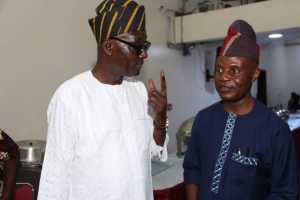
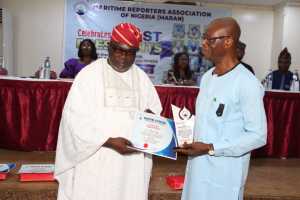
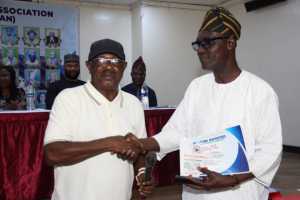
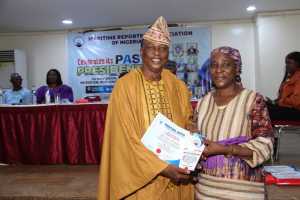
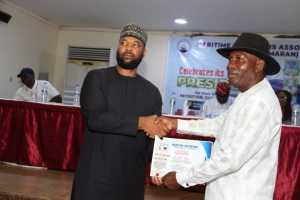
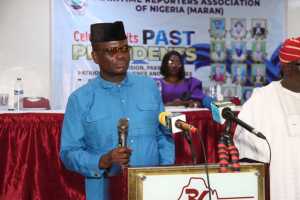
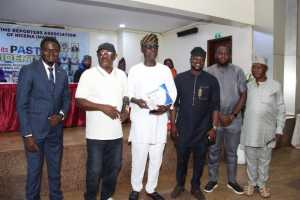
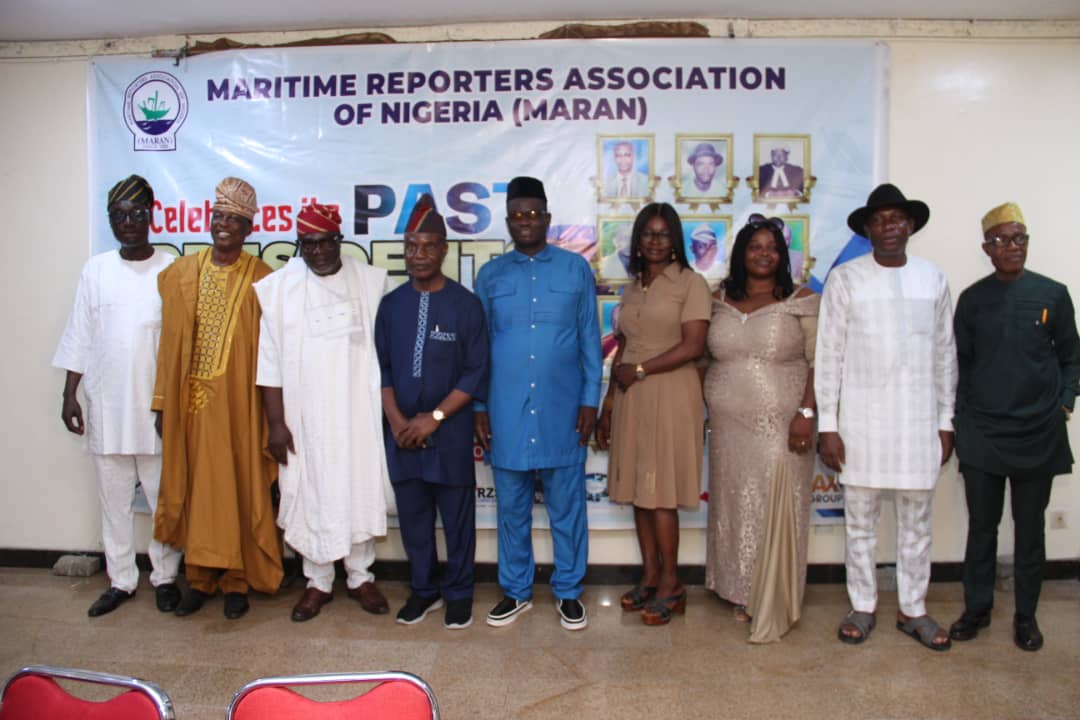
It was a night of glitz, bliss and glamour when the Maritime Reporters Association of Nigeria (MARAN), hosted its past presidents to an appreciation reception at the Rockview hotel, Apapa Lagos.
It was a night when MARAN showcased its 13 past leaders who had toiled and sweated to build the association into a formidable group of maritime journalists that has over the years shaped government policies and programmes in the maritime industry.
It started like a mustard seed sown by the present Caretaker committee of the association led by Tunde Ayodele when it mooted the idea at the Association’ s Congress meeting in January, 2026.
According to Ayodele, his caretaker committee was inspired to organize a befitting reception for the past presidents, given their sacrifices, passion, patriotism and sheer resilience they had displayed to berth a MARAN that was the progenitor of all other journalists association in the maritime industry.
“When my team and I assumed responsibility as the caretaker committee, one of our foremost priorities was to reconnect with our roots by honouring these great men.
“This event was not just a celebration; it was  a reminder that their labour was not in vain.
“Nearly four decades later, MARAN remains strong, relevant, and growing.
“We recognise that the wisdom, experience, and guidance of our past leaders are invaluable” Ayodele said, giving an insight into what motivated its committee to organize the reception.
So they tapped on a five- man Organising committee led by Funso Olojo, the Chairman of Board of Trustees (BOT) of MARAN, to ensure that this vision becomes a reality.
So, the Organising committee, which also consisted of John Iwori, Enyeribe Anyanwu, Ruth Umunna, and Sandra Chkwunyere, set to work, toiling day and night to organize the most befitting reception for the past leaders of the association.
On April 24th, 2026, the past presidents of MARAN, for the first time in the 38 years of the establishment of the association, gathered together under the same roof where they were unveiled to the stakeholders in the industry.
It was a night of glowing tributes, good will messages and effusive show of love to the men and woman of valor who built and nurtured MARAN to stardom.
The roll call was intimidating and inspiring.
Rev. Alban Opara, the Minister of God in His vineyard and the pioneer President of MARAN, Elder ASU Beks,  an enigmatic media mogul who is the CEO of Maritime Media Limited, the publisher of the influential Shipping World and the one commonly called the God Father, Barrister Tino Buoro, a legal luminary and expert in Arbitration law, Ubon Akpan, now late but a colossus in the media world, Emmanuel Adegbe, now late who was also a force to be reckoned with in journalism  and  Pius Mordi, the  Media Aide to the Governor of Delta. state.
Others were  Ray Ugochukwu, now late , the two – terms President of MARAN, the first ever person to achieve such a rare feat . He was also an erudite journalist.
Sesan Onilemo, another brilliant and consummate journalist who is the CEO of First Mediacon Media Limited, the publisher of the influencial Shipping position Newspaper and producer of Shipping position on radio, Dele Aderibigbe, another fearless journalist who is the pioneer and current Chairman of the Nigeria National Maritime Journalists(NNMJ),  the confederation of six maritime journalists associations in the maritime industry, Adeleye Ajayi, a retired Director at the News Agency of Nigeria (NAN) and the current two- term Chairman of Lagos council of the Nigerian Union of Journalists(NUJ), Dr Bolaji Akinola, the Special Adviser to the Minister of Marine and Blue Economy, Adegboyega Oyetola, Ifeyinwa Obi, now late who was a humanist, passionate and committed welfarist who was a crack journalist.
The last but not the least on the roll call of MARAN past presidents celebrated on that night of glitz was Anya Njoku, a fiery and fearless journalist.
However, the deceased past presidents were represented by their dear wives and family friends and members.
While Mrs Nneka Rosemary Ugochukwu stood for her late husband, Ray Ugochukwu, Mrs Paulina Adegbe and her two adorable daughters stood in for her late husband, Emmanuel Adegbe.
Mr Frank Meke, a seasoned journalist, represented the family of late Ubong Akpan as the wife of the deceased was away on a family engagement.
By and large, it was a night to remember as MARAN, in an unprecedented way, honoured the labour of its heroes past to ensure that they did not labour in vain.
The event attracted a large assemblage of stakeholders, consisting maritime agencies, terminal operators, freight forwarders, technocrats ,academia and well wishers of MARAN and the Awardees.
In their  reactions to the unexpected appreciation night, some of the Awardees expressed their heartfelt gratitude to MARAN, the organisers of the event.
The wives of two of the deceased past presidents, Mrs Nneka Rosemary Ugochukwu and Paulina Adegbe, delivered moving messages of gratitude to MARAN.
“With heartfelt appreciation, the family of Ugochukwu sincerely appreciate the Maritime Reporters association of Nigeria (MARAN) for the honor bestowed on my late husband, Ray Ugochukwu, your former president.
“Though he is no longer here, your thoughtful recognition of his leadership through the love, honor and respect showed is really comforting to us .
“Thank you for keeping his memory alive.
We are truly grateful for this kind gesture.
“Thank you Chairman, caretaker committee.
“Thank you Chairman, organizing committee.
“Thank you Maritime Reporters association of Nigeria.
Thank you all stakeholders.
God bless you” Mrs Nneka Rosemary Ugochukwu said in an emotion- laden voice, tears welling up in her eyes.
 Mrs Paulina Adegbe was no less emotional in her message of appreciation for the honour done her late husband, Emmanuel Adegbe.
“The family of late Emmanuel Adegbe sincerely wants to appreciate the organizers of the event held 24/4/2026 in honor of their past presidents living and the deceased.
“Thank you Maritime Association of Nigeria (MARAN )for what you did, it was an amazing experience.
“We pray for long life and success for the Association in the nearest future. Thank you once again.”
At the rendition of these messages of appreciation, the audience fell into a solemn mood.
The event, chaired by the legendary Engineer Greg Ogbeifun, was spiced by a thought- provoking seminar paper  by Captain Emmanuel Iheanacho, the former Minister of Interior who spoke on the topic:The Role of Media in Sustainable Maritime Development.
Rev. Alban Opara, the first MARAN President, took the awe- struck audience on a historical tour of the the creation of MARAN.
Rev.Opara told the audience about the dramatic story of how MARAN was born on April 10th,1988 during the fraud- induced port congestion era of that year.
He also listed the founding members of the historic nascent body of maritime journalists to include
Alban Opara – the Vanguard Newspaper, (Pioneer President),
 Emeka Okoroanyanwu – The Guardian Newspaper ( Pioneer Vice president),
Friday Odoemena – The Republic Newspaper ( Pioneer General Secretary),
Remi itie – Radio Nigeria ( Pioneer Treasurer), later Maritime Economist)
Martin Nwanne – Daily Times Newspapers
Goke Odeyinka replaced Tunde Fabunmi – National Concord
Eddie Iroha – Business Times
Hanni Okoroafor –  Business Concord
News Agency of Nigeria, NAN Correspondence ( Name not available)
 Rasheed Williams  – National Television Authority
These are the men and woman that braved the odds and the intimidation of the military government of General Ibrahim Babamosi Babangida and the oppressive port authority of that period.
It was a historical expedition that make the audience fall into a pin- drop silence while listening with rapt attention but later erupted in a spontaneous applause after the thrilling details of how MARAN was formed.
The occasion afforded most MARAN members, especially the younger ones, many of who were still toddlers or were even not yet born at the creation of MARAN, to behold, flesh and blood, those men who were the forerunners of the association.
The appreciation night was a night to remember which will be etched on the memory of all those who attended.
Continue Reading
Click to comment

Leave a Reply

Your email address will not be published. Required fields are marked *

Customs

Tinubu hails Nigeria’s Customs model as AfCFTA picks local firm for $multi-billion project

Bergmans subsidiary wins 20-year continental customs modernisation contract 

Gloria Odion, Maritme reporter

President Bola Ahmed Tinubu has hailed the emergence of Nigeria’s homegrown Customs modernisation model as a continental benchmark following the selection of a subsidiary of Nigerian-owned Bergmans Security Consultant and Supplies Limited to execute a 20-year, multi-billion-dollar AfCFTA Customs Modernisation Project.

The development, according to the President, represents a major vote of confidence in Nigeria’s growing capacity to develop indigenous technology and expertise capable of powering Africa’s emerging trade architecture.

The project will be implemented by AfriTrade CMP Limited, a subsidiary of Bergmans, and is expected to deploy digital and physical infrastructure for customs processing, cargo tracking, border management and trade-data exchange across participating African countries.

Tinubu’s commendation was contained in a State House statement issued yesterday, Monday, August 10th, 2026, by his Special Adviser on Information and Strategy, Bayo Onanuga.

The President said the continental deal was particularly significant because another subsidiary of Bergmans, Trade Modernisation Project Limited, is already implementing Nigeria’s Customs Modernisation Programme in partnership with the Nigeria Customs Service (NCS).

He described the development as evidence that solutions developed and tested in Nigeria could now be scaled across the continent.

“What has been built and tested in Nigeria is now providing a model for the continent. This is how African integration should work: Africans building African solutions for African markets,” Tinubu said.

He added that Nigerian institutions and businesses could play a pivotal role in building the technology and infrastructure required to make the African Continental Free Trade Area work effectively.

“Under our Nigeria First policy, we will continue to create opportunities for capable Nigerian businesses to compete at home, across Africa and globally,” the President said.

Tinubu specifically commended Bergmans, AfriTrade CMP Limited, Trade Modernisation Project Limited, the Nigeria Customs Service, Comptroller-General of Customs, Bashir Adewale Adeniyi and Nigerian professionals whose work, he said, had earned continental confidence.

The President said the development also reflected the transformation taking place within the Nigeria Customs Service under Adeniyi, particularly in the areas of digitalisation, institutional reform, trade facilitation and indigenous technology deployment.

AfCFTA endorsement

The continental endorsement gathered momentum during the recent visit of the Secretary-General of the AfCFTA Secretariat, Wamkele Mene, to the NCS Headquarters in Abuja, where he inspected the Customs Service’s modernisation platform.

Mene visited the headquarters alongside members of the Senate Committee on Customs led by Senator Jibrin Isah, following a two-day retreat on customs modernisation and reforms.

After witnessing the system in operation, the AfCFTA Secretary-General described B’Odogwu, Nigeria’s indigenous Unified Customs Management System, as a model with potential for wider adoption across Africa.

Mene disclosed that non-African companies had also offered similar solutions but said AfCFTA had opted for an African solution, underscoring the continent’s determination to develop its own expertise and infrastructure.

The endorsement effectively elevates B’Odogwu from a Nigerian Customs digitalisation initiative to a potential template for the continent’s evolving customs administration.

Senator Isah also expressed the Senate committee’s support for the modernisation programme after witnessing the technology in operation, saying members had become ambassadors of the initiative.

B’Odogwu at centre of transformation

First piloted in October 2024, B’Odogwu has become a major component of the NCS modernisation programme, supporting the digitalisation of customs processes and integrating critical functions including cargo tracking, data infrastructure, surveillance, risk management and non-intrusive inspection.

The system is also being integrated with the National Single Window, which was launched in March 2026 as a unified digital gateway for cross-border trade processes.

The integration is expected to improve the speed and transparency of cargo clearance while reducing inefficiencies and strengthening data exchange among agencies involved in international trade.

For Nigeria, the AfCFTA development goes beyond the commercial value of the continental project.

It represents a rare opportunity for the country to export technology, expertise and institutional know-how, rather than merely participate in Africa’s expanding trade market as a consumer.

The development also reinforces the argument that investment in indigenous technology and institutional reform can produce solutions with commercial value beyond Nigeria’s borders.

With AfCFTA seeking to dismantle barriers to intra-African trade, modern customs infrastructure will remain critical to achieving faster cargo clearance, improved revenue collection, effective border controls and seamless exchange of trade information.

The emergence of Nigerian-developed customs technology at the centre of that continental ambition could therefore mark a significant shift in Nigeria’s role in Africa—from being principally a market for imported technology to becoming a provider of strategic trade infrastructure for the continent.

Continue Reading

Customs

Customs FOU ‘A’ crushes smuggling ring, seizes N3.24bn worth of contraband, recovers N729m revenue

-intercepts cannabis, tramadol, rice, vehicles, elephant tusks, other prohibited goods

Funso Olojo, Editor

The Nigeria Customs Service (NCS) Federal Operations Unit Zone ‘A’ (FOU ‘A’), Ikeja-Lagos, has dealt a heavy blow to smuggling and revenue fraud, intercepting 220 consignments of prohibited and smuggled goods with a combined Duty Paid Value of N3.24 billion and recovering N728.98 million in lost revenue.

The seizures, recorded through a series of intelligence-driven operations, highlight the escalating battle by the Customs Service to shut down illicit trade routes, protect domestic production and plug revenue leakages arising from false declarations, under-valuation and other customs infractions.

Among the major seizures were 4,956 bags of foreign parboiled rice weighing 50kg each, equivalent to eight trailer loads; 12 foreign-used vehicles; 2,683 parcels of synthetic cannabis (Sativa) weighing 1,439.9kg; 49 parcels of Ghanaian Loud weighing 26.1kg; one parcel of crystal methamphetamine weighing 0.35kg and 13 parcels of granular cannabis weighing 1.35kg.

The Unit also intercepted 240,000 tablets of Tramadol, 12,000 tablets of Hypnox and 22 elephant tusks weighing 130.84kg, alongside 964 25-litre jerrycans of Premium Motor Spirit (PMS), representing 24,100 litres.

Other items seized include 26 cartons of foreign vegetable oil, 686 cartons of foreign poultry products, 414 bales of used clothing and 2,947 pieces of used tyres, among other prohibited and smuggled goods.

The Comptroller of FOU ‘A’, Gambo Aliyu, said the N728.98 million revenue recovery represented an important component of the Unit’s enforcement mandate, particularly its efforts to recover government revenue lost through fraudulent trade declarations.

Aliyu warned importers, exporters and licensed customs agents against deliberate attempts to short-change the government, urging them to make accurate declarations and comply fully with applicable customs laws and regulations.

He said the Unit would continue to facilitate legitimate commerce but would show no mercy to operators involved in smuggling, revenue evasion and other forms of economic sabotage.

According to him, the latest seizures demonstrate the importance of intelligence gathering, risk profiling, inter-agency collaboration and intelligence fusion in dismantling sophisticated smuggling networks.

He attributed the Unit’s operational successes to improved intelligence capabilities and cooperation from sister agencies, stakeholders, border communities and members of the public.

Beyond the revenue implications, the seizures have significant economic and public-safety consequences.

The interception of foreign rice, poultry products, vegetable oil, used clothing, tyres and foreign-used vehicles is expected to provide additional protection for local manufacturers and producers already battling the effects of illicit imports.

Similarly, the seizure of large quantities of cannabis, tramadol, crystal methamphetamine and other controlled substances underscores the Customs Service’s growing role in preventing the movement of illicit drugs and potentially harmful pharmaceutical products through Nigeria’s trade corridors.

The recovery of the elephant tusks also reinforces the Service’s contribution to the fight against illegal wildlife trafficking and the protection of endangered species.

Aliyu, however, stressed that FOU ‘A’ was not at war with legitimate trade, insisting that its enforcement strategy was built around striking a balance between strong border control and trade facilitation.

He assured compliant traders that the Service remained committed to a fair, predictable and transparent trading environment, while warning that the Unit would sustain its zero-tolerance posture towards smuggling and revenue fraud.

The Customs boss called for stronger partnership with the business community and the general public, noting that sustained intelligence sharing and vigilance were critical to consolidating the gains recorded in revenue recovery, border security, public safety and economic protection.

He said the NCS, through FOU ‘A’, would continue to align its enforcement operations with the Federal Government’s broader economic agenda by protecting domestic production, promoting compliance, facilitating legitimate trade and blocking the circulation of prohibited and harmful goods.

Continue Reading

Analyses

The National Single Window Illusion: Why phase two cannot succeed on paper

Monday Discourse with Nasiru Ibrahim

The official rollout of Phase One of the National Single Window (NSW) was heralded as a monumental leap toward a paperless, automated trade ecosystem.

On paper and within executive dashboards, the achievements are clear: the serialization of Licenses, Certificates, and Permits (LCPO), streamlined electronic manifest transmissions, and integrated risk management for primary regulators like SON and NAFDAC.

Yet, as the steering committee aggressively prepares for the imminent deployment of Phase Two, a severe operational reality check is required.

The claim that the Single Window has successfully “taken off” remains a purely administrative illusion when measured against the brutal, manual friction remaining at our terminal gates.

The core vulnerability of the current transition is the absolute failure to align digital front-end clearances with physical back-end enforcement.

Importers are successfully navigating the centralized National Single Window Portal, obtaining official electronic green lights, only to watch their consignments get trapped by manual human greed the moment the cargo hits the access roads.

Phase Two promises end-to-end electronic customs clearance, full payment digitization, and automated interoperability with the Nigeria Customs Service’s new B’Odogwu Unified Customs Management System.

However, if the federal administration continues to pour billions into software updates while leaving parallel manual check-points unpunished, Phase Two will simply become a highly expensive digital facade masking an archaic extortion regime.

True trade facilitation is not a technological achievement; it is a direct function of political will.

The integration of advanced platforms like B’Odogwu across major commands like Apapa and Tin Can proves that our regulatory arms possess the technical capability to automate. The problem is cultural and financial.

Entrenched administrative empires are deliberately preserving parallel manual structures because documentation loops, artificial delays, and manufactured compliance flags remain incredibly lucrative.

For the National Single Window to transition from a policy delusion into a genuine economic catalyst, the state must move past cosmetic celebrations.

The presidency must deploy the executive power required to completely outlaw physical interventions outside the approved digital framework and enforce severe punitive consequences for any agency chief who authorizes parallel verification processes.

Until the gate complies with the portal, the National Single Window project remains grounded.

Chief Ibrahim Nasiru, a public affairs analyst, writes from Abuja

Continue Reading

Trending