Connect with us

Customs

Nigeria’s business community lauds Customs performance in Q1 2026, seeks improvement in service delivery 

Funso OLOJO,Editor 
The critical section of stakeholders in the maritime and aviation industries have expressed satisfaction with the level of performance, service delivery and discipline among officers in the Zone A of the Nigeria Customs Service.
Their commendation was based of the performances of all the commands in the Zone in the last three months
Customs Commands in Zone ‘A’ are those located across the six states of the South west geopolitical zone, at the land, airport and sea port borders.
Some of the prominent Commands in Zone ‘A’ include the Apapa  Port Command, Tincan Island Port (TCIP) Command,  Ports and Terminals Multi-Services Limited (PTML) Command, Kirikiri Lighter Terminal (KLT) Command and the Western Marine Command.
 Others are the Ijora Export Terminal, Federal Operations Unit (FOU) Zone ‘A’, Murtala Mohammed Cargo Airport Command, Seme Border Command, Idiroko Border Command, Ogun State, the Oyo/Osun Command and Ondo Command.
Many stakeholders who volunteered comments on the scorecard of the NCS Commands in Zone ‘A’ within the first three months of the year, said although Customs officers needed to improve in their service delivery, they however rated their performance high within the period under review.
The assessment focused mainly on resumption time, closing time, prompt attention to, and resolution of complaints from the business community, physical appearance, trade facilitation and revenue generation.
Many stakeholders scored the NCS in the Zone high on resumption time and closing time.
According to them, in most of the Commands,  resumption time and closing time, as well as prompt response to complaints and physical appearance of officers are rated grade A.
A respondent, Uju Clifford, a freight forwarder who plies his business between the Seme Border Command and Apapa Area 1 Command, said he felt sorry for Customs officers because most of them resumed as early as 7.45 am and closed around 8 PM.
Clifford narrated a story of how his container was one day detained at the FOU for issues that related to documentation, but when he rushed to the Command in the evening to sort out the cargo, he witnessed that some officers closed by 8 PM. He said he felt sorry for the officers.
Clifford, who hinted that he normally pursues his jobs till late in the evening at the Apapa Area 1 Command, added that under the present management of the NCS led by Bashir Adewale Adeniyi,the Comptroller- General of the Nigeria Customs service, he has witnessed the highest level of discipline among officers.
 According to him, “They look neat and decent. They talk to us politely, not like those days when they shouted at us. I commend the leadership of the current CG”.
The NCS has continued to demonstrate resilience and efficiency in the first and second quarters of 2026, with its performance scorecard reflecting strong achievements in revenue collection, enforcement, compliance, and strategic seizures across major commands.
Stakeholders were unanimous that from the Apapa Area Command to Tin Can Island and the Murtala Mohammed International Airport Command, operations have remained seamless, with service delivery running smoothly and unhindered.
At Apapa Area Command, revenue collection surged beyond projections, with recoveries from under-declarations and infractions reinforcing the Service’s vigilance.
In the same vein, the Tin Can Island Command recorded significant seizures of contraband, including restricted goods and counterfeit products, underscoring the Service’s commitment to safeguarding national security and economic interests.
Similarly, the Murtala Mohammed International Airport Command maintained its reputation for precision enforcement, intercepting illicit consignments while ensuring legitimate trade flows without disruption.
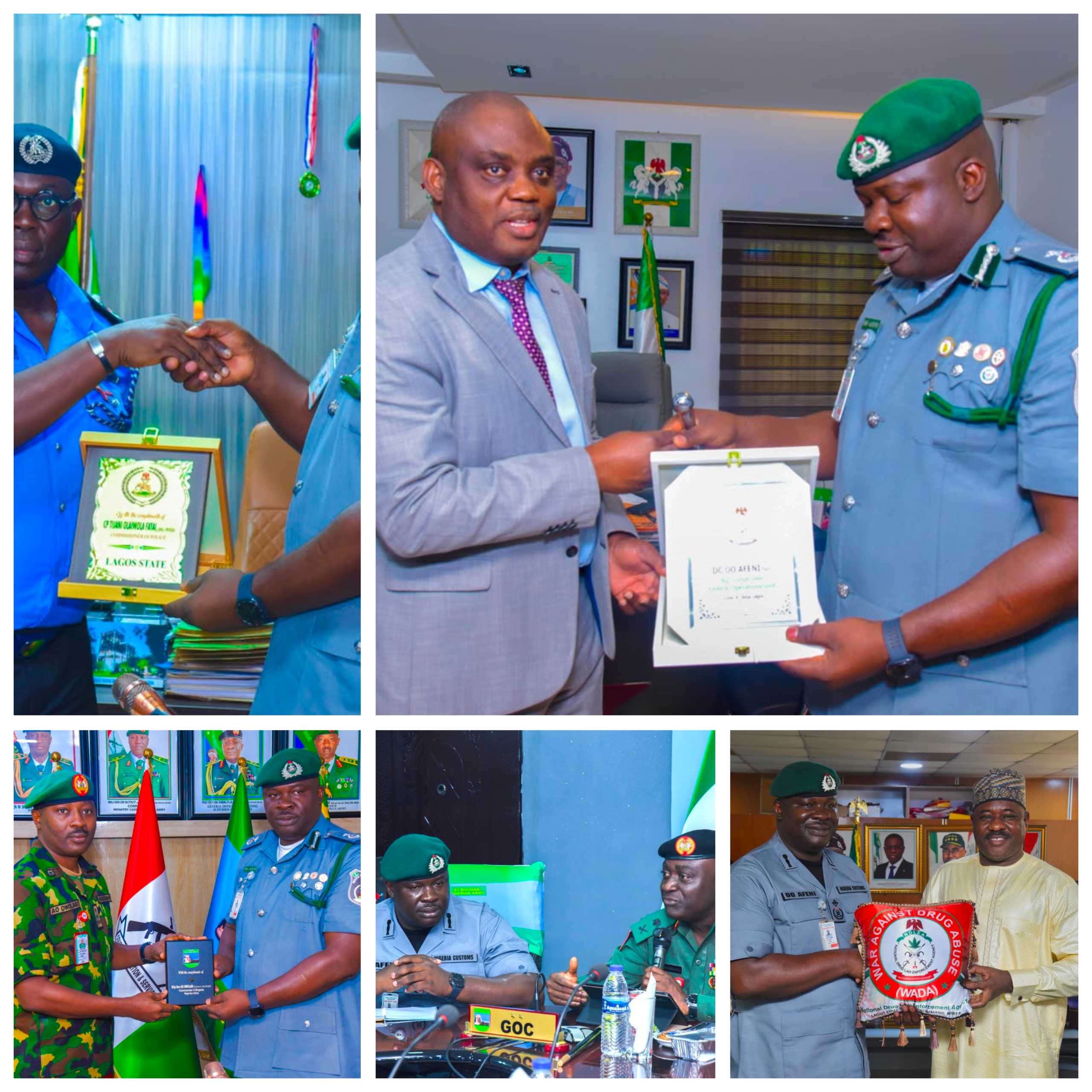
The Idiroko Border Command led by Deputy Comptroller Oladapo Afeni, was scored high on enforcement drives, discipline, wellness activities and officers welfare.
Stakeholders across the maritime and aviation sectors also commended the Service’s performance.
“The Customs Service has shown remarkable consistency in revenue generation and enforcement.
“Their efficiency in Q1 and Q2 ,2026 has been a stabilizing factor for the economy,” said Mrs. Adeola Ogunleye, a maritime industry player.
Assessing the Service’s performance scorecard within the period under review, the National Publicity Secretary of the Association of Nigerian Licensed Customs Agents (ANLCA), Mr. Emmanuel Onyeme, noted that men and officers of the NCS attended to their duties with passion and commitment.
He also saluted the high-level of professionalism displayed by personnel, while encouraging management and operatives within the zone to maintain the traction.
“The reality on the ground is that the Officers and men of the Nigeria Customs Service in Zone ‘A’ have been very patriotic and professional in the discharge of their duties in recent months, particularly as regards  promptness to duty and attending to clearing agents with courtesy and professionalism.
“I commend the officers in the commands across the zone for discharging their duties so well.
“This shows that the high-level professionalism and patriotism of the Comptroller General Bashir Adewale Adeniyi is running off down the ladder.
“I also want to commend all the Customs Area Controllers in the zone for being a very good example to their officers.
“The implication of this good development will be more revenue for the government and enhanced trade facilitation, and it will boost the cordial relationship existing between Customs and the stakeholders, especially Clearing Agents and Freight Forwarders”, Onyeme said.
Mr. Chinedu Okafor, a freight forwarder at Tin Can Island, also evaluating service delivery in the cargo clearance system said: “The seizures recorded this year are proof of Customs’ vigilance.
” Beyond that, clearance procedures have become faster, and revenue recoveries are impressive.
” Why we can speak of the need for improvement across board, we must commend the Customs for taking the lead and continue to incline to its appeal for other players like us to step up.”
Also speaking, Dr. Ibrahim Musa, an aviation logistics expert, emphasized the Service’s resilience:
 “At the airport command, operations have been seamless. Revenue targets are being met, enforcement remains strong, and compliance levels are high.
” The Service deserves commendation for balancing trade facilitation with security.”
The Nigeria Customs Service posted a strong performance in Q1 and Q2 2026, surpassing revenue targets, recording billions in recoveries, and executing major seizures across key commands.
 Stakeholders have lauded the Service’s efficiency, noting its resilience in revenue collection, enforcement, and compliance.
Revenue Performance:
While Q1 2026 export earnings hit $925.84 million, a 38.68% increase compared to Q1 2025, container throughput amounted to 19,014 for Q1 2026, up 95.58% from 9,722 in Q1 2025.
In the same vein, export surcharge collections grossed ₦199.36 million in Q1 2026, with an upswing of 21.81% year-on-year.
 This is even as the Nigeria Export Supervision Scheme (NESS) collections amounted to ₦6.03 billion for Q1 2026, amounting to a 20.15% increase, up from ₦5.01 billion collected in Q1 2025.
Instructively, there’s a projected ₦9 trillion revenue for 2026, based on ₦7.28 trillion collected in 2025; with a projected target increase of ₦697 billion.
Enforcement & Seizures
With a total of 473 smuggling operations foiled in 8 weeks, the Federal Operations Unit Zone A, Lagos seizures included 8,794 bags of rice (15 trailer loads), 22 used vehicles, 1,863 refrigerator compressors, 328 bales of clothing, and 531 cartons of frozen poultry.
Drug Interceptions records indicate that while 3,340 parcels of cannabis (1,540kg), plus 6.4kg of cocaine and methamphetamine valued at ₦2.35 billion was made within the period under review, revenue recovery by the unit amounted to ₦5.5 billion in Duty Paid Value (DPV) and ₦97.7 million recovered via Demand Notices.
Command Highlights:
While Apapa Area Command surpassed revenue projections, with strong recoveries from under-declarations, Tin Can Island the second largest command recorded significant seizures of contraband and counterfeit goods, reinforcing compliance.
This is even as Murtala Mohammed International Airport Command maintained a seamless enforcement trajectory, intercepting illicit consignments, while facilitating legitimate trade.
With stakeholders affirming the Service’s credibility and efficiency, the Nigeria Customs Service continues to uphold its reputation as a cornerstone of trade facilitation and national revenue generation. Its Q1 and Q2 2026 scorecard reflects not only resilience but also a forward-looking commitment to excellence in service delivery.
Continue Reading
Click to comment

Leave a Reply

Your email address will not be published. Required fields are marked *

Customs

NCS offers employment to 3,852 candidates as 2025 recruitment exercise ends

By Gloria Odion, Maritime Reporter

The Nigeria Customs Service (NCS) has concluded its 2025 recruitment exercise, offering employment to 3,852 successful candidates after more than one year of screening and assessment.

The recruitment exercise, which began with a newspaper advertisement on December 27, 2024, was initially designed to fill 3,927 vacancies across various cadres of the Service.
The exercise attracted a staggering 573,500 applications, out of which 286,697 candidates were shortlisted after the initial screening.

Following several phases of rigorous screening, the number was eventually reduced to 3,853 candidates, with 3,852 candidates completing the final screening and being offered employment.

The final stage of the exercise was conducted at the Training and Doctrine Command (TRADOC), Gwagwalada, Abuja, where candidates across the different cadres underwent documentation, physical fitness assessment and medical screening.

The two-week final screening exercise, which commenced on Monday, September 7, 2026, ended on Saturday, September 19, 2026.

It covered candidates shortlisted for the Assistant Superintendent of Customs II (ASCII), Inspectorate and Customs Assistant cadres.

The screening was conducted in batches to ensure an orderly process, reduce congestion and improve the overall experience of candidates.

Speaking on the outcome of the exercise, the Assistant Comptroller-General of Customs in charge of Human Resource Development, Frank Onyeka, said the Service had introduced measures to address challenges identified during the earlier stages of the exercise and improve the efficiency of the final screening.

“We have put measures in place to reduce congestion and ensure a smoother process this week. The gaps identified last week have been addressed, and we do not expect them to recur this week,” Onyeka said.

He also stressed the need for discipline, responsibility and strict compliance with established procedures throughout the recruitment process.

Also speaking, the Deputy Comptroller of Customs and member of the coordinating team, Adamu Musa, said the exercise recorded significant improvements, with nearly 3,000 candidates screened without any casualty.

According to him, one of the major innovations introduced into the process was the use of personalised screening forms containing candidates’ records from the various stages of the assessment.

“Any candidate that has been shortlisted has a form designed especially for him, unlike in the past where you come, they issue you a form, and then some people along the way go and even change some of the records.

“These forms come with the candidates’ records, including their names and details for sports, medical, documentation, and the checklist of required items. So, once the candidate comes, you just verify what you already have from the system,” Musa explained.

He said the introduction of the personalised forms had helped to strengthen the integrity of the process and reduce the possibility of manipulation of candidates’ records.

Musa further underscored the importance of continuous manpower development in strengthening the capacity of the Service to effectively discharge its responsibilities in national security, border protection, trade facilitation and other statutory functions.

He noted that the expanding responsibilities of the Customs Service made it imperative to continually improve the quality, competence and preparedness of its workforce.

According to him, candidates were assessed against established recruitment criteria, including age, physical fitness and drug screening.

He explained that candidates who tested positive for prohibited substances, exceeded the prescribed age limit or were found to have physical conditions capable of affecting their ability to perform assigned duties could be disqualified, subject to the final decision of the Service management.

Musa also advised candidates and members of the public to rely only on recruitment information published through the official Nigeria Customs Service website and verified social media platforms.

He warned against relying on unverified messages or individuals claiming to possess privileged information about the recruitment exercise, stressing that such channels could expose unsuspecting candidates to fraudulent activities.

The completion of the recruitment exercise marks a major step in the Customs Service’s efforts to expand and strengthen its human resource base, while ensuring that new personnel are selected through a structured, transparent and merit-based process.

Continue Reading

Customs

Nigeria, Benin Customs move to harmonise trans-border trade, establish joint border post at Seme-Krake

Funso OLOJO, Editor

Nigeria and Benin Republic have taken a major step towards harmonising cross-border trade procedures and removing bottlenecks along the strategic Abidjan-Lagos Corridor, with the two countries moving to establish a Joint Border Post at the Seme-Kraké frontier.

The initiative is designed to deepen regional economic integration, facilitate legitimate trade, improve border security and enable the seamless movement of goods and people between the two countries.

The development gathered momentum on Friday, September 11, 2026, when the Nigeria Customs Service (NCS) and the Benin Customs Administration conducted a joint assessment of the infrastructure and operational readiness of the proposed One-Stop Border Post at Seme-Kraké.

The exercise, tagged “Joint Nigeria-Benin Republic One-Stop Border Post Assessment at Seme-Kraké,” was themed “Leveraging the Nigeria Customs Service Trade Modernisation Project to Advance Seamless Cross-Border Trade and Shared Prosperity.”

The assessment is part of a broader effort by the two Customs administrations to harmonise border procedures, reduce trade barriers, strengthen institutional coordination and improve the efficiency of legitimate commerce across the Nigeria-Benin border.

Speaking at the ceremony, the Comptroller-General of the Nigeria Customs Service, Dr. Adewale Adeniyi, said the assessment was aimed at reviewing the operational readiness of the facility, examining existing border processes and infrastructure, and demonstrating the border-modernisation solution being deployed to support secure interoperability between the two Customs administrations.


Adeniyi stressed the strategic importance of the Seme-Kraké crossing, describing it as one of the busiest land borders in West Africa and a critical gateway along the Abidjan-Lagos Corridor.

According to him, the corridor carries more than 70 per cent of the sub-region’s transit trade, making efficiency at the Seme-Kraké border critical to the economies of countries along the route.

He said the border operates around the clock throughout the year, warning that delays at the crossing have consequences far beyond the immediate border environment.

“Every hour lost at this gate is multiplied across thousands of consignments and tens of thousands of travellers, and is paid for in the price of goods in markets from Cotonou to Lagos.

“Conversely, an hour saved here is saved for the whole region. There are few places on this continent where the ratio between effort and effect is as favourable as it is at this crossing,” he said.

The Customs boss, however, noted that despite the two administrations operating within the same border environment, they were yet to achieve full digital interoperability.

He said there was still no seamless real-time exchange of declarations, manifests, transit information, risk profiles and enforcement alerts between the two countries.

Adeniyi disclosed that the NCS had therefore commenced work towards interconnecting the two administrations through a common data-exchange arrangement.

He explained that the system would enable declarations lodged on one side of the border to become visible to the other administration in real time, while transit consignments could be tracked from origin to destination.

He added that risk profiles and enforcement alerts generated by one Customs administration would also be transmitted to its counterpart while such information remained operationally useful.

The CGC further drew attention to the critical role of informal cross-border traders, particularly women, in the regional economy.

He said women account for more than 70 per cent of informal cross-border traders across Africa, adding that the pattern was particularly pronounced along the Nigeria-Benin corridor.

According to him, about 22 per cent of Benin’s informal exports are destined for Nigeria, while informal trade accounts for an estimated one-fifth of economic activity in Nigeria and a significantly higher proportion in Benin.

Adeniyi commended the Benin Customs Administration for the confidence it had placed in the Nigerian Customs Service and the leadership of both administrations to drive the One-Stop Border Post initiative.

On his part, the Director-General of the Benin Customs Administration, Raouf Malehossou, commended Nigeria for spearheading the initiative, describing the integration of border operations as critical to economic growth and regional trade.

Malehossou said the proposed Joint Border Post was fundamentally about strengthening risk management and prevention by enabling Customs administrations to anticipate potential threats and address them at the earliest possible stage.

He said the ability to identify risks early was critical to effective border management, trade facilitation and national security.

“These are the fundamental questions that a Joint Border Post operating under a One-Stop-Shop model must be able to answer,” he said.

The Benin Customs chief stressed that achieving the desired level of efficiency would require more than modern roads, scanners and physical infrastructure.

He said smooth and secure border operations depended on a comprehensive package of reforms encompassing close institutional coordination, genuine digital interoperability, clear lines of responsibility and sustained investment in Customs personnel.

He urged the technical teams from both countries to use the assessment to identify not only what currently exists but also what needs to be done to make the facility capable of meeting future demands.

Malehossou said the ultimate objective should be a border operating through genuine coordination, shared facilities, harmonised procedures and joint controls.

He described the initiative as a critical component of the future of African trade and regional integration within ECOWAS, particularly the Abidjan-Lagos Corridor.

“The bridge we see today provides a vital physical link between Abidjan and Lagos and beyond. Our historic responsibility now is to ensure that the movement of people and goods across this corridor is as efficient and seamless as the infrastructure allows,” he said.

He called on both administrations to move from assessment to implementation, declaring: “Let us therefore get to work.”

Continue Reading

Customs

The Afeni Effect: Inside Ogun I Customs’ war on smuggling and battle for Nigeria’s economy

Funso OLOJO, Editor 

At Nigeria’s south-western border with the Republic of Benin, the battle against smuggling is no longer merely about intercepting bags of rice, petroleum products or second-hand clothing.

Increasingly, it is a battle over the survival of local industries, food security, public health, legitimate trade, national revenue and, ultimately, Nigeria’s economic security.

At the centre of that battle is the Ogun I Area Command of the Nigeria Customs Service, Idiroko, where Deputy Comptroller Olukayode Oladapo Afeni, the Acting Customs Area Controller, has presided over an increasingly aggressive enforcement campaign.

The numbers tell part of the story.

Under Afeni, the Command’s seizure diary has expanded from narcotics and prohibited food products to petroleum products, tyres, pharmaceuticals, clothing, sugar, fertiliser and even antiquities and wildlife.

But perhaps more significant than the sheer volume of seizures is the philosophy emerging behind them: make the border hostile to illicit trade while making it more accessible to legitimate commerce.

That approach dovetails with the broader economic direction of President Bola Ahmed Tinubu’s administration, which has consistently presented the Renewed Hope agenda as a programme aimed at strengthening domestic production, protecting investment, improving revenue and securing Nigeria’s economic space.

At Ogun I, those objectives are increasingly being translated into frontline enforcement.

THE AUGUST SCORECARD: ₦3.574 BILLION IN ONE ENFORCEMENT WINDOW

The latest chapter in Afeni’s seizure diary is particularly revealing.
Between June 24 and August 13, 2026, the Ogun I Command intercepted prohibited goods with a combined Duty Paid Value of ₦3,574,435,248.08.

Among the most striking seizures were 6,035 parcels of Ghana Loud/Indica, 2,339 bags of foreign parboiled rice, 70 cartons of basmati rice, 30 bags of foreign sugar, 11,450 litres of Premium Motor Spirit in kegs, another 1,750 litres of PMS in drums and 30 kegs of diesel.

The inventory also included 100 bags of fertiliser, 67 bales of second-hand clothing, 2,674 pieces of new shorts and trousers, 3,760 pieces of new tops, 85 fire extinguishers, 480 cartons of Pure Haven drinks, cosmetics, oats, hair accessories, surgical shoes and 127 new purses.

Yet the cannabis seizure stood out.
The 6,035 parcels of Ghana Loud/Indica were formally handed over to the National Drug Law Enforcement Agency, NDLEA, Idiroko Special Command, for further investigation and necessary action.

Afeni subsequently disclosed that from January 2026 to the August briefing, the Command had handed over 32,412 parcels of hard drugs and 92 sacks of raw Cannabis Sativa to the NDLEA Idiroko Special Command.

That statistic provides perhaps the clearest indication of the changing character of smuggling through the Ogun border.

It is no longer simply a question of economic contraband. Increasingly, it is a question of economic and national security.

BEFORE AUGUST CAME ₦4.63 BILLION

The August seizure did not emerge in isolation.
Between April 1 and June 23, 2026, the Command recorded 146 seizures with a cumulative DPV of ₦4,628,591,970.16, while generating ₦259,777,346.89 during the same period.

The revenue figure represented a remarkable 238 per cent increase over the ₦76.81 million recorded during the corresponding period of 2025.

That performance is significant because the Ogun I story under Afeni has not been exclusively about seizure.

There has also been an attempt to combine enforcement, revenue generation and trade facilitation.

The second-quarter seizure list was extensive: 2,807 bags of foreign parboiled rice, 9,482 parcels of Cannabis Sativa, 62 sacks of raw marijuana, 16,525 litres of PMS, 475 litres of diesel, 7,642 pieces of footwear, 2,427 pneumatic tyres, 63 sacks of foreign sugar, 73 bales of second-hand clothing, fertiliser, imported flour, frozen products and pharmaceuticals.

The Command also handed over 6,981 parcels of Cannabis Indica/Ghanaian Loud and 62 sacks of raw marijuana to the NDLEA, while illicit pharmaceutical products, including 77 cartons of Analgin injections containing 138,600 tubes, were transferred to NAFDAC.

In other words, Afeni’s seizure diary is also becoming a diary of inter-agency enforcement.

THE ₦1.35 BILLION CHAPTER

Earlier, between February and March, the Command intercepted prohibited goods valued at approximately ₦1.35 billion.
That operation produced another revealing catalogue of commodities moving through the border environment.

They included 2,539 kegs of vegetable oil, 4,325 cartons of foreign spaghetti, 1,204 bags of foreign parboiled rice, 2,547 parcels of Cannabis Sativa and 13,625 litres of PMS.

Four live pangolins and two antique artefacts believed to date from the 19th century were also intercepted.The vegetable oil seizure was particularly significant.

Customs described it as part of efforts to protect domestic producers from unfair competition created by smuggled goods.

That is where the anti-smuggling campaign intersects directly with the Renewed Hope economic argument.

For every prohibited consignment that enters Nigeria outside the legal import regime, there is potentially a local manufacturer, farmer, investor or legitimate trader being placed at a disadvantage.

The Customs position, therefore, is that enforcement is not simply about confiscation. It is about protecting the productive economy.

THE RICE WAR

Foreign rice has perhaps become the most visible symbol of the economic contest at the Ogun border.

Again and again, rice appears in Afeni’s seizure diary.
In the April-June enforcement period alone, 2,807 bags of foreign parboiled rice were intercepted.

In the latest June-August operation, another 2,339 bags, alongside 70 cartons of basmati rice, were seized.

Afeni’s argument has been straightforward: the illegal inflow of foreign rice undermines local farmers, domestic rice mills and agricultural investors.

That position aligns the border enforcement campaign with the Federal Government’s broader food-security objectives.
The logic is compelling.

If government policy encourages Nigerians to invest in agriculture and local food processing while smugglers simultaneously flood the market with cheaper prohibited imports, then the border becomes the first point at which that economic policy must be defended.

In this sense, a bag of seized foreign rice is no longer merely a Customs seizure. It represents a direct intervention in the competition between illegal imports and domestic production.

WHEN SMUGGLERS FIGHT BACK

Afeni’s seizure diary also records an increasingly dangerous side of the border war.
In one June operation, Customs officers intercepted a truck carrying 113 bags of foreign parboiled rice along the Itori-Wasimi-Abeokuta corridor.

According to the Command, the driver ignored the officers’ signal to stop and attempted to ram the patrol vehicle before he was apprehended.

In another operation, 630 bags of foreign rice were intercepted along the Afamin-Igbogila axis.

Earlier enforcement operations had also involved resistance and attacks on Customs personnel.

This suggests that the enforcement environment around the Ogun border cannot be treated as an ordinary regulatory exercise.
The stakes are evidently high enough for some operators to risk confrontation with armed government personnel.

That makes the Command’s emphasis on intelligence, technology and collaboration with sister agencies particularly important.

FROM PATROLS TO INTELLIGENCE

Perhaps the most important change in the Afeni approach is the apparent movement away from purely reactive patrols towards intelligence-led enforcement.

The August operation, according to Customs, was strengthened by intelligence gathering, technology and collaboration with sister security agencies.

That is significant because border smugglers are themselves adapting.

Their methods increasingly involve concealment, multiple routes, small consignments, night movements, abandoned structures, bush paths and waterways.

The Customs response, therefore, has had to become more sophisticated.

The objective is no longer simply to wait for contraband to appear at a checkpoint. It is to identify the networks, understand the routes and intercept consignments before they reach the Nigerian market.

That represents a fundamentally different model of border enforcement.

BUT THERE IS ANOTHER SIDE TO THE STORY

Interestingly, while the seizure diary has expanded, so has the Command’s legitimate trade profile.

Between April and June, Ogun I facilitated 20,972 metric tonnes of exports with a Free-On-Board value of ₦1.049 billion — a dramatic improvement over the corresponding period of 2025, when no export activity was recorded.

By the August briefing, the Command reported 10,110 metric tonnes of exports, valued at ₦2.594 billion FOB, with white talc, crushed thermal coal and CNG identified among the major export commodities.

That development deserves attention.
A successful border command cannot simply become a wall. It must become a filter.
The illegal must be stopped; the legitimate must be facilitated.

So far, the figures suggest that Ogun I is attempting to pursue both sides of that equation.

THE AFENI EQUATION

The emerging Afeni equation can be reduced to four words:
Enforcement. Revenue. Security. Trade.

The enforcement figures are substantial.
The revenue numbers show improvement.
The volume of narcotics handed over to the NDLEA demonstrates the security dimension.

And the rising export statistics point towards the trade-facilitation component.

The interconnectedness of the four is clear.
A secure border encourages legitimate commerce.

Legitimate commerce generates revenue.
Revenue strengthens government capacity.
And strong enforcement protects legitimate operators from unfair competition.

This is the economic-security argument behind the Ogun I experience.

A COMMAND UNDER PRESSURE

Yet the Afeni record should not be romanticised. It should be understood for what it is.

The persistence of large-scale seizures itself demonstrates that the smuggling economy remains alive.

Every seizure is evidence of successful enforcement, but it is also evidence that somebody remains willing to attempt the illegal movement of the goods.

The continued appearance of rice, petroleum products, narcotics, clothing and other prohibited commodities means that the underlying economic incentives driving smuggling have not disappeared.

Perhaps this is where the larger policy question arises:
Can enforcement alone permanently defeat smuggling?
Probably not.

Border communities need legitimate economic alternatives. Traders need predictable procedures. Exporters need efficient processing. Security agencies need sustained inter-agency cooperation.

And the Customs Service must continue to ensure that legitimate trade is not inadvertently caught in an enforcement net designed for criminal networks.

Afeni’s challenge, therefore, is bigger than producing impressive seizure statistics.
It is to help transform Idiroko from a border corridor defined by illicit commerce into a gateway for legitimate Nigerian production and exports.

THE RENEWED HOPE TEST

The real test of the Renewed Hope agenda at the border is not how many bags of rice Customs can seize.

It is whether those seizures ultimately contribute to a market environment in which Nigerian farmers can produce competitively, local manufacturers can survive, legitimate traders can operate profitably, government can collect its lawful revenue and criminal networks can no longer exploit the border as an economic highway.

By that measure, Afeni’s diary offers an interesting case study.

From the ₦1.35 billion seizure chapter of February-March, to the ₦4.63 billion recorded between April and June, and then the ₦3.574 billion seizure window stretching from June 24 to August 13, the operational tempo has remained high.

And behind those numbers is an increasingly diversified enforcement portfolio: drugs, rice, petroleum products, vegetable oil, tyres, pharmaceuticals, clothing, sugar, fertiliser, wildlife and antiquities.

More importantly, the Command has coupled seizures with drug handovers, inter-agency operations, revenue collection and legitimate export facilitation.

That may ultimately prove more significant than any single seizure.

THE DIARY CONTINUES

As August 2026 closes, one conclusion appears difficult to dispute:
The Ogun I border is no longer being treated merely as a Customs collection point. It is increasingly being managed as an economic-security theatre.

For smugglers, the apparent message from Idiroko is unmistakable: the routes are being watched, the networks are being pursued and the cargoes are increasingly vulnerable to interception.

For legitimate businesses, however, there is another message: the border is expected to become a safer and more predictable channel for lawful commerce.

And for the Tinubu administration’s Renewed Hope agenda, that distinction is critical.
Because the ultimate measure of success is not the size of the seizure warehouse.

It is the size of the legitimate economy that emerges when the smuggling economy is squeezed out.
For now, Afeni’s seizure diary is still being written.
And at Idiroko, the pages are filling up fast.

Continue Reading

Trending