Headlines
US lifting of 12-year condition of entry imposed on Nigeria excites foreign shipping companies

By Funso OLOJO, Editor
The United States Coast Guard’s (USCG) decision to lift the 12-year Condition of Entry (CoE) imposed on vessels calling at Nigerian ports has elicited strong positive reactions from international shipping companies operating in Nigeria, with the carriers describing the development as a major boost to the country’s maritime security credentials and trade prospects.
The shipping lines said the removal of the restriction could improve Nigeria’s image in the international shipping community, facilitate more direct maritime connections with the United States and create fresh opportunities for importers, exporters and shipping operators.
The USCG had imposed the enhanced security regime on vessels that had called at Nigerian ports and were subsequently destined for the United States.
Its removal, according to industry operators, signals growing confidence in the security of Nigeria’s maritime environment after 12 years of additional security requirements.
Reacting to the development, Maersk, one of the world’s largest shipping companies, said the US decision could further strengthen Nigeria’s position in global shipping and encourage carriers to consider expanding their operations.
The Terminal Planning Lead, West Africa, Srijesh Subramanian, described the development as “a welcome move”, saying it would benefit both importers and exporters.
“This is a welcome move which will enable better trade both for the importers as well as the exporters because we have quite a lot of exports going on, lots of Nigerians in the US.
“Shipping companies will be a little more bold in their expansion plans for the future. With the US removal of the Condition of Entry (COE), it is saying that Nigeria looks more like a safer environment than previously perceived,” he said.
Subramanian said the lifting of the restriction reflected improved international confidence in Nigeria’s maritime security, urging the relevant authorities to sustain the gains.
Also reacting, the Nigeria Director of Ocean Network Express (ONE), Stefan Pedersen, congratulated Nigeria on the development, although he noted that the company currently has no direct services between Nigeria and the United States.
“Congratulations to Nigeria on the lifting of the Condition of Entry. It shows the work that NIMASA has been doing all these years has actually paid off, so that is good,” Pedersen said.
According to him, while ONE was not directly affected by the restriction because it does not currently operate direct US services, its removal could make direct trade between Nigeria and the United States easier.
“At the moment ONE does not have any direct sailings to and from the US, so we are not really impacted by this. I’m certain that it would make direct trade with the US through the ports easier.
“When restrictions go away, it usually improves trade, so for our colleagues in the industry that have direct sailings to the US, it’s going to make it easier for them,” he added.
Pacific International Lines (PIL) also welcomed the development, saying it would positively affect Nigeria’s image as a serious maritime country.
The Managing Director of PIL, Ugo Opiah, said the US decision had a significant reputational implication for Nigeria.
“I think it’s a very good one in terms of the image. Of course, the US is categorized as one of, let’s say, the big brother of the world, and most times if you do qualify for things that concern the US, then you are seen as a high-integrity player.
“So for Nigeria, with this being lifted after the number of years that it had been on us, it does give a good sign that we have upped our game in terms of anything to do with security in the maritime industry,” he said.
For Mediterranean Shipping Company (MSC), the lifting of the restriction could have a more direct operational impact because of its extensive global network and services connecting major ports, including those in the United States.
The Vessel and Terminal Coordinator for MSC, Adesina Omoparuwa, said the restriction had previously necessitated trans-shipment arrangements for some cargo moving between Nigeria and the US.
“Because of this restriction, we have to do some trans-shipments. We do not have direct services to the US like we have now in China.
“Basically, China’s service that we have now, we didn’t have them before. We have to go through trans-shipment ports, but now with this development, it will give us more direct service from the US and opportunities for people that are doing business from the US to come directly down to Nigeria,” Omoparuwa said.
The lifting of the Condition of Entry on vessels that have visited Nigerian ports within their last five port calls and are destined for the United States brings to an end a 12-year regime of enhanced security requirements for such vessels.
The development is also expected to have implications beyond maritime security, particularly for shipping connectivity, cargo routing and Nigeria-US trade.
For industry operators, the removal of the restriction could reduce operational complications associated with additional security requirements and trans-shipment, while creating a more favourable environment for direct shipping services.
The development also represents a significant milestone in the Federal Government’s efforts to strengthen maritime security, improve port competitiveness and restore confidence in Nigeria’s position within the global maritime industry.
However, the reactions from the shipping companies also underline the importance of sustaining the security improvements that led to the US decision, as continued compliance with international maritime security standards will remain critical to Nigeria’s ability to attract more direct shipping services and deepen its participation in global trade.





Headlines
NIWA reaffirms commitment to safer waterways, maritime excellence

Funso OLOJO, Editor
The National Inland Waterways Authority (NIWA) has reaffirmed its commitment to safer waterways, improved navigation infrastructure and sustainable economic growth, declaring that effective implementation of maritime policies remains critical to unlocking Nigeria’s marine and blue economy potential.
The Acting Managing Director of NIWA, Alhaji Yusuf Girei, gave the assurance in his goodwill message to mark the 2026 World Maritime Day celebration, themed “From Policy to Practice: Powering Excellence.”
Girei congratulated maritime stakeholders on the occasion and commended their contributions to the development of Nigeria’s maritime industry.
He stressed that policies could only deliver meaningful value when translated into concrete actions that improve operational efficiency, strengthen safety and stimulate economic growth.
“This year’s theme reminds us that strong policies create value only when they are translated into meaningful action. In the maritime sector, that means safer waterways, reliable infrastructure, environmental stewardship and services that support trade and economic growth,” he said.
The celebration was attended by the Minister of Marine and Blue Economy, Adegboyega Oyetola; the Permanent Secretary of the Ministry, Mrs. Fatima Sugra Mahmood; the chairperson and keynote speaker, Mrs. Mfon Usoro; directors and heads of departments; chief executives of agencies under the Ministry; members of the diplomatic corps; maritime industry stakeholders; and the media.
The NIWA chief executive reiterated the Authority’s resolve to strengthen collaboration with state governments, industry operators, host communities and development partners to improve navigation, enhance safety standards, modernise facilities and safeguard the waterways that sustain millions of livelihoods.
According to him, excellence in the maritime sector requires collective commitment, supported by skilled professionals, effective regulation, investment in innovation and an operational culture that prioritises safety and environmental sustainability.
He added that sustained collaboration among stakeholders would help build a maritime industry capable of competing globally while responding to the needs of local communities and emerging economic opportunities.
“By working together, we can build a maritime sector that is competitive, inclusive and prepared for the future,” Girei stated.
He also commended President Bola Ahmed Tinubu, the Minister of Marine and Blue Economy, the Permanent Secretary and other stakeholders for their contributions to the growth and advancement of Nigeria’s maritime industry.
The NIWA boss urged participants at the celebration to move beyond shared commitments and translate their collective vision into practical initiatives capable of delivering measurable improvements across the sector.
A major highlight of the celebration was the presentation of awards to winners of the Primary School Children’s Essay Competition, sponsored by NIWA as part of efforts to encourage young Nigerians to develop an interest in the maritime sector.
Girei participated in the presentation of prizes to the winners, who received cash awards and laptop computers in recognition of their outstanding performances.
Idris Jibril Oladimeji of Holy Cross Primary School, Lagos, emerged first and received ₦200,000 and a laptop computer.
Suleiman Aisha of St. Paul’s Anglican School, Lagos Island, came second, winning ₦150,000 and a laptop computer, while Yahaya Aliyah of St. Mathias Girls Primary School, Lagos, took third position, receiving ₦100,000 and a laptop computer.
The initiative underscored the importance of engaging younger generations in maritime development and encouraging early awareness of the sector’s economic, environmental and social significance.
Girei, on behalf of the NIWA Board, Management and staff, wished maritime stakeholders a successful World Maritime Day celebration, reiterating the Authority’s commitment to safer inland waterways, operational excellence and sustainable development.
Headlines
World Maritime Day 2026: NIMASA DG calls for action to translate policies into maritime gains

Funso OLOJO,Editor
The Director-General of the Nigerian Maritime Administration and Safety Agency (NIMASA), Dr Dayo Mobereola, has called for stronger implementation of maritime policies to translate Nigeria’s vast maritime potential into tangible economic benefits, improved operational efficiency and greater opportunities for Nigerians.
Mobereola made the call while addressing stakeholders at the commemoration of World Maritime Day 2026 on Friday, October 16th, 2026 with the themed “From Policy to Practice: Powering Maritime Excellence.”
He stressed the need for government institutions and private-sector operators to focus on measurable results that would strengthen the maritime industry and contribute to national economic development.
According to him, the strength of a maritime nation is determined not only by the policies it formulates but also by its ability to implement them effectively and deliver meaningful outcomes for its citizens.
He described Nigeria’s maritime sector as a critical pillar of economic growth, noting that it serves as a gateway to international trade, a driver of investment and employment, and a major contributor to the activities of businesses and industries across the country.
The NIMASA chief said this year’s theme challenged stakeholders to look beyond policies, regulations and institutional frameworks and assess the extent to which their implementation improves the performance of the maritime industry and the livelihoods of Nigerians.
He disclosed that Nigeria accounted for more than 46 per cent of total port calls in the Gulf of Guinea region in 2025, underscoring the country’s strategic importance in regional maritime activities and the need to strengthen the institutions, infrastructure and human capacity required to sustain its position.
Mobereola, however, maintained that maritime excellence should not be measured by shipping traffic and operational statistics alone, but also by the safety and security of Nigerian waters, the efficiency of port and shipping operations, environmental protection, seafarers’ welfare and the participation of Nigerians in maritime asset ownership, management and operations.
The Director-General stated that NIMASA remained committed to ensuring that maritime regulations and government policies translated into practical results capable of improving safety, efficiency, professionalism and economic opportunities within the sector.
He noted that, over the past two years, Nigeria had recorded significant progress in several critical areas with the support and strategic leadership of the Minister of Marine and Blue Economy.
Among the achievements highlighted were four consecutive years without reported piracy incidents in Nigerian waters, Nigeria’s successful re-election to the International Maritime Organization (IMO) Council after a 14-year absence, and the lifting of United States Condition of Entry restrictions after 12 years.
Other milestones included the establishment of the Cabotage Vessel Financing Fund (CVFF) application portal and ongoing preparations for fund disbursement, the full automation of the Nigerian Ship Registry, and the implementation of the IMO Standards of Training, Certification and Watchkeeping for Seafarers (STCW) Compliance Audit after 18 years.
Mobereola described these developments as important milestones that demonstrated the impact of sustained institutional reforms and strategic interventions in the maritime sector.
He explained that improved maritime security strengthens the confidence of shipowners, operators, workers and investors, while the automation of the Nigerian Ship Registry enhances operational efficiency and strengthens the country’s participation in the global maritime system.
Similarly, he said improved seafarer training and certification standards would enhance the professional competence of Nigerian maritime personnel and expand their employment opportunities within the international maritime labour market.
On maritime financing, the NIMASA boss noted that access to funds through the CVFF could enable indigenous operators to acquire vessels, expand their businesses, create employment and improve Nigeria’s capacity to participate in shipping activities.
He emphasised that the real value of government policies lies in their practical implementation and their ability to deliver measurable benefits to individuals, businesses and the wider economy.
Despite the progress recorded, Mobereola cautioned against complacency, stressing that existing gains must be sustained through continuous investment, stronger collaboration among government agencies, technological innovation, capacity development and modern maritime infrastructure.
He maintained that achieving maritime excellence required a collective commitment from the Federal Ministry of Marine and Blue Economy, its agencies, other government institutions, terminal operators, shipowners, seafarers, maritime labour unions, financial institutions, academic institutions, development partners and private-sector operators.
According to him, effective collaboration among these stakeholders would be essential to addressing industry challenges, strengthening institutional capacity and unlocking the full economic potential of Nigeria’s maritime domain.
He also highlighted the importance of the Blue Economy in promoting sustainable resource management, expanding economic opportunities and ensuring that the country’s marine and maritime resources contribute more significantly to national development.
Looking ahead, Mobereola urged stakeholders to prioritise practical actions that would transform Nigeria’s maritime potential into sustainable economic value, noting that the success of maritime policies must ultimately be reflected in improved industry performance and better opportunities for citizens.
The Director-General also acknowledged the contributions of maritime workers and professionals, describing them as central to the effective functioning of the maritime industry and the continuity of global trade.
He recognised the dedication of seafarers, dockworkers, port workers, ship operators, regulators, security personnel, engineers and other maritime professionals whose efforts sustain shipping operations and international commerce.
Mobereola stressed that their safety, welfare, professional development and dignity must remain central to the formulation and implementation of maritime policies.
He also commended the Minister of Marine and Blue Economy for providing strategic direction and appreciated government institutions and industry stakeholders for their continued contributions to the growth of Nigeria’s maritime sector.
As the country marked World Maritime Day 2026, the NIMASA chief called for renewed commitment to building a maritime industry that is safe, secure, efficient, environmentally sustainable and globally competitive, with strong indigenous participation.
He urged stakeholders to work collectively towards translating policies into practical achievements that would strengthen Nigeria’s maritime position, create economic opportunities and deliver lasting benefits to the nation.
Mobereola concluded by reiterating the need for stakeholders to move beyond policy formulation and focus on effective implementation as the foundation for sustainable maritime development.
Headlines
Oyetola pledges Independent port regulation as he unveils NPERA Act, Logo in Lagos
– directs transition committee as FG targets balanced modernisation of ports nationwide
Funso OLOJO with Gloria Odion
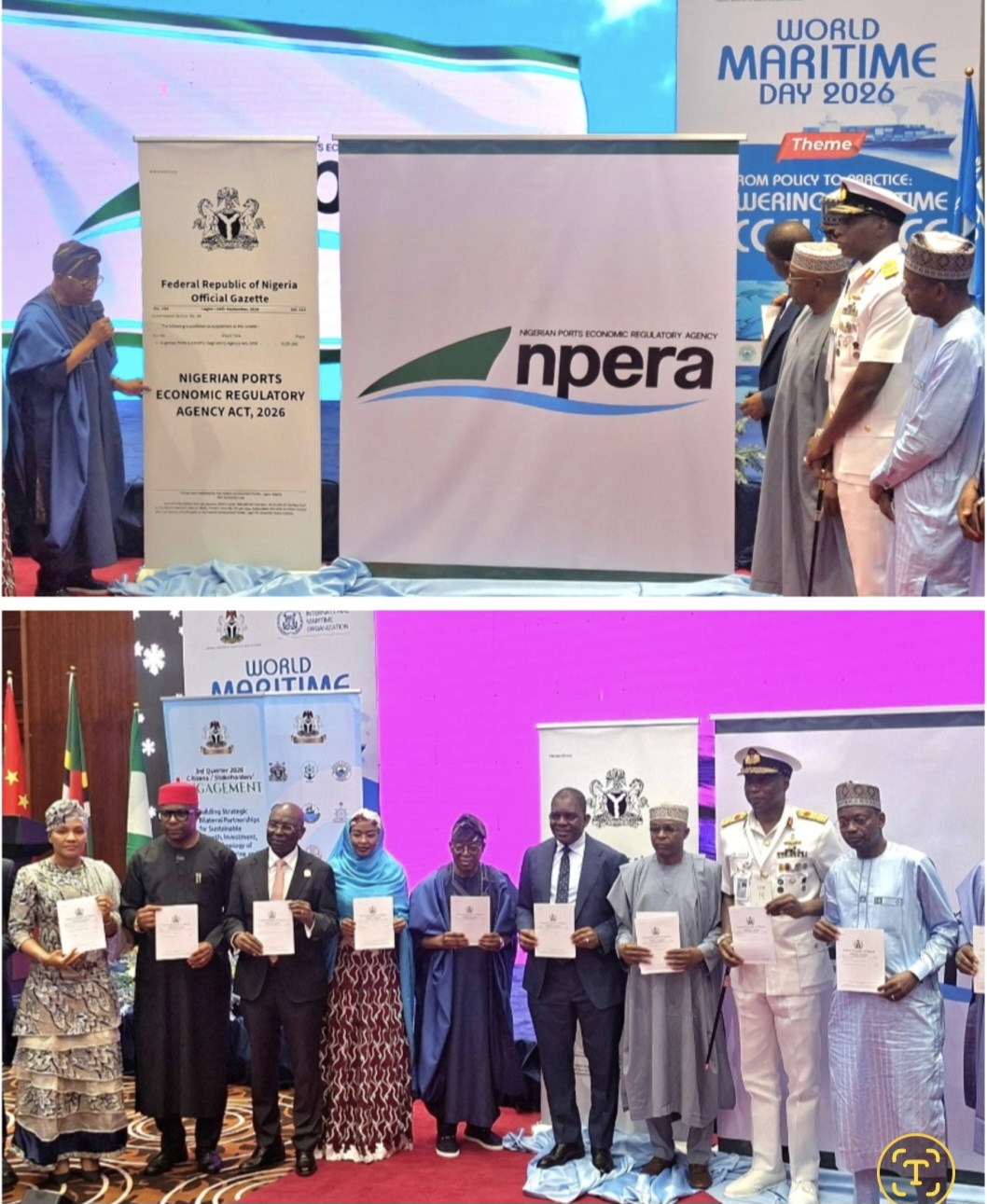
The Minister of Marine and Blue Economy, Adegboyega Oyetola, has unveiled the gazetted Nigeria Ports Economic Regulatory Agency (NPERA) Act, 2026, alongside the agency’s official logo, signalling the Federal Government’s move to establish a substantive framework for economic regulation of Nigeria’s port industry.
Oyetola, who made the announcement on Friday, October 16th,2026 at the Third Quarter 2026 Citizens’ and Stakeholders’ Engagement of the Federal Ministry of Marine and Blue Economy in Victoria Island, Lagos, said the new regulatory framework would strengthen investor confidence, promote fair competition and improve the global competitiveness of Nigerian ports.
The development follows President Bola Ahmed Tinubu’s assent to the NPERA Act in June 2026, bringing nearly two decades of efforts to institutionalise port economic regulation closer to fruition.
Speaking at the engagement, themed “Building Strategic Bilateral Partnerships for Sustainable Growth, Investment, and Technology of Nigeria’s Marine and Blue Economy,” the minister disclosed that he had directed the immediate constitution of a ministerial committee to oversee the transition of the Nigerian Shippers’ Council, which has served as the interim port economic regulator since 2014, into the new agency.
Under the new framework, NPERA will regulate port tariffs and charges, promote competition, enforce service standards, resolve commercial disputes and protect the interests of port users.
Oyetola stressed that the effectiveness of the agency would depend largely on its independence, impartiality and ability to discharge its statutory responsibilities without conflicts of interest.
“The credibility of an economic regulator rests, in no small measure, on its independence, impartiality and freedom from responsibilities that could give rise to actual or perceived conflicts of interest,” he said.
He therefore directed the agency to operate as an impartial arbiter, insulated from competing regulatory and operational responsibilities.
The establishment of NPERA is expected to provide a more structured framework for addressing commercial disputes, improving transparency in port pricing and strengthening accountability across the maritime value chain.
Beyond regulatory reforms, Oyetola reaffirmed the Federal Government’s commitment to modernising ports across the country, stressing that the programme would not be concentrated in Lagos at the expense of other maritime gateways.
He identified Apapa, Tin Can Island, Onne, Rivers, Delta and Calabar ports among the facilities earmarked for modernisation, describing balanced port development as essential to expanding trade opportunities and stimulating economic activities across Nigeria.
“No part of our national port system will be left behind in this modernisation programme,” the minister declared.
He emphasised that ports outside Lagos remained critical to Nigeria’s economic future and would play important roles in improving cargo distribution, strengthening regional trade and reducing pressure on the country’s busiest maritime gateways.
Oyetola also disclosed that the Federal Government had approved the development of six deep seaport projects at Ibom, Bakassi, Agge, Gateway, Ondo and Bonny.
According to him, the proposed projects are intended to expand the country’s maritime capacity, improve logistics infrastructure and strengthen Nigeria’s position as a regional shipping and trade hub.
The projects, alongside the planned modernisation of existing ports, form part of the government’s broader strategy to improve the efficiency of the maritime sector and unlock the economic potential of the nation’s coastline and inland waterways.
On maritime security, the minister said Nigeria had maintained zero piracy incidents in its territorial waters through the Deep Blue Project, describing the achievement as evidence of progress in securing the country’s maritime domain.
He also highlighted the removal, in August 2026, of the 12-year United States Coast Guard Condition of Entry imposed on vessels arriving in the United States from Nigeria.
The restriction, which had been in place since 2014, required affected vessels to comply with additional security measures before arriving at US ports.
Oyetola said its removal reflected improvements in Nigeria’s maritime security architecture and compliance with the International Ship and Port Facility Security Code.
The development is expected to ease additional security requirements previously imposed on affected vessels and support the competitiveness of Nigerian shipping and international trade.
The minister also reiterated the Federal Government’s commitment to strengthening indigenous shipping capacity through improved access to financing for qualified Nigerian shipowners.
He disclosed that he had directed the Nigerian Maritime Administration and Safety Agency (NIMASA) to work with approved Primary Lending Institutions to accelerate the processing and disbursement of the Cabotage Vessel Financing Fund (CVFF) to eligible applicants.
The fund was established to support the development of indigenous capacity in coastal and inland shipping, including the acquisition and operation of vessels by Nigerian operators.
Faster access to the fund is expected to help address financing constraints facing local shipping companies and improve their ability to participate in the maritime transport market.
Oyetola further underscored the importance of international cooperation in advancing Nigeria’s marine and blue economy, citing the country’s election into Category C of the International Maritime Organization Council in November 2025.
He also highlighted ongoing engagements with Denmark, India, Norway and the United Kingdom as part of efforts to attract investment, facilitate technology transfer and strengthen institutional capacity.
“Our approach to international cooperation is purposeful and results-oriented,” he said, adding that partnerships must strengthen local capabilities and deliver measurable, sustainable outcomes.
As part of the engagement, Denmark’s Ambassador to Nigeria, Jens Ole Bach Hansen, delivered a presentation on “Denmark’s Experience in Building a Sustainable Blue Economy: Lessons for Strategic Partnerships, Investment and Technology Transfer with Nigeria.”
The presentation provided a platform for discussions on how Nigeria could draw on international experience to develop its marine resources, attract investment and expand technology-driven opportunities across the blue economy.
The stakeholders’ engagement brought together government officials, industry leaders, development partners and other participants to deliberate on investment opportunities, regulatory reforms and strategic partnerships capable of advancing Nigeria’s maritime industry.
With the unveiling of the NPERA Act and the planned transition to a substantive port economic regulator, the Federal Government is seeking to strengthen the institutional foundations of the port sector while pursuing infrastructure modernisation, indigenous shipping development and international cooperation.

 Customs3 months ago
Customs releases final recruitment list for ASC II, ends nearly one-year wait for applicants
- Headlines2 months ago
Oyetola presents three-year score card as blue economy industry revenue hits ₦1.83trn
- Customs2 months ago
Apapa Customs sets new single-day revenue record with ₦28.1bn collection
- Customs2 months ago
Apapa Customs sets new record of monthly revenue haul with ₦323bn collection in July
- Customs3 months ago
Customs launches MIS file tracker at PTML in fresh digitalisation drive
- Customs2 months ago
NCS intercepts container concealing pump-action rifle parts, seizes ₦373.8m worth of cannabis products at Tincan Port