Connect with us

Headlines

Sanwo-Olu camp jittery over Jandor’s determination to overturn election victory at tribunal

The Eyewitness reporter
There is a palpable fear mixed with anxiety in the camp of Governor Babajide Sanwo-Olu over the latest move by the Lagos State’s  Peoples Democratic Party (PDP) submission of a petition before the Lagos governorship election tribunal, challenging the outcome of the state guber election.
Inside sources revealed that Sanwo-Olu,the Governor of Lagos State and his men, who are of the APC, are aware of the groundswell of allegations of corruption surrounding the March 18, 2023, gubernatorial elections in the State and are afraid that if these allegations are properly proven, might upset the apple cart at the elections tribunal.
Besides, Abdul-Azeez Adediran, the PDP governorship candidate, popularly known as Jandor has presented a very strong case at the tribunal with weighty evidence that will likely upturn the election results.
Jandor is calling for the disqualification of the All Progressives Congress (APC) and the Labour Party (LP) candidates in the election for “non-compliance” with the Electoral Act 2022 as well as the guidelines of the Independent National Electoral Commission (INEC).
In the petition marked EPT/LAG/GOV/01/2023 dated April 7, the petitioners said APC did not comply with the INEC timetable and schedule of activities for the 2023 general election which stipulated that all political parties must give 21 days’ notice to INEC before the conduct of the primary election.
While INEC is the first respondent, Babajide Sanwo-Olu; Obafemi Hamzat, his deputy governorship candidate; APC; Gbadebo Rhodes-Vivour, LP governorship candidate, and the LP respectively are the 2nd, 3rd, 4th, 5th, and 6th respondents.
Besides the allegation of non-compliance with relevant provisions of the Electoral Act 2022, Adediran added that at the time of the governorship election, Sanwo-Olu, Hamzat, and Rhodes-Vivour were not qualified to contest the election.
He asked that all votes cast for them in the election be declared wasted.
According to the petition, the APC also failed to comply with the requirement of the Electoral Act 2022 which states that every political party sponsoring a candidate in the general election shall submit the nomination form of such candidate(s) not later than 180 days before the conduct of the general election in forms EC9.
Adediran and the PDP added that Sanwo-Olu failed to attach a copy of the GCE O’Level result he claimed to have sat for in 1981 along with his form EC9 as required by the Electoral Act 2022 among other allegations.
Some lawyers that looked at the breakdown of the petition gave Jandor kudos for doing a thorough job capable of disqualifying Sanwo-Olu and the Labour Party candidate at the tribunal.
Analysts believe that Jandor did a yeoman’s job and with experienced Lawyers, Sanwo-Olu may just be on his way out of the government house if the case is properly decided.
Jandor came third in the election with 62,449 votes, behind the duo of Governor Babajide Sanwo-Olu and Gbadebo Rhodes-Vivour of the Labour Party.
Sanwo-Olu scored 762,134 votes to edge out the LP candidate who got 312,329 votes.
Rhodes-Vivour had since rejected the outcome of the election and vowed to challenge it in court.
Before the elections, Jandor had expressed confidence in winning, irrespective of the antics of the ruling party or enemies within. He declared that no candidate including the incumbent Gov. Babajide Sanwo-Olu, had ever worked like he had done in the electioneering, going to meet people in various communities across the 245 wards in the state.
Bolstered by this and the reception he was getting from fans, he took the offensive. Addressing newsmen sometime at his campaign office in Ikeja, the 45-year-old Adediran said he was in the race to win and bring in a breath of fresh air.
According to him, “We know they (APC) have been collecting Permanent Voter Cards, PVC, from the electorate to manipulate the polls’ result. But we are assuring them they will meet their waterloo this time.
“They (APC) do not have the monopoly of madness. Machinery has been put in place to check for any fraudulent moves. We will protect our votes from polling to collation centres.
“This election is to send the ruling APC packing. Remain steadfast, and calm down because the battle is of the Lord. We will win this election.
He urged his fans not to succumb to their threats and intimidation, adding, “We will protect our votes. Our votes will count this time, come out en-masse to exercise your rights.”
The weeks leading to the elections came with much turbulence for Jandor with allegations of rape, stepping down for other candidates, his campaign DG leaving him for LP as well as perceived backstabbing by trusted members of his party.
Jandor believed that the campaign of calumny and machinations was orchestrated by members of the opposing party who saw his rising profile and wanted to pull him down by all means.
He told the media in one of his briefings, ”We are all aware of the whirlwind in the polity towards this governorship polls in Lagos as a result of activities of some godfathers in PDP and APC who are bent on subverting the wishes of the majority.
” It is about the candidate that has been everywhere to see things for himself. It is about time that we elected a governor that is not tied to the apron of any godfather.
“We are here stating that all the rumours that are out there purportedly being sold by some people in some quarters is nothing but false.
“Lagos PDP is not in alliance with any political party. As the candidate of the party, I have not stepped down for anybody, we are not stepping down for anybody, and we are not going to step down for anybody.
“There has not been any formal meeting between Lagos PDP and any political party as such to say that we are on a round-table discussing alliance,” he said.
“The leaders have been beating the drums of war for the last few weeks with provocative statements, harassment, and propaganda. But am sure all these will soon subside. God has exposed them as they are beating the drums of war.
“Because I resisted the move by a godfather in PDP to pick Rhodes-Vivour as my deputy, they lured him (Rhodes Vivour) to Labour Party to confront us and stop our dream but this will definitely fail. We are resolute in attaining victory. We have worked hard for it in the last 10 years. The new wave of LP will not stop us.
One of those that Jandor accused of sabotaging him was former PDP Deputy National Chairman, South, Chief Bode George, and a few other members of the party in the state who had a few days before the election endorsed Rhodes-Vivour on the basis of his capacity.
Jandor  accused these PDP elders of leaving him for crumbs.
But Bode George told the media that Jandor breached an agreement on running-mate selection.
He said Jandor flouted the agreement to make Gbadebo Rhodes-Vivour his running mate, instead of Funke Akindele.
He said Adediran’s decision to pick Akindele, the Nollywood actress, as running mate forced Rhodes-Vivour to join the Labour Party as its standard bearer for the Lagos governorship election.
“After their presentation here in my office, we saw that these were the best two we have (Gbadebo Rhodes-Vivour and Adediran), and we asked him (Adediran) pointedly here, would you work with this man as your deputy, and he said, ‘yes sir,” he said.
“Haven paid for the price of the form, for us to have a seamless primary, would you take him to be your running mate, he answered ‘yes sir”
“After that, he came to me to say his mentor, Denrele Ogunsanya asked him to choose a deputy from Ikorodu, a woman. I told him why didn’t tell me at the time. I’m saying this now for history because that was what transpired. I have heard rumours that I am the one sponsoring Gbadebo.”
Jandor however weathered storm, bearing the burden without shaking.  The PDP candidate stressed that he ran the governorship campaign without any support from the party.
“We went into this election against all odds and even against some of our leaders within the PDP. Some respected leaders, supposedly, in the party had to leave us for crumbs.
“ I didn’t get a single money from the party at the state or national level after February 25 presidential and National Assembly Elections.
“We stayed behind to see this to the last. Even when some left the party to form a false alliance, we stood our ground to see this to fruition.
“I want to commend the people of Lagos, all loyal PDP leaders who stayed to see that the election came to a logical conclusion.
Analysts believe that Jandor, who hails from the Ojo/Badagry division, is a better alternative to replacing Sanwo-Olu who many see as a lackey, lily livered and a non performer.
Besides, his division is seen to have been marginalized all these years by the APC government. He promised to work for its development, to erase years of neglect by successive administrations in Lagos.
Adediran is his familiarisation tour urged the artisans and people living with disabilities to vote for PDP candidates at all levels in the state, stressing that the ruling party and their candidates have failed Lagosians.
Barnabas Abiodun Raji, the leader of the People Living with Disabilities, and Kola Alatise, the chairman of Coalition of Artisans in Badagry, pledged the support of their members for the gubernatorial bid of Jandor and his running mate, Olufunke Akindele.
Also, Jandor in an interactive session with the league of Pastors in Igbede/Iyana axis of Ojo Council,  said that the state needed a breath of fresh air that would make it work for all and sundry.
According to him, the Badagry Division, where Ojo LGA is also located, has suffered long neglect, hence the need to support him as an indigene of Ojo LGA, to change the story of the division for the better.
Promising free and compulsory education, security and massive infrastructural development, Adediran said that he would ensure that the wealth of the state worked for the residents, especially the masses.
While at the palace of the Royal Majesty, Elekunpa of Ekunpa Kingdom, Oba Abu Kazeem Kosoko in Ojo Council, Jandor promised never to let the traditional institutions down.
He told the Oba that he would run a government of the masses that everyone would be proud of.
His running mate Funso Akindele also helped to enhance the saleability of Jandor to the people especially the women. Akindele said that their administration would give women opportunities and ensure total inclusiveness.
Akindele said that Jandor would implement 35 per cent affirmative action for women if elected.
Also speaking during a visit to a coalition of artisans and physically challenged people in the Agamadeh part of Badagry, Jandor promised to set up a ministry for the physically challenged in the state and it would be headed by one of them.
“I want to appeal to all of us that this election is about giving Lagos a breath of fresh air. It is about time we did something else in the state.
Analysts believe that the outcome of the court case by Jandor will be a make or mar for the APC government in the state.
Continue Reading
Click to comment

Leave a Reply

Your email address will not be published. Required fields are marked *

Analyses

National Single Window: Paper on glass(6)

Monday Discourse with Nasiru Ibrahim 

The deployment of digital software portals across Nigeria’s maritime gateways has created a dangerous sense of administrative accomplishment.

On paper, policy declarations boast of automated workflows and modern interfaces designed to ease the cost of doing business. On the ground, however, the reality remains stubbornly archaic.

If the presidency and the newly minted National Single Window team believe that true automation begins and ends with front-end digital software portals like the new B’Odogwu Customs System, they are falling for an expensive trap.

True technological transformation cannot simply mean scanning old bureaucracies onto a computer screen. Cosmetic digitization does not eradicate systemic corruption; it merely moves the extortion from the physical Port gate onto a digital dashboard.

The structural flaw undermining our current modernization drive is the “scanned paper” reality. Clearing agents are routinely forced to upload digital documents onto unified portals, only to face the absurdity of printing out those exact same files to present them physically at various Port commands.

This duplication completely defeats the purpose of an automated gateway.
True single window success requires the total legal abolition of physical paper documentation within the Port perimeter.

We must transition from an era of “paper-on-glass” to pure, untampered digital data flows. A digital portal is utterly useless if the data it processes is still manually verified, delayed, or altered by human gatekeepers behind the scenes.

To break this cycle, the system must shift from human discretion to algorithmic risk profiling. We must enforce a machine-driven risk engine that automatically routes cargo through green, yellow, or red channels based entirely on hard data and compliance history.

Under this framework, once a container profile passes automated risk evaluation, an individual officer should not possess the arbitrary power to flag it for a manual “re-examination.”

Unauthorized human interventions on automated system routing must be treated as institutional sabotage and criminalized accordingly. Removing human delays from the logistics chain requires stripping human actors of the capacity to stall.

Furthermore, we must aggressively implement a single wallet mandate to clean up the financial architecture of our Ports. A true single window platform must consolidate all customs duties, agency fees, and terminal charges into one single electronic transaction.

This eradication of multi-layered payment checkpoints will instantly dry up the illicit cash demands that fuel the multi-billion-naira demurrage trap.

By deploying automated escrow systems, the central portal can instantly distribute revenues to the respective agency accounts—be it the Nigeria Customs Service, NPA, or NIMASA—only after automated cargo release metrics are met.

The ultimate structural shift, however, requires moving the entire national Port philosophy beyond the physical gate.

Top-tier maritime capitals like Singapore and Rotterdam do not stall their economies by interrogating cargo at the wharf; they rely on Post-Clearance Audits (PCA).

Nigeria must transition to a system where cargo is released instantly within a guaranteed 24-hour window based on automated risk profiles, while reserving heavy verification for robust, off-site corporate audits later.

Until we replace cosmetic upgrades with this level of raw process re-engineering, our software portals remain empty promises. True automation is not a software purchase; it is an uncompromising institutional discipline.

Chief Ibrahim Nasiru, a public affairs analyst, writes from Abuja

Continue Reading

Headlines

Oyetola presents three-year score card as blue economy industry revenue hits ₦1.83trn
Funso OLOJO,  Editor

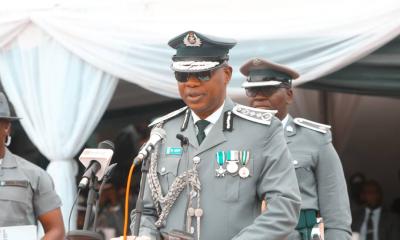
The Minister of Marine and Blue Economy, Adegboyega Oyetola, has declared that Nigeria’s maritime sector has undergone a far-reaching transformation in the three years since President Bola Ahmed Tinubu created the Federal Ministry of Marine and Blue Economy in August 2023.

Oyetola, while presenting the Ministry’s three-year scorecard, said the administration had made significant progress in unlocking the economic potential of Nigeria’s 853-kilometre coastline and extensive inland waterways, with the marine and blue economy increasingly emerging as a major driver of revenue, trade, security and employment.

According to him, the reform programme has produced measurable gains in revenue generation, port infrastructure, maritime security, regulation, indigenous shipping, human-capital development, fisheries and inland-waterway safety.

“At the heart of our mandate is a simple but powerful objective: to turn Nigeria’s vast marine resources into sustainable economic value for Nigerians,” Oyetola said.

Revenue climbs 160 per cent

The Minister identified revenue growth as one of the clearest indicators of the sector’s transformation.

Agencies under the Ministry generated ₦1.83 trillion in 2025, representing a 160 per cent increase over the ₦700.79 billion recorded in 2023.

Oyetola attributed the surge to regulatory reforms, stronger revenue assurance, digitisation and the systematic closure of financial leakages.

He said the improved revenue performance was part of a broader strategy to establish a more transparent, efficient and investment-friendly maritime economy.

Nigeria gets first blue economy policy

A major milestone of the reform programme, according to Oyetola, was the approval in May 2025 of Nigeria’s first National Policy on Marine and Blue Economy.

He said the policy provided, for the first time, a unified framework for developing shipping, fisheries, offshore energy, marine biotechnology and other emerging opportunities within the marine economy.

“This policy gives us a clear roadmap. It provides the predictability and transparency investors need while ensuring that our marine resources are developed sustainably,” he said.

The Minister said the policy would guide government intervention while providing greater certainty for private-sector investment across the marine and blue economy value chain.

Ports undergo major transformation

Port modernisation, Oyetola said, remained at the centre of the Ministry’s transformation agenda.

He said the Federal Government was implementing a comprehensive programme to upgrade major seaports, including Apapa, Tin Can Island, Onne, Rivers, Calabar and Warri.

The programme covers channel improvements, modern cargo-handling infrastructure and increased digitisation of terminal operations, aimed at improving efficiency and enabling Nigerian ports to handle larger volumes of international trade.

The reforms have also attracted international recognition.

The World Bank and S&P Global Market Intelligence ranked Tin Can Island Port 10th and Lagos Port Complex, Apapa, 12th among the world’s 20 most improved container ports between 2020 and 2025.

Oyetola said government had also made progress in tackling congestion around the Apapa port environment through the electronic truck call-up system, dedicated holding bays and expanded inland barging.

The acquisition of modern tugboats, pilot cutters and dredging equipment by the Nigerian Ports Authority, he added, had further strengthened port operations.

“We have moved from managing congestion to building a port system that can compete globally,” Oyetola said.

He said the Federal Government was also pursuing an expansion of port capacity through deep-seaport projects in Akwa Ibom, Cross River, Bayelsa, Ondo, Lagos and Rivers states.

The operationalisation of inland dry ports, including the Funtua Inland Dry Port in Katsina State, is similarly expected to take cargo-handling and clearance services closer to businesses in the hinterland and reduce pressure on coastal ports.

Regulation, lower costs for port users

The Minister said regulatory reforms had also delivered tangible benefits to businesses operating in the maritime sector.

According to him, the new Nigeria Ports Economic Regulatory Authority framework will strengthen economic regulation of the port sector, while interventions by the Ministry and its agencies have saved port users more than ₦86 billion in unjustified demurrage.

He added that nearly 300 commercial disputes had been resolved through Alternative Dispute Resolution.

Oyetola said government had introduced measures to eliminate unauthorised shipping charges and strengthen freight and foreign-exchange verification in an effort to reduce leakages and curb capital flight.

He said the objective was to create a maritime business environment where legitimate operators could compete on a level playing field while Nigerian businesses were protected from avoidable costs.

Maritime security records major gains

Improved port efficiency, Oyetola said, had been accompanied by significant gains in maritime security.

Nigeria has maintained zero piracy in its territorial waters for four consecutive years, according to the Minister, with maritime security assets deployed under the Deep Blue Project helping to secure the country’s waters.

He said the achievement had eliminated costly piracy-related surcharges on vessels calling at Nigerian ports while strengthening Nigeria’s reputation as a safer maritime corridor.

Nigeria also regained its seat on the International Maritime Organization Category C Council in November 2025, following a 14-year absence.

Through the Nigerian Maritime Administration and Safety Agency, the country also secured the lifting of the 12-year United States Coast Guard Condition of Entry restrictions affecting vessels arriving from Nigerian ports.

“These achievements demonstrate that Nigeria is not only reforming its maritime sector at home; we are reclaiming our rightful voice and influence internationally,” Oyetola said.

Indigenous shipping gets renewed attention

Oyetola said the Federal Government remained committed to increasing Nigerian participation in the shipping industry.

He disclosed that plans were at an advanced stage to revive a national shipping carrier through a public-private partnership, while the long-awaited process for disbursing the Cabotage Vessel Financing Fund (CVFF) had commenced.

The fund, he said, would enable Nigerian shipowners to acquire modern vessels and strengthen indigenous capacity.

“We cannot build a truly blue economy if Nigerians remain spectators in their own maritime industry,” he said.

Human-capital development has also received increased attention, with seafarer training and sea-time placements expanded to create more opportunities for Nigerians seeking careers at sea.

According to Oyetola, the interventions have contributed to an increase of more than 80 per cent in average seafarer earnings.

He added that the Ministry, through the Nigeria Port Economic Regulatory Agency, facilitated a ₦200,000 monthly minimum wage for maritime and shipping workers.

Blue economy expands beyond ports

Oyetola said the Ministry’s transformation agenda extends beyond shipping and ports to fisheries, inland waterways, marine safety and environmental sustainability.

He said the Ministry supported the Federal Government’s Naira-for-Crude policy by streamlining marine logistics for domestic refineries.

On inland waterways, safety interventions have included the distribution of thousands of lifejackets and plans to replace unsafe wooden boats with modern fibreglass vessels.

The fisheries sector, he said, recorded further growth, with fish production reaching 1.4 million metric tonnes in 2025.

Nigeria also achieved 100 per cent compliance with Turtle Excluder Device requirements among inspected commercial shrimp trawlers, helping to protect marine biodiversity and preserve access to international markets.

Oyetola said the interventions reflected the Ministry’s broader philosophy that economic development and environmental sustainability should reinforce rather than undermine each other.

Digitisation and new institutions

Institutional reform has also featured prominently in the Ministry’s three-year programme.

Oyetola said the Ministry had digitised its internal operations through an Enterprise Content Management System (ECMS) to improve efficiency, transparency and accountability.

He also disclosed that the Ministry helped resolve a 16-year impasse that paved the way for the operationalisation of the Regional Maritime Development Bank (RMDB) in Nigeria.

According to him, the development would improve access to financing for businesses and projects across the maritime value chain.

Foundation for the next phase

Oyetola said the achievements recorded over the past three years should be regarded as the foundation for a much larger economic opportunity.

He said the ultimate objective was to establish a maritime ecosystem in which efficient ports support trade, stronger security attracts shipping, Nigerian businesses capture a greater share of the maritime value chain, coastal and inland communities benefit from new economic opportunities, and marine resources are developed sustainably.

According to him, the combination of rising revenues, a new national policy framework, port modernisation, improved maritime security, stronger regulation, investment in human capital and renewed international engagement had placed Nigeria’s marine and blue economy on a stronger trajectory.

“The blue economy is no longer an untapped frontier. It is becoming a major engine of national prosperity, regional competitiveness and sustainable growth,” Oyetola said.


Continue Reading

Headlines

NIHOTOUR promotes culinary, cultural exchange at Nigeria-China food festival

Gloria Odion, Reporter

The National Institute for Hospitality and Tourism (NIHOTOUR), in collaboration with the China Cultural Centre in Nigeria, has used the 2026 Nigeria-China Food Festival to promote culinary diplomacy, cultural exchange and stronger people-to-people relations between the two countries.

The festival, held on August 27 at the China Cultural Centre in Abuja, was themed “From Farm to Feast” and formed part of activities marking 55 years of diplomatic relations between Nigeria and China.

The event brought together more than 200 participants, including hospitality professionals, chefs, tourism stakeholders, government officials, diplomats, entrepreneurs and cultural practitioners from both countries.

A major attraction of the festival was the presentation of 14 Chinese dishes representing seven regions of China alongside 12 Nigerian dishes reflecting the country’s six geopolitical zones.

The diverse selection offered guests an opportunity to experience the distinctive ingredients, preparation techniques and culinary traditions of both countries while learning about the communities and cultures behind the food.

For NIHOTOUR, the festival also served as a platform to showcase Nigerian cuisine as an important component of the country’s tourism proposition and draw attention to the wide range of people and enterprises that make up the food and hospitality value chain.

Speaking at the event, the Director-General/Chief Executive Officer of NIHOTOUR, Aare Abisoye Fagade, reaffirmed the Institute’s commitment to developing the skills and human capacity needed to strengthen Nigeria’s hospitality and tourism industry.

Fagade said such initiatives could help create opportunities for young people, professionals and entrepreneurs while promoting Nigeria’s rich culinary heritage to domestic and international audiences.

The theme, “From Farm to Feast,” also highlighted the extensive value chain behind every meal—from farmers and food producers to processors, chefs, hospitality operators and businesses that ultimately serve consumers.

NIHOTOUR used the occasion to emphasise the tourism potential embedded in Nigeria’s diverse culinary traditions. Each of the country’s six geopolitical zones has distinctive dishes, ingredients and methods of preparation that can be developed into authentic cultural and tourism experiences.

The Chargé d’Affaires ad interim of the Embassy of the People’s Republic of China in Nigeria, Mr. Zhou Hongyou, underscored the importance of food in promoting cross-cultural understanding and strengthening people-to-people relations.

Also in attendance was the Cultural Counsellor of the Chinese Embassy and Director of the China Cultural Centre in Nigeria, Mr. Yang Jianxing.

Their participation reinforced the role of cultural diplomacy in deepening the longstanding relationship between Nigeria and China.

Beyond the food presentations, the festival featured cultural activities and opportunities for interaction between Nigerian and Chinese participants. It also opened avenues for potential collaboration in hospitality, tourism, culinary training, cultural exchange and enterprise development.

The event comes at a significant point in Nigeria-China relations, with both countries commemorating 55 years of diplomatic ties. While bilateral relations have expanded into areas such as trade, investment, infrastructure and education, cultural initiatives provide an important avenue for strengthening the relationship at the people-to-people level.

NIHOTOUR said it would continue to pursue partnerships capable of advancing Nigeria’s hospitality and tourism sector, strengthening professional capacity, supporting enterprise development and creating opportunities across the tourism value chain.

Through initiatives such as the Nigeria-China Food Festival, the Institute is positioning food and hospitality not only as avenues for economic development but also as powerful instruments of cultural diplomacy and international engagement.

Continue Reading

Trending