Connect with us

Uncategorized

Wale Bashir Adeniyi: One year of impactful leadership as Customs Field Marshal 

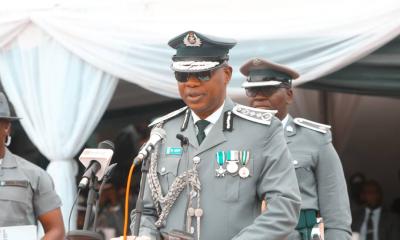
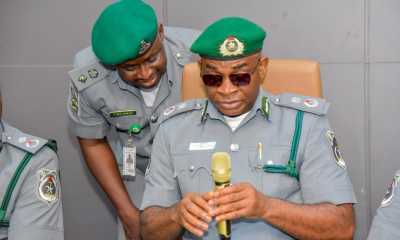
With his towering stature, Wale Bashir Adeniyi, the 14th indigenous Comptroller General of the Nigeria Customs service, bestrides the landscape of the service with maximum impact in the last one year of stewardship.
In a blistering performance which has left many in admiration and awe, Adeniyi has revolutionized the administration and operations of the NCS in the last one year in office.
The new Customs Sheriff clocks one year in office today, July 19th, 2024.
His appointment as the Comptroller General of Customs on 19th, June, 2023 by President Bola Ahmed Tinubu, marked a turning point in the annal of the agency.
The last eight years in the Nigeria Customs Service have been characterised by undulating performance.
It has been a mixed bag of fortunes and misfortunes, rise and fall and tragicomedy in the performance of the service.
During those years, the rating of the service plummeted in the eye of the public and the stakeholders who were detached from the cold attitude of the top hierarchy of the Customs were not amused.
Most of the policies and actions of the service, most of which were devoid of human face, brought the agency into direct conflict with the public and the stakeholders due to the leadership style of the man who directed the affairs of the service for those years.
During those years, the officers were muffled and the stakeholders were ruffled.
Then came Adewale Adeniyi, the new Sheriff in Town.
Adeniyi ascended the high stool of Customs as the Customs Comptroller General at a time when the morale of officers was at the lowest ebb.
However, his coming, within a year in office,  has brought hope, joy and renewed enthusiasm among the officers while it has sparked off a newfound love among the stakeholders who are elated over the crowning of the home-grown officer.
The fortune of the service which dipped during the last eight years and its public rating which plummeted within that period due to the rein of a non-customs officer as the head, have now suddenly sprang to life with the coming of the new Sheriff.
In June 2023, the appointment of Adeniyi as the new CGC by President Bola Ahmed Tinubu marked a turning point in the affairs of the Customs.
It signalled a rebirth of the service which has been grappling with unfavourable public opinion.
As expected, the appointment of the new Sheriff sparked a spontaneous jubilation and exhilaration among the staff of the service and the stakeholders.
This was expected given the professional acumen of the new CGC and his impressive track record in a service he had held sway for the past 30 years.
Stakeholders, especially the confraternity of the freight forwarders, are unanimous in their assessment of the one year in office of Adeniyi.
Babatunde  Mukaila Abdulazeez, the former  National Secretary of the Association of Nigerian Licensed Customs Agents (ANLCA) couldn’t hide his feelings over the inspiring leadership of Adeniyi.
“It is a personal roller coaster feeling for me. We have never had it so good.”, he declared when he was asked to assess the performance of Adeniyi in his first year in the saddle as the CGC.
Ada Ozomena Akpunonu, another frontline freight forwarder and a top-notch member of the ANLCA, was no less impressed by the performance of Adeniyi as the CGC.
“He could eventually emerge as the best CGC customs ever had” she declared.
Ibrahim Tanko, the Vice President, the Western Zone of the National Association of Government Approved Freight Forwarders (NAGAFF) who is also the National Coordinator of the 100 compliance team of the association, also acknowledged the uncommon professional ingenuity of the new CGC.
“He has done well so far”, he stated tersely.
Dr Boniface Aniebonam, the legendary founder of NAGAFF was no less enamoured by the sparkling leadership qualities of Adeniyi as displayed within his first year in office.
“He is a communication strategist” he declared as a matter of fact.
Adeniyi, as a thoroughbred professional in customs administration and human relations, immediately brought remarkable changes from the stiff and top-of-horse leadership approach of the last eight years.
As an astute public relations expert, Adeniyi immediately went on an extensive engagement with all his officers and critical stakeholders.
He first engaged the powers that be with his direct engagement of Mr President, Governor of Lagos state, Babajide Sanwolu and the National Security Adviser, Nuhu Ribadu.
He also paid homage to the traditional rulers, including the Oni of Ife, Oba Adeyeye Enitan Ogunwusi.
He thereafter engaged the officers, one-on-one at the Headquarters, interacting with them in their various offices under the air of camaraderie, displaying a rare leadership style that was alien in the last years in the service.
He then followed this up with a tour of the commands where he met with the officers before he headed to the border communities where he made a lot of efforts to create an atmosphere of mutual trust, support and harmonious relationship with the host communities and the customs, a vital ingredient that have long been lost to the last eight years of deep-seated suspicion and acrimony that were engendered by the unfriendly posture of the last regime.
Not done, the new CGC also engaged the members of the maritime media, his constituency during his almost two-decade-long impressive rein as the super public relations officer of the service.
Adeniyi was not unmindful of his counterpart across the border in the Benin Republic to whom he paid homage in a bid to foster a harmonious working relationship that would promote trade and discourage smuggling between the two West African neighbours.
The lawmakers were also not left out in his extensive and strategic engagement as he hosted the members of the Senate Committee on Customs.
In addition, members of various government organizations and private bodies tasted the irresistible lure of Wale’s hospitality.
He didn’t leave the freight forwarders out of his public engagement as he made direct contact with them in their areas of operations.
Adeniyi also reinvigorated the  Corporate Social Responsibility(CRS) of the service by visiting a motherless baby home in Ibadan where he promised to reactivate the milk of human kindness in the Customs under his leadership.
There was hardly any segment of society that Adeniyi did not court its cooperation and support to have an inclusive administration that is anchored on the goodwill of the people.
Adeniyi also thrust the NCS to the consciousness of the global community with his visit to China recently where he sold the boulstered the international image of the agency.
That is the hallmark of leadership excellence.
Adeniyi, as a versatile public relations expert, achieved a dual purpose with this extensive and strategic engagement.
First, he used it to reunite the customs with the critical stakeholders who had hitherto felt alienated by the detached managerial style of the last administration in customs.
Secondly, it used the engagement to launch the customs into a new path of operational rebirth where the new management he leads will carry out its onerous task with full cooperation and collaboration of critical stakeholders.
Similarly, the disbandment of the controversial CGC strike force and streamlining of the mushroom customs checkpoints has also endeared the new Sheriff to the stakeholders, especially the freight forwarders, who had had cause to complain in the past about the excesses of those special forces.
According to Babatunde Mukaila Abdulazeez “It is a personal roller coaster feeling for me. We had never had it so good
“Wale has shown that he has the capacity and what it takes to take Nigeria Customs to the next level.
“He has shown that Nigeria can be at par with the rest of the advanced world in the deployment of trade tools.
“Within his first year in office,  he has shown uncommon courage, commitment and uncanny knowledge of customs operations and processes that are meant to facilitate trade.
“For instance, he introduced what is called the Advance Ruling which holds Customs officers accountable for whatever their position is on pre-importation requests.
“I can tell you that it takes courage to do that as no officer would want to be held responsible for his action.
“But Adeniyi has done that. He was the first CG to bell the cat on this novel idea. This shows his courage and passion to transform customs.
“Also, he introduced another novel idea by partnering with the Japanese government to establish a laboratory for Nigeria Customs.
“The issue of argument on chemical imports will be a thing of the past. This will not only help the customs but the NAFDAC as well.
“Adeniyi, in his first one year in office, has shown us that he knows what needs to be done and that he is a core professional customs officer.
“We can only pray for him to succeed. He has put on the table accountability and transparency, he declared
For Ada Ozomena Akpunonu, Wale is a professional customs officer and “we all know his rich antecedents”
“Unfortunately, he came at a time when Nigeria’s economy is in comatose. This will make his task a bit difficult.
“For instance, the exchange rate is too high and the Customs duties are equally high which have both combined to make goods clearance at the port very exorbitant.
“Wale is a team player. He carries everyone along.
“Through the deployment of his Area Controllers, he has shown the depth of his managerial acumen because his men at the Area Commands are square pegs in square holes.
“By the time he spends four year in office,  he will perform wonders. The atmosphere in the customs now is that of conviviality and sanity.
“If not for the instability of the naira and the bastardized economy, Wale could emerge as the best CGC ever.
Ibrahim Tanko believed Wale is doing well as the CGC.
“He has done well in terms of reducing the bottleneck in clearance procedures by reducing the number of units.
“For instance, he has disbanded the notorious CG strike force as well as border drills.
“He is also working hard to restore the core values of the Federal Operations Units ( FOUs) of the service by enhancing their professionalism.
“He is also doing well in the area of checking the excesses of officers.
“He is also doing well in attending to pending cases such as seizures, detentions, dismissals and suspensions.
“However, I would like him to define and delineate the functions of Customs Police, FOU and Provosts.
Their functions and duties should be well-defined and clearly stated to avoid overlap and clash.
Boniface Aniebonam said Wale is a master communication strategist.
” I commend him on the disbandment of the CG strike force.”The interventionist squad had abused the customs process under previous customs administrations.
“We appreciate him for that. He should also take a very strong stance against avoidable trade alerts from different customs units.
“This does not facilitate trade. He should coordinate and hamonise the alert system and I know as a listening officer, he shall look into this disturbing issue.
“There are lot to still be done. However, his one year in office is well and good.
“He should, however, contact critical stakeholders and partner them by using established platforms such as ANLCA and NAGAFF to reach out to the trading public.
“His one year in office has been avoidably aggressive in revenue target and collection.”But the modern-day customs practice is not about revenue but trade facilitation.
”If you raise the compliance level of the trading public, this will lead to high revenue. He should de-emphasize revenue and emphasize trade facilitation which leads to high revenue” retorted Aniebonam.
But Wale’s one year in office has raised the compliance level of the trading public.
The deployment of one of the trading tools which is the Authorized Economic Operator (AEO) is an eloquent testimony to that.
Adeniyi also showed his vast understanding of customs operations when he made trade facilitation the fulcrum of his administration.
All over the world, the Customs has duties to facilitate trade, collect revenue, detect and prevent smuggling, with none of the functions running counter against the others.
But over the years, especially in the last eight years, trade facilitation has been subjugated to revenue collection to the chagrin of stakeholders, but the decision of the new CAC not to injure trade facilitation in pursuit of revenue and smugglers is welcomed by the appreciative freight forwarders.
It is more gratifying to note that the new CGC has promised to break away from the past crude method of anti-smuggling tactics which had led to the avoidable death of officers and innocent people.
He hoped to achieve this by relying more on the deployment of technology which will maximise performance and minimise casualties.
The triumph of brain over brawn.
As the 14th indigenous Comptroller-General of Customs and 31st since its establishment in 1891, Wale Adeniyi, a brilliant public relations expert who is well grounded in Customs operations, is fast becoming a new face of the customs, a beckon of hope for the officers and stakeholders who have been yarning for a change from the last eight years of mutual suspicion and acrimony between the customs and its publics.
Stakeholders have therefore hailed the  Nigerian Customs Service Act, especially Section 14(1)(a) of the Act,  which states that “The President shall appoint a career officer from the Service, not below the rank of Assistant-Comptroller General (who shall be responsible for the overall management of the service) and be accountable for all revenue collections and all expenditures made under this Act”.
It was this new Act that enabled President Bola Ahmed Tinubu to discover and unleash the talents and professional acumen of Wale Adeniyi on the customs for maximum impact.
Until his appointment, Adeniyi was in charge of Strategic Research and Policy at the Customs Headquarters in Abuja.
A professional who is conscious of the need to build a solid image for the agency, Adeniyi once served as customs spokesman for almost two decades until January 2017 when he was redeployed to the Apapa Area Command as a Deputy Comptroller.

He was promoted to the rank of Comptroller in 2017 and appointed Deputy Commandant of the Nigeria Customs Command and Staff College, Gwagwalada, Abuja.In 2019, he was redeployed to serve as the Controller of the Murtala Muhammed International Airport (MMIA) Command, Lagos where he made the famous seizure of $8.07m cash.

He was promoted to the rank of Assistant Comptroller General in February 2020 shortly after he supervised the seizure of $8.07 million cash being illegally taken out of Nigeria through the E-Wing of the international airport tarmac.

 He was subsequently posted to head the Nigeria Customs Command and Staff College, Gwagwalada, Abuja as Commandant.

In recognition of his service, former President Muhammadu Buhari, on October 11, 2022, conferred the national honour of Member of the Order of the Federal Republic (MFR) on Adeniyi.

Stakeholders are unanimous in their conviction that the Nigeria Customs Service will witness a galloping development, turn around of fortunes and professional excellence under the stewardship of  Adeniyi.

Continue Reading
Click to comment

Leave a Reply

Your email address will not be published. Required fields are marked *

Headlines

NIHOTOUR promotes culinary, cultural exchange at Nigeria-China food festival

Gloria Odion, Reporter

The National Institute for Hospitality and Tourism (NIHOTOUR), in collaboration with the China Cultural Centre in Nigeria, has used the 2026 Nigeria-China Food Festival to promote culinary diplomacy, cultural exchange and stronger people-to-people relations between the two countries.

The festival, held on August 27 at the China Cultural Centre in Abuja, was themed “From Farm to Feast” and formed part of activities marking 55 years of diplomatic relations between Nigeria and China.

The event brought together more than 200 participants, including hospitality professionals, chefs, tourism stakeholders, government officials, diplomats, entrepreneurs and cultural practitioners from both countries.

A major attraction of the festival was the presentation of 14 Chinese dishes representing seven regions of China alongside 12 Nigerian dishes reflecting the country’s six geopolitical zones.

The diverse selection offered guests an opportunity to experience the distinctive ingredients, preparation techniques and culinary traditions of both countries while learning about the communities and cultures behind the food.

For NIHOTOUR, the festival also served as a platform to showcase Nigerian cuisine as an important component of the country’s tourism proposition and draw attention to the wide range of people and enterprises that make up the food and hospitality value chain.

Speaking at the event, the Director-General/Chief Executive Officer of NIHOTOUR, Aare Abisoye Fagade, reaffirmed the Institute’s commitment to developing the skills and human capacity needed to strengthen Nigeria’s hospitality and tourism industry.

Fagade said such initiatives could help create opportunities for young people, professionals and entrepreneurs while promoting Nigeria’s rich culinary heritage to domestic and international audiences.

The theme, “From Farm to Feast,” also highlighted the extensive value chain behind every meal—from farmers and food producers to processors, chefs, hospitality operators and businesses that ultimately serve consumers.

NIHOTOUR used the occasion to emphasise the tourism potential embedded in Nigeria’s diverse culinary traditions. Each of the country’s six geopolitical zones has distinctive dishes, ingredients and methods of preparation that can be developed into authentic cultural and tourism experiences.

The Chargé d’Affaires ad interim of the Embassy of the People’s Republic of China in Nigeria, Mr. Zhou Hongyou, underscored the importance of food in promoting cross-cultural understanding and strengthening people-to-people relations.

Also in attendance was the Cultural Counsellor of the Chinese Embassy and Director of the China Cultural Centre in Nigeria, Mr. Yang Jianxing.

Their participation reinforced the role of cultural diplomacy in deepening the longstanding relationship between Nigeria and China.

Beyond the food presentations, the festival featured cultural activities and opportunities for interaction between Nigerian and Chinese participants. It also opened avenues for potential collaboration in hospitality, tourism, culinary training, cultural exchange and enterprise development.

The event comes at a significant point in Nigeria-China relations, with both countries commemorating 55 years of diplomatic ties. While bilateral relations have expanded into areas such as trade, investment, infrastructure and education, cultural initiatives provide an important avenue for strengthening the relationship at the people-to-people level.

NIHOTOUR said it would continue to pursue partnerships capable of advancing Nigeria’s hospitality and tourism sector, strengthening professional capacity, supporting enterprise development and creating opportunities across the tourism value chain.

Through initiatives such as the Nigeria-China Food Festival, the Institute is positioning food and hospitality not only as avenues for economic development but also as powerful instruments of cultural diplomacy and international engagement.

Continue Reading

Uncategorized

Relief as USCG lifts 12-year condition of entry on Nigerian vessels

Funso OLOJO, Editor

Relief has come to Nigeria’s shipping industry as the United States Coast Guard (USCG) has lifted the 12-year-old Condition of Entry (CoE) imposed on vessels arriving in the United States after calling at Nigerian ports.

The landmark development, announced by the Minister of Marine and Blue Economy, Adegboyega Oyetola, ends more than a decade of enhanced security requirements imposed on vessels trading between Nigeria and the United States.

The decision is being viewed as a major vote of confidence in Nigeria’s maritime security architecture and a significant boost for the competitiveness of Nigerian ports.

The CoE, which came into effect on June 25, 2014, required vessels destined for the United States that had called at designated Nigerian ports within their previous five port calls to undergo additional security measures and enhanced scrutiny before being allowed into U.S. waters.

Oyetola said the removal of the restriction represented a strong affirmation of the progress Nigeria had made in strengthening maritime security and implementing the International Ship and Port Facility Security (ISPS) Code across its ports and maritime facilities.

He attributed the breakthrough to sustained efforts by the Federal Ministry of Marine and Blue Economy, through the Nigerian Maritime Administration and Safety Agency (NIMASA), in collaboration with government agencies, port operators, terminal and facility operators, shipping companies and other industry stakeholders.

According to the Minister, the stakeholders worked systematically to strengthen Nigeria’s maritime security framework, close identified gaps and demonstrate sustained compliance with internationally accepted security standards.

The lifting of the restriction followed four comprehensive assessments conducted by the United States Coast Guard over the past two years.

The assessments were undertaken on March 11–13, 2024, April 15–19, 2024, March 15–21, 2025, April 13–17, 2026

The assessments covered Nigeria’s national maritime security framework and port facilities and, according to the Minister, demonstrated significant improvement in the country’s maritime security performance and implementation of the ISPS Code.

The positive outcome ultimately paved the way for the withdrawal of the Condition of Entry.

Oyetola described the development as a major milestone for Nigeria’s maritime sector and a reflection of sustained regulatory oversight, institutional collaboration and investment in maritime security.

“The lifting of the Conditions of Entry is a major milestone for Nigeria’s maritime sector. It is a strong affirmation of the progress we have made in strengthening maritime security and implementing the ISPS Code across our ports and facilities,” the Minister said.

He added: “We are committed to sustaining this momentum and ensuring that Nigeria remains a safe, secure and competitive destination for international shipping”

The Minister commended the Director-General of NIMASA, Dr. Dayo Mobereola, and his team for their contribution to the achievement.

He said the lifting of the restriction demonstrated the positive impact of effective regulation, stakeholder collaboration and sustained investment in maritime security.

The development is particularly significant for NIMASA, which is responsible for driving compliance with international maritime safety and security standards within Nigeria’s maritime domain.

Beyond its immediate security implications, the lifting of the CoE could have far-reaching commercial consequences for Nigeria’s maritime economy.

For more than a decade, vessels that had called at Nigerian ports before proceeding to the United States were subjected to additional security and operational requirements.

The regime translated into additional inspections, documentation, security measures and potential delays, increasing operational costs for shipping companies and creating concerns about vessel turnaround time and schedule reliability.

With the restriction now lifted, vessels calling at Nigerian ports and subsequently sailing to the United States will no longer be subjected to the additional USCG security requirements imposed specifically under the CoE.

The development is expected to improve vessel turnaround and schedule reliability while reducing costs associated with additional inspections, documentation and security procedures.

It could also make Nigerian ports more attractive to international shipping lines, potentially encouraging increased vessel calls, trade flows and investment.

  1. For Nigerian ports already battling to improve their competitiveness against regional rivals, the decision represents a major reputational and operational gain.

The lifting of the CoE also carries an important symbolic value.

For 12 years, the restriction served as an international reminder of deficiencies identified in Nigeria’s maritime security environment. Its removal now provides evidence that the country has made measurable progress in addressing those concerns.

The challenge, however, is to ensure that the achievement is sustained.

Nigeria will need to maintain rigorous enforcement of the ISPS Code, strengthen port facility security, sustain regulatory oversight and prevent a relapse into the weaknesses that triggered the restriction in the first place.

For Oyetola and the maritime administration, therefore, the lifting of the CoE is not the end of the journey but a new benchmark.

If sustained, the breakthrough could help Nigeria attract more shipping activity, reduce avoidable costs, improve port efficiency and strengthen the country’s position in the global maritime economy.

After 12 years of heightened scrutiny, Nigeria’s maritime sector now has a fresh opportunity to turn improved security credentials into greater port competitiveness, increased trade and stronger participation in international shipping.

Continue Reading

Headlines

Osun election: How Oyebamiji lost to Osun APC internal power struggle

Funso Olojo, Editor 

The defeat of Asiwaju Munirudeen Bola Oyebamiji in the August 15th, 2026  Osun governorship election may ultimately be remembered as more than a failure at the ballot box.

It was, in many respects, the latest chapter in the long-running struggle for control, influence and political direction within the Osun State chapter of the All Progressives Congress (APC).

Oyebamiji fought a formidable campaign and came within striking distance of Governor Ademola Adeleke.

But when the votes were finally counted, Adeleke emerged with 511,067 votes against Oyebamiji’s 444,815, winning by 66,252 votes and taking 19 of the state’s 30 local government areas, while the APC candidate won 11.

For a party that entered the contest determined to reclaim Osun, the result raises a painful question: Did the APC lose the election at the polling booths—or did it lose vital ground much earlier, in the battles within its own ranks?

The evidence suggests that the answer is a combination of both.

The ghost of 2022

The greatest weakness of Osun APC has always been its inability to completely bury its internal wars.

The party’s 2022 experience remains instructive. The feud between the camps associated with former Governor Gboyega Oyetola and former Governor Rauf Aregbesola fractured the APC before the election.

Political analysts subsequently identified the division within the party as one of the factors that contributed to Oyetola’s defeat by Adeleke.

Four years later, the APC entered another election under the shadow of unresolved factional relationships.

This time, the principal fault lines included the longstanding rivalry involving Oyetola and former deputy governor and former APC National Secretary, Iyiola Omisore.

By mid-2026, the party was still making efforts to reconcile the two camps. A peace meeting reportedly brokered by former APC National Chairman Bisi Akande was held to resolve the lingering rift between Omisore and Oyetola.

That fact alone was significant.
A political party preparing for a major governorship election should ideally be discussing how to defeat its opponent, mobilise voters and sell its candidate.

Instead, substantial political energy was still being expended on reconciling influential actors within the party.

Oyebamiji inherited a fractured and divided house. Oyebamiji himself was not necessarily the cause of the crisis.

Indeed, he emerged as the APC’s consensus candidate after an internal process in which he was widely regarded as acceptable across several political interests within the party.

His candidacy therefore offered the APC an opportunity to put its factional history behind it.

But choosing a consensus candidate and building a genuinely united political machine around him are two different things.

The APC needed all its major blocs to translate their individual structures into one coordinated campaign organisation.

The challenge was not simply getting party leaders to appear together at rallies. It was ensuring that their supporters, ward leaders, local government structures and grassroots networks were equally committed to the same candidate.

That is where the war within became electorally consequential.

The Omisore question

Few issues illustrated the APC’s internal dilemma more clearly than the place of Omisore in the campaign.

Omisore remained an important political figure in Osun APC, but reports of defections by some of his associates raised questions about the extent of his influence and whether the party had successfully integrated all its competing tendencies ahead of the election.

In June, THISDAY reported the resignation of Kolawole Ismaila, described as one of the strong pillars in Omisore’s camp.

Other reports similarly documented defections and resignations from the APC as the election approached.

For an opposition party trying to unseat an incumbent, every prominent defection mattered—not necessarily because one politician alone could determine an election, but because defections could signal deeper dissatisfaction among networks of ward leaders, local organisers and grassroots loyalists.

The danger was that the APC could appear united at the top while remaining fragmented below.

A party fighting yesterday’s battles

The deeper problem was structural.
Osun APC spent years fighting over who controlled the party, who should determine its leadership and which political tendency should dominate its affairs.

That history did not disappear merely because the party selected Oyebamiji.

Indeed, earlier in 2026, THISDAY described the Osun APC as a party “fighting itself”, with its internal disagreement becoming a major political issue ahead of the election.

The irony is striking.
Oyebamiji was campaigning to reclaim the Government House from Adeleke, but the APC itself had not completely resolved the struggle for ownership of the political house.

That distinction matters in Nigerian elections, where victory is often determined not only by the popularity of a candidate but by the efficiency of the party’s grassroots machinery.

Adeleke exploited what APC left unresolved
While the APC wrestled with internal cohesion, Adeleke had an important advantage: incumbency and an established grassroots political structure.

The election ultimately became a battle between a governor seeking another term and an opposition candidate attempting to build a coalition broad enough to remove him.

Oyebamiji ran a competitive race. But defeating an incumbent in Osun required more than an attractive candidate and federal backing.

It required an exceptionally disciplined statewide machine.

The APC had federal visibility and national political weight. But Adeleke had the advantage of incumbency, local visibility and a political family whose influence remains deeply rooted in Osun politics.

The result showed the limits of federal political leverage when it is not matched by complete grassroots cohesion.

The numbers tell the story
The final figures make the defeat difficult to dismiss as a narrow accident.

Adeleke’s 511,067 votes represented a substantial statewide mobilisation.

Oyebamiji’s 444,815 votes were also significant and demonstrated that the APC remained a powerful force in Osun.

But the 66,252-vote gap was large enough to show that the APC still had considerable work to do before it could translate its strength into victory.

The geographical spread was equally revealing.

Adeleke carried 19 LGAs, while Oyebamiji won 11.

The APC was therefore not annihilated. It was beaten by an incumbent who was able to assemble a broader electoral coalition.

That distinction is important because it means the APC’s defeat was not simply a rejection of Oyebamiji.

Rather, the result suggests that the party had the capacity to compete but failed to convert that capacity into the winning coalition required to capture the state.

The lesson from 2022 was not fully learned.
Perhaps the most disturbing aspect of the defeat is that the warning signs had been visible.

In 2022, the APC lost the governorship amid bitter internal divisions. Analysts explicitly linked the party’s internal crisis to its electoral setback.

In 2026, the party again entered an election with questions about internal cohesion.

There were even public calls from within the party for unity.

In May, APC chieftain Olatunbosun Oyintiloye said unity among party members was crucial to securing victory in the August 15 election.

That warning now looks prophetic.
The party apparently understood the problem. What it struggled to achieve was a sufficiently deep and lasting solution.

It would be unfair to blame everything on the APC crisis.

Yet attributing Oyebamiji’s defeat entirely to internal APC politics would be too simplistic.
Elections are multidimensional.

Adeleke’s performance as incumbent mattered. His campaign strategy mattered. His political network mattered.

Voter perceptions of the state government mattered. The candidates’ individual appeal mattered. Local political calculations mattered.

The election was also fought in an environment characterised by intense political competition, defections, court battles, accusations and counter-accusations.

There was also the presence of the ADC’s Najeem Salam, who competed for the same broad political space and potentially affected the distribution of opposition votes.

Therefore, the APC’s internal crisis should be seen not as the only reason for defeat, but as a force that weakened the party’s ability to maximise its other advantages.

The painful irony of the campaign

Perhaps the greatest irony is that Oyebamiji had entered the race as a unifying figure.
His emergence was meant to provide the APC with a candidate around whom the different tendencies could rally.

He was not carrying the baggage of the old political wars in the same way as some of the party’s older combatants.

But a candidate can only unite a party to the extent that the party’s leaders are prepared to subordinate personal ambitions to collective victory.

That appears to have been the central challenge.

The APC needed its leaders to make Oyebamiji’s victory bigger than their individual political calculations.

The result suggests that the process was incomplete.The real loser may be the old APC structure.

Oyebamiji has lost the governorship election, but the larger question concerns the future of Osun APC.

The party remains competitive. Its candidate secured 444,815 votes—an impressive figure that shows the APC cannot be dismissed in Osun politics.

But the defeat has exposed a fundamental weakness. The APC cannot continue to approach every governorship election as another contest between old factions.

If the party wants to win in Osun in the January Presidential election and other future elections, it must move from factional politics to institutional politics.

That means building a party structure in which ward leaders matter as much as political godfathers; where defeated aspirants genuinely work for the candidate; where former office holders do not operate parallel structures; and where reconciliation happens months before an election—not weeks before polling day.

Oyebamiji’s defeat is therefore a warning.
The APC’s problem in Osun is not a shortage of politicians.

It is a shortage of political cohesion.
The party has influential personalities, experienced former governors, ministers, senators, former national officers and a large grassroots base.

Yet these assets become liabilities when they are deployed in competing directions.

The August 15 election has once again demonstrated a brutal rule of Nigerian politics: A divided opposition can have the better candidate and still lose to an incumbent.

Oyebamiji came close. But close was not enough.

Adeleke’s 511,067 votes against Oyebamiji’s 444,815 have now written another chapter in Osun’s political history.

For the APC, the message from the electorate is unmistakable.

The party cannot keep fighting yesterday’s battles and expect to win tomorrow’s election.

If Osun APC fails to settle its internal wars, rebuild trust among its factions and create a genuinely united grassroots structure, the defeat of Oyebamiji may not be remembered as an isolated electoral setback.

It could become a pattern.
And that would make the real casualty of the August 15 election not Bola Oyebamiji alone but the APC’s unfinished struggle to become a truly united political force in Osun.

Continue Reading

Trending