Customs
Customs’ FOU intercepts smuggled vehicles, rice, cannabis, expired drugs, bulletproof vests worth N3.63 billion, recovers N63.017million revenue in June


Within the same period, the unit also recovered the sum of N62.017million in revenue garnered through the Demand Notice(DN)
Speaking to journalists during a press conference in Lagos on Thursday, June 18th, 2024, the Controller of the FOU Zone A, Lagos, Comptroller Kola Oladeji, said the unit also intercepted 1,500 pieces of bulletproof vests smuggled into the country.According to him, other items seized within the month of June by the unit are 343,750 liters of Premium Motor Spirit (PMS); 7,150 bags of foreign parboiled rice at 50 kg each; 32 units of used motor vehicles were intercepted; 120 bags of sugar at 50 kg each and 3,560 cartons of poultry products worth N3.63billion.
Oladeji, who conducted newsmen round the seized items, said the vehicles conveying the contraband were intercepted at various border posts and points within the southwest area of operations of the unit.


“These decisive and uncompromising actions took place at various times and locations within the South-Western States. You may recall that some security and medical experts reported that people who take illicit drugs can lead to mental health cases, and are most often motivated for the wrong reasons; where extreme motivations could lead to loss of conscience that aids the commission of crimes.“The intake of expired drugs can have serious health consequences on the kidneys and the liver, inclusive of the development of allergies and lowering of immunity. Security is the bed-rock of Nigeria’s economy which underscores the Federal Government’s commitment to achieving self-sustaining growth that would enhance the quality of life for all citizens.

“We have always been working on credible intelligence and if it evades the eagle eye of the officers at the seaports, our officers roving around the hinterland will get them. We have intelligence on the cargoes moving.“The seizure of bulletproof vests is unique because it’s a breach of security, they are organized certificates. No End User Certificate (EUC), because you get EUC before you bring your cargo into the country, and if you bring it after importation we will arrest you. You can bring in arms if the NSA licenses you to import arms,” Oladeji explained.

Oladeji stated further, “Worthy of note is the fact that under Schedule four (4) of the Customs Common External Tariff (CET), the importation of all kinds of military wares by individuals is under “absolute prohibition”. EUC is required for the importation of controlled items and products into Nigeria.”
The Customs boss, however, disclosed that four suspects were Intercepted in connection of the smuggling activities, saying it recovered N62.01 million from importers that under declared their cargoes.
He stated that the cumulative Duty Paid Value (DPV), of the intercepted goods amounts to N3.63billion
“Four suspects were apprehended in connection with various offenses, including violating import/export guidelines, concealment, wrong classification, smuggling, and contravening policy directives. The cumulative DPV of the intercepted goods amounts to N3.63 billion.

“Furthermore, the unit recovered the sum of N62.0 million in revenue for the month of June 20024 through meticulous documentary checks and the issuance of Demand Notices on consignments that were found to have paid lesser amounts than the appropriate Customs duties.
“I implore all patriotic citizens to provide useful and timely information that would lead to the arrest of illegal importation of military wares, illicit drugs and counterfeit goods.
“Importers and licensed agents are also urged to make sincere declarations, adhere to existing import and export guidelines, and avoid the risk of losing their goods,” he stated.



Customs
MACI hails Customs’ anti-corruption framework, demands full implementation
Funso OLOJO, Editor
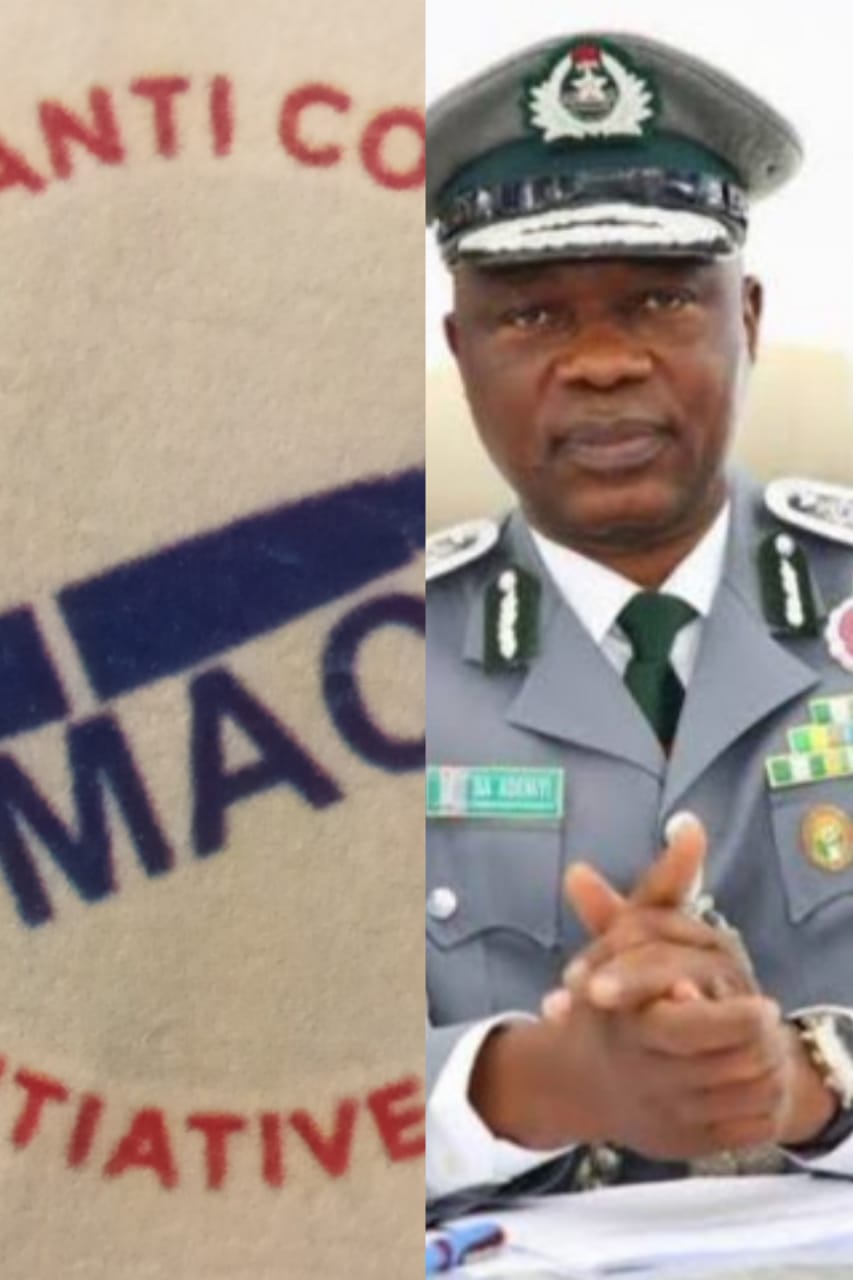
The Media Anti-Corruption Initiative (MACI) has applauded the Comptroller-General of Customs, Adewale Adeniyi, for introducing a comprehensive anti-corruption framework aimed at identifying institutional vulnerabilities, strengthening internal controls and promoting integrity across the operations of the Nigeria Customs Service (NCS).
The initiative, which MACI described as a significant milestone in the fight against corruption within the Service, is anchored on three key documents signed by the Customs chief: the Standard Operating Procedure (SOP) for Internal Corruption Risk Analysis and Mapping (ICRAM), the ICRAM Handbook and the Integrity Action Plan (IAP).
In a statement jointly signed by MACI President, Funso Olojo, and Project Coordinator, Lod Onyeji, the organisation described the development as a “pivotal moment in the fight against corruption within the Nigeria Customs Service.”
Mr Olojo, who commended the initiative of the Customs, noted that the stance of the agency on corruption is in alignment with the aims and objectives of MACI which is an advocate for corruption- free society.
The signing ceremony, held on October 6th, 2026, at the NCS Headquarters in Abuja, also witnessed the inauguration of the ICRAM Steering Committee, which is responsible for identifying, assessing and mapping corruption risks across the Service’s operations.
According to the statement, the framework represents a proactive institutional approach to tackling corruption by identifying vulnerabilities in Customs processes and establishing measures to prevent abuse of office, improve accountability and strengthen public confidence in the Service.
The Comptroller-General, Adeniyi, disclosed that the framework was developed in collaboration with the World Customs Organisation (WCO) and partner administrations, including His Majesty’s Revenue and Customs (HMRC) of the United Kingdom.
He explained that the documents provide practical guidance for Customs officers operating at seaports, land borders and airports, equipping them with procedures and controls designed to promote integrity, transparency and accountability in the discharge of their responsibilities.
MACI noted that the introduction of the framework followed a pilot programme conducted across seven Customs Commands and Units, covering 66 processes spanning regulatory activities, core Customs operations and support functions.
The exercise culminated in the development of a comprehensive Integrity Action Plan containing 101 action items and 295 sub-actions designed to address identified corruption risks and strengthen institutional safeguards.
Key measures outlined in the plan include increased automation and improved audit trails, stronger supervisory mechanisms, clearer accountability structures, effective segregation of duties, regular staff rotations and targeted training programmes.
The framework also seeks to strengthen controls governing interactions between Customs officers and stakeholders, an area considered critical to reducing opportunities for corrupt practices and improving compliance with established procedures.
MACI commended the Customs leadership for adopting a risk-based approach to corruption prevention, noting that identifying and addressing institutional weaknesses before they are exploited is essential to building a transparent and accountable public institution.
The organisation, however, stressed that the effectiveness of the initiative would ultimately depend on the consistent implementation of the prescribed measures across all commands and operational units of the Service.
It therefore urged Customs management, officers, stakeholders and relevant partner institutions to support the full implementation of the framework to ensure that the initiative delivers measurable improvements in institutional integrity.
MACI expressed confidence that effective implementation of the ICRAM framework and Integrity Action Plan would strengthen internal controls, reduce corruption risks, promote ethical conduct and enhance public trust in the Nigeria Customs Service.
The organisation emphasised that the new framework should not merely remain a collection of policy documents but should translate into tangible changes in operational practices, staff conduct and the overall culture of accountability within the Service.
Customs
FOU Zone ‘A’: Aliyu retires after ₦3.19bn revenue recovery, Afeni takes over

Gloria Odion, Maritme reporter
The Nigeria Customs Service (NCS), Federal Operations Unit (FOU) Zone ‘A’, Ikeja-Lagos, on Wednesday, 30th September 2026, welcomed Deputy Comptroller Oladapo Olukayode Afeni as the unit’s 30th Acting Comptroller, following the retirement of Comptroller Gambo Aliyu after a distinguished career in the Service.
The formal handing-over ceremony, held at the unit’s conference hall, was attended by colleagues, friends, well-wishers, senior Customs officers and other stakeholders.
Among those present were the Acting Customs Area Controllers of the Port and Terminal Multipurpose Limited (PTML), Ogun 1 Area Command, and the Enugu/Ebonyi/Anambra Area Command.
Addressing officers and stakeholders for the first time as Acting Comptroller, DC Afeni pledged to provide purposeful, professional and accountable leadership in advancing the mandate of the Nigeria Customs Service.
He expressed appreciation to the Comptroller-General of Customs, Bashir Adewale Adeniyi and the management of the Service for the confidence reposed in him.
The new Acting Comptroller said his administration would strengthen intelligence- led enforcement,tackle revenue leakages and safeguard Nigeria’s economic and security interests.
He said that enforcement operations under his leadership would remain firm, lawful and respectful of human dignity, while legitimate trade would be facilitated through constructive engagement with traders, manufacturers, importers, exporters, customs brokers and other stakeholders.
DC Afeni also called for stronger collaboration with sister security and law enforcement agencies to combat trans -border crimes, particularly the illicit movement of drugs, arms, currencies, counterfeit goods and other prohibited items across the Nigeria border.
He also pledged to prioritise officers’ welfare and professional development, strengthen institutional discipline and encourage regular sporting activities to promote physical fitness, teamwork and work-life balance among personnel.
In his handing-over address, the immediate past Comptroller, retired Comptroller Gambo Aliyu, expressed gratitude to God and the Service, describing the ceremony as an important transition in leadership and an opportunity to reflect on the responsibilities and challenges of commanding the unit.
Comptroller Aliyu said his administration persevered on combating smuggling, revenue fraud, concealment, under-declaration, false declaration and the illicit movement of prohibited goods.
The report,according to him includes, recorded 779 seizures during his tenure, involving various prohibited and illegally imported items, including:
- More than 20,900 bags of foreign parboiled rice;
- 61 used vehicles;
- Thousands of used compressors and clothing items;
- Foreign poultry products;
- 4,418 jerrycans of vegetable oil;
- 12,606 parcels of cannabis weighing 6,194.3kg;
- 2.30kg of cocaine;
- More than 3,000 jerrycans of Premium Motor Spirit (PMS), equivalent to 76,505 litres; and
- 22 elephant tusks weighing 130.84kg.
According to him, the seizures had a combined duty-paid value of ₦13,075,056,616.00.
On revenue recovery, Comptroller Aliyu disclosed that the unit recovered ₦3,192,511,547.52 between 10 December 2025 and 24 September 2026.
He said the figure represented 798 per cent of the unit’s ₦400 million annual revenue recovery target for 2026, while also recording a 776 per cent increase over the ₦411,451,901.18 recovered during the corresponding period in 2025.
Aliyu attributed the performance to strengthen risk profiling, stricter compliance checks, targeted examination of suspicious declarations, teamwork,and collaboration with sister agencies and stakeholders.
He stressed that effective enforcement required collective efforts, noting that “no enforcement agency can succeed in isolation.”
Concluding his address, the retired Comptroller congratulated his successor and expressed confidence that the new administration would build on the operational foundation already established.
He urged DC Afeni to lead with fairness, firmness, courage and sound judgment, while assuring him of the cooperation and support necessary to sustain the unit’s mandate.
Comptroller Aliyu also commended officers of the unit for their loyalty, discipline and resilience throughout his tenure.
He prayed for the success of the new leadership, the continued growth of the Nigeria Customs Service and the security and prosperity of Nigeria.
Customs
Mu’azu steps in as 33rd CAC at Apapa port as Oshoba bows out

— Vows to sustain ₦323bn monthly revenue record, end cargo delays
Funso OLOJO, Editor
Comptroller Murtala Mu’azu has assumed duty as the 33rd Customs Area Controller (CAC) of the Apapa Area Command, pledging to sustain the Command’s revenue momentum while eliminating avoidable delays in cargo clearance and strengthening trade facilitation at Nigeria’s busiest port.
Mu’azu formally took over from Comptroller Emmanuel Oshoba (rd) on Tuesday, September 29th, 2026, at a ceremony held at the Auditorium of the Apapa Area Command, Lagos, attended by senior security and regulatory officials, government agencies, terminal operators, shipping companies, customs brokers, importers, exporters and other port stakeholders.
The new Controller inherits a Command that recently posted some of the most impressive revenue figures in its history, including a record ₦323 billion monthly collection in July 2026 and a single-day collection of ₦28.102 billion on August 18, 2026.
Acknowledging the weight of the responsibility before him, Mu’azu described his appointment as “a great honour and privilege,” thanking the Comptroller-General of Customs, Bashir Adewale Adeniyi, for the confidence reposed in him.
He pledged to discharge the responsibility with “a deep sense of duty” and in line with the economic interests of the country, promising to build on the Command’s achievements in revenue generation, enforcement, trade facilitation and institutional discipline.
The new CAC said his administration would be anchored on the three strategic pillars of the Comptroller-General — consolidation, collaboration and innovation — with particular attention to revenue integrity, efficient trade facilitation, professionalism and meaningful engagement with stakeholders.
On revenue collection, Mu’azu was unequivocal, declaring that every revenue due to government must be properly assessed and collected.
“Every revenue due to government must be properly assessed and collected, and every decision taken by our officers must be capable of standing the test of scrutiny over time,” he said.
But beyond revenue, the new Controller signalled that reducing bottlenecks in cargo clearance would be a major priority of his administration.
He declared that avoidable human delays in cargo processing, which he described as “Non-Tariff Barriers”, would no longer be tolerated.
“Unnecessary human delays in cargo processing otherwise known as Non-Tariff Barriers shall not be tolerated henceforth,” Mu’azu said.
According to him, once all statutory requirements have been met, legitimate cargo should be allowed to move without unnecessary obstruction.
He consequently charged Customs officers to maintain discipline, professionalism, courtesy and decorum in their dealings with importers, exporters, customs brokers and other members of the trading public.
Mu’azu also promised to deepen collaboration with importers, exporters, licensed customs agents, shipping companies, terminal operators, the Nigerian Ports Authority and other government agencies operating within the port environment.
He said such collaboration was essential to making Apapa Port more efficient, predictable and responsive to legitimate trade.
The new CAC openly acknowledged the scale of the revenue challenge left by his predecessor, Oshoba, particularly the unprecedented figures recorded under the outgoing Controller.
“This is indeed a record to reckon with and strive towards matching same. It is therefore a Herculean task upon myself and my team to match and surpass such a record,” Mu’azu said.
He also commended Oshoba for his contributions to enforcement, trade facilitation and the implementation of key modernisation initiatives of the Nigeria Customs Service.
Among the initiatives highlighted were B’Odogwu, Advance Ruling, the Authorised Economic Operator Programme, the One-Stop Shop and Non-Intrusive Inspection technology.
The Advance Ruling programme, in particular, has been positioned as a mechanism for providing greater predictability to legitimate traders by enabling them to obtain clarity on Customs treatment before importation.
Oshoba had, in his farewell address, described Advance Ruling as an initiative that provides legitimate traders with greater predictability and clarity on Customs treatment before importation, thereby reducing uncertainty and strengthening confidence in the trading environment.
In his farewell remarks, Oshoba attributed the achievements recorded during his tenure to the collective efforts of officers, stakeholders and partners of the Command.
“The achievements recorded during my tenure do not belong to one individual. They belong to all of us,” he said.
He charged officers to sustain the standards established during his tenure, stressing that discipline, professionalism and excellence must remain central to the Command’s operations.
“Discipline must remain our foundation, professionalism our standard and excellence our aspiration,” Oshoba said.
He also appealed to officers and stakeholders to extend the same cooperation and support to his successor.
Mu’azu, in turn, called for collective ownership of the Command’s mandate, stressing that the responsibility for sustaining Apapa’s performance could not rest on the CAC alone.
“The success we seek cannot be achieved by the CAC alone. It requires our collective efforts, operational integrity and willingness to uphold the standards of the Service,” he said.
He assured stakeholders that his administration would operate an open and constructive engagement framework based on fairness, mutual respect and the national interest.
With the transition now completed, the new Apapa Customs administration faces the dual task of protecting the Command’s record-breaking revenue performance while making cargo clearance faster, more predictable and less burdened by avoidable administrative delays.
Mu’azu expressed confidence that, with the support of officers and stakeholders, Apapa Area Command would continue to serve as a model of efficient revenue administration, legitimate trade facilitation and professional Customs conduct.

 Customs3 months ago
Customs releases final recruitment list for ASC II, ends nearly one-year wait for applicants
- Headlines3 months ago
As NRC recovers ₦200m stolen railway assets, Opeifa vows diligent prosecution of suspects
- Customs3 months ago
Customs launches MIS file tracker at PTML in fresh digitalisation drive
- Customs2 months ago
Apapa Customs sets new record of monthly revenue haul with ₦323bn collection in July
- Customs2 months ago
Apapa Customs sets new single-day revenue record with ₦28.1bn collection
- Headlines1 month ago
Oyetola presents three-year score card as blue economy industry revenue hits ₦1.83trn