
Headlines
Navy seeks collaboration with NIMASA for enhanced security on Nigeria’s waters
Gloria Odion
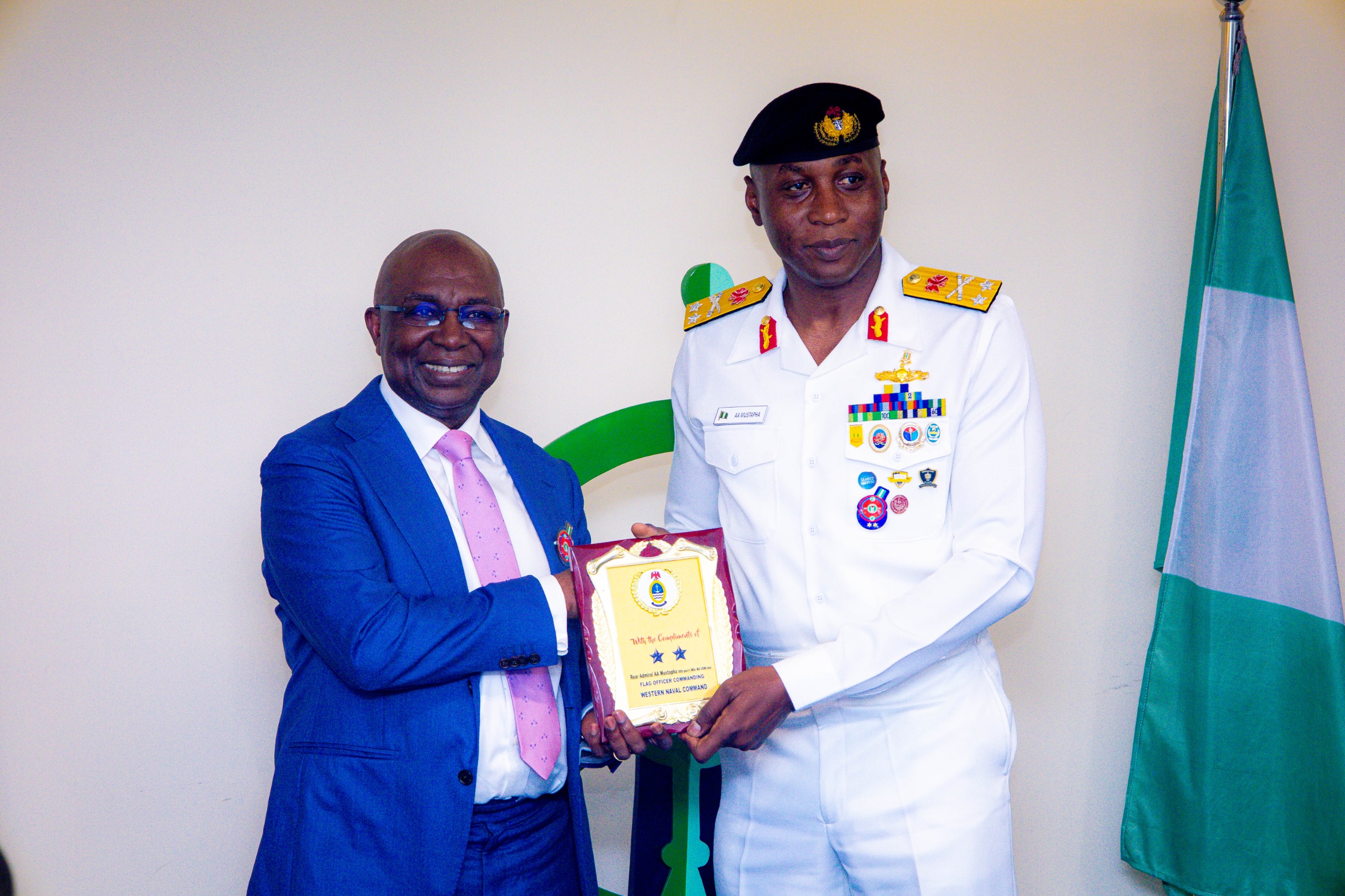
The Nigerian Navy has called for increased collaboration with the Nigerian Maritime Administration and Safety Agency, NIMASA in the area of hydrography to sustain improved safety of navigation in Nigerian waters.
The Flag Officer Commanding, Western Naval Command (FOC-WNC), Rear Admiral Abdullahi Mustapha, made this call during a familiarization visit to NIMASA Headquarters, where he also acknowledged the gains recorded from NIMASA’s longstanding partnership with the Nigerian Navy.
Rear Admiral Mustapha noted that “the longstanding and unwavering partnership NIMASA has maintained with the Nigerian Navy has culminated in the current tranquility being witnessed within the Nigerian maritime domain, and it is a clear testament to the strength of this partnership.”
The FOC West further stated that enhanced information sharing through the integration of NIMASA’s C4i Centre with the Navy’s Falcon Eye system would significantly improve security within the nation’s maritime domain.
Speaking further, Rear Admiral Mustapha said: “I would like to use this opportunity to commend NIMASA for providing and maintaining platforms under the Deep Blue Project, which are operated by the Nigerian Navy. This has greatly enhanced our operations.”
He added that the two newly acquired hydrographic vessels, with the capability to identify the exact location and size of wrecks, would significantly enhance NIMASA’s operations in wreck removal.
According to him, “Utilizing advanced vessels such as NNS Lana and NNS Ochuzor has undoubtedly contributed to improved safety standards within the maritime sector.
“It is therefore important that we jointly sustain these standards through deeper collaboration with NIMASA.”
In his response, the DG/CEO NIMASA, Dr. Dayo Mobereola, described the improved security in Nigeria’s territorial waters as the backbone of President Bola Tinubu administration’s economic diversification policy.
According to him, “the maritime sector is at the forefront of President Tinubu’s Renewed Hope Agenda as well as the Federal Government’s economic diversification policy and it is our shared obligation (NIMASA and the Navy) to deliver a safe and secure maritime space for maritime activities to thrive.
” Accordingly, achieving optimum security levels in our maritime area is the backbone of these aims and is what gives shipping companies the confidence to invest in the sector”.
The NIMASA DG also acknowledged the support of the Honourable Minister of Marine and Blue Economy, Adegboyega Oyetola, noting that his unwavering commitment to the development of the Blue Economy sector has continued to yield results.

Headlines
National Assembly spurns opposition against Tantita’s pipelines surveillance contract

Headlines
NSW team acknowledges challenges, assures of better days ahead

— pledges to waive demurrage on containers caught in system glitches
Funso OLOJO, Editor
The Nigerian Revenue Service (NRS), the Nigeria Customs Service (NCS), and the Presidential Enabling Business Environment Council (PEBEC) on Tuesday conducted an assessment visit to the National Single Window (NSW) office in Apapa, Lagos, to evaluate progress, identify challenges, and chart a path forward for the newly launched trade facilitation platform.
NRS Chairman ,Dr. Zacch Adedeji, acknowledged President Bola Tinubu’s role in finally bringing the long-elusive project to fruition after multiple failed attempts of the past.
While reacting to concerns about teething problems raised by stakeholders, Dr Adedeji assured that the government would cushion the financial impact on traders grappling with initial operational difficulties.
“This is a special period. We will engage terminal operators and relevant stakeholders to ensure that demurrage charges are waived on affected containers,” Adedeji assured.
He attributed some of the delays to the complexities of migrating data from the old system, noting that not all transactions had been affected.
“When you have people that have delay, it is a certain percentage of the overall, some are smooth.
“The reason for that is migration from the old system. Imagine when you have the master manifest, you’ve shipped one in the old system and the other one is here,” he explained.
Adedeji also expressed appreciation for the broad acceptance the platform has received across the trade community.
“I thank Nigerians, because the success is just the adoption. If you look at it, you’ve not seen anyone say, no, this is not what we want to do, or this is what we want to do.
“So we thank Nigeria, we thank Mr. President,” he said.
On the teething challenges that have accompanied the rollout, Adedeji urged stakeholders not to lose heart.
“When you have a project of this magnitude, definitely you experience hitches. But if you look at where we’re coming from, there cannot be demoralizing.
“Instead of submitting cargo documents in 10 to 15 places, stakeholders are now submitting in one place.
“And even if you have delay, it is far, far less than going to seven places,” he said.
Comptroller-General of Customs, Bashir Adewale Adeniyi, described the visit as a working review of the system’s performance since launch and reaffirmed the service’s commitment to seeing it succeed.
“We are here to see what progress we’ve recorded, what challenges there have been, and what do we do moving forward to ensure that we get over those challenges,” he said.
Adeniyi was unequivocal about the long-term significance of the platform, saying that “National Single Window is here to stay.
“It will revolutionise the trading environment for good. It will definitely deliver benefits to the Nigerian economy, to make our trade environment more competitive.
“It will increase trade facilitation, no doubt about that. Of course, it will impact our economy,”
He acknowledged that glitches were to be expected with a deployment of such scale, adding that the team had been proactively addressing them.
“We’ve been experiencing those glitches, and we’ve been working together as a team under the National Single Window to confront those challenges and to ensure that we get over them and we move on.
“Initially, we had issues with uploading manifests from DHL. We got over that. We had issues with the shipping company. We got over that.
“Training is going on. There has been stakeholder acceptance, buy-in by all of them. You could see here that they are also undergoing those training programs,” he said.
Drawing on the experience with the Customs B’Odogwu platform, Adeniyi expressed confidence that the NSW team would overcome its current challenges faster, noting that similar complaints raised at the time of the B’Odogwu launch had since been put to rest.
PEBEC Director-General ,Zahrah Mustapha Audu, framed the NSW within the broader ease-of-doing-business agenda, describing it as a welcome solution for businesses engaged in import and export trade.
She acknowledged that software-related teething problems were inevitable but argued that the direction of travel was clearly positive.
“Yes, we will have teething problems because it’s a software, but something that is noteworthy is the fact that technology is constantly evolving.
“So as such, it’s good for us to get on board and to move with the trends. I see this as definitely progress for Nigeria,” she said.
Audu was optimistic about the prospect of achieving the administration’s cargo dwell time target.
“We started 2026 with the vision of reducing cargo dwell time to less than seven days. At this point, I’m becoming very optimistic because we’re in April.
“The system has been deployed. So hopefully, maybe we can even reduce it to three to four days, who knows, with the right political will, with the right determination, as well as cooperation from all the sister agencies who are involved in this process,” she said.
She pledged PEBEC’s continued collaboration with businesses across all sectors to ensure that government policies deliver tangible results, and congratulated the NSW team on the progress recorded so far.
Headlines
UN-POLAC appoints Prince Shittu as International peace advocate

-

 Headlines3 months ago
Ayobo residents protest deplorable road at LCDA, complain of 10- year neglect by successive local council administrations.
-

 Headlines2 months ago
FIFA sends Nigeria’s Super Eagles to 2026 World Cup, awards boardroom scoreline of 3 goals to nil against DR Congo
-

 Customs3 months ago
Tinubu pays glowing tribute to Adeniyi, CGC, at 60
-
 Headlines3 months ago
NIWA, LASWA reopen Ikorodu ferry terminal after completion of water hyacinth removal
-

 Headlines2 months ago
NANTA holds zonal elections in February amidst golden jubilee celebration
-
 Headlines3 months ago
Oyetola laments surge in waterways accidents.