Connect with us

Headlines

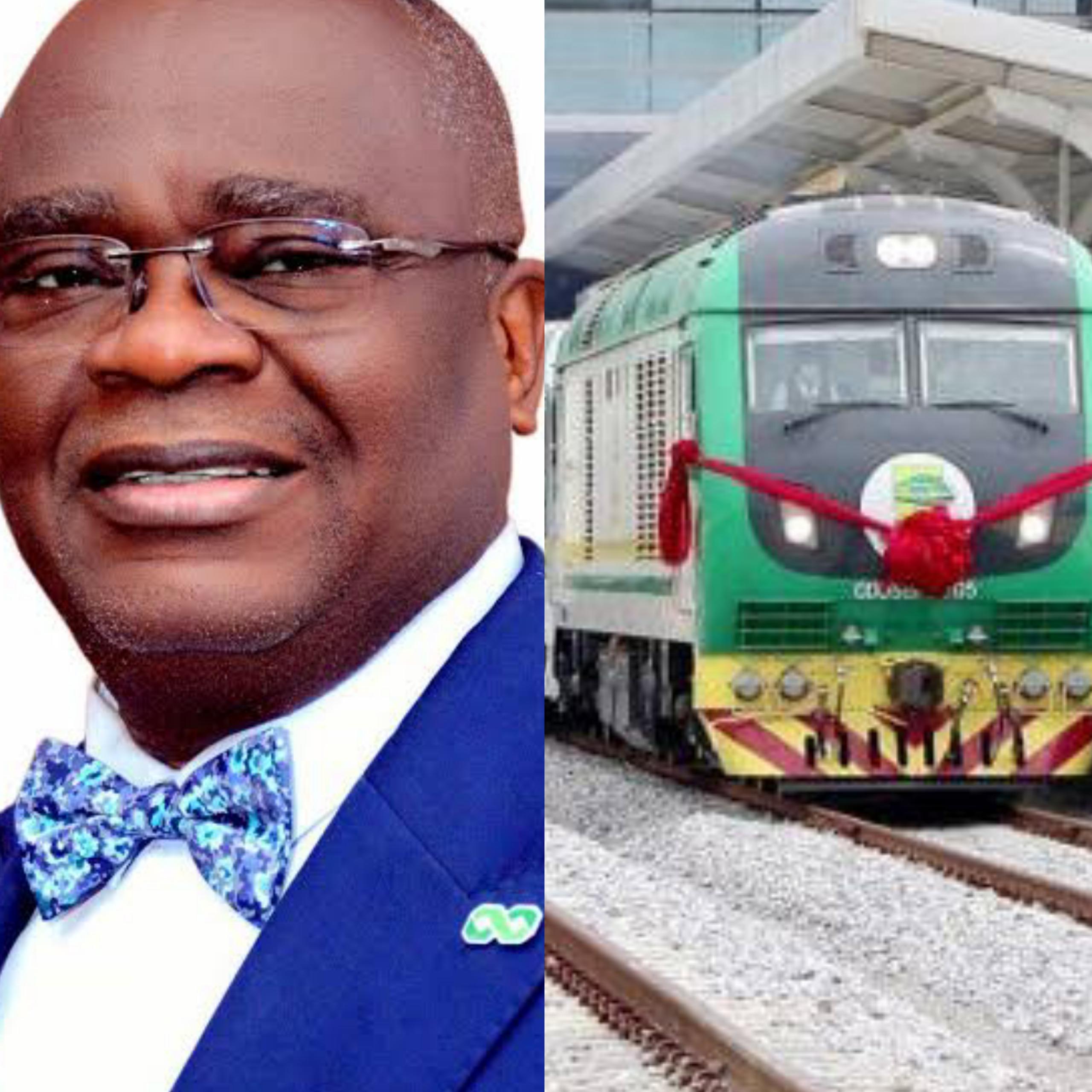
NRC plans to adopt use of natural gas for train operations .
— listed among 10 revenue earners for federal government.
Gloria Odion
The management of the Nigerian Railway Corporation (NRC) has concluded plans to adopt the use of Liquidfied Natural Gas(LNG) to power its locomotives.
The plan, according to the NRC, expected to cut costs of operations and enhance clean environment.
Dr Kayode Opeifa, the Managing Director of NRC who disclosed this in an interview, revealed that the Corporation has successfully demonstrated this technology for one month , signalling a major step toward cleaner, more efficient rail operations.
He disclosed that Lagos–Ibadan and Warri–Itakpe  will be used as the pilot routes for the new technology.
“We have completed the LNG prove of concept and demonstrated it for one month.
“As soon as we get gas systems to the Lagos–Ibadan and Warri–Itakpe corridors, where gas is readily available, and resolve all regulatory issues, we will use gas to generate electricity to power the trains,” Opeifa declared.
Opeifa noted that adopting LNG aligns with Nigeria’s gas expansion agenda and will significantly cut operating costs while improving energy security for the rail sector.
Meanwhile, the NRC boss claimed that the Corporation has been listed amongst the top 10 contributors to Nigeria’s Gross Domestic Product (GDP) in the year 2025.
Quoting the National Bureau of Statistics (NBS) latest report for 2025, Dr Opeifa said the corporation came tops among revenue generating Federal MDAs that is contributing to the growth of the nation’s GDP.
Opeifa however listed vandalism, washouts and poor funding as the biggest challenge of the corporation in the outgone year, insisting that though the Federal Government has been very magnanimous in giving the NRC more than it generates, yet, more funding, he said ,is needed to enable the corporation operate optimally.
The NRC MD,who disclosed that both the narrow and standard gauge are working in Nigeria, said plans are on to embark on aggressive recovery of locomotives, wagons and other rolling stocks in order to improve on rail efficiency.
Opeifa also outlined an ambitious expansion plan for the national rail network.
 He noted that the corporation would soon unveil its national rail roadmap to expand the national rail network from about 4,000 to 10,000 kilometres over the next five years.
According to him, Nigeria currently has about 4,000 kilometres of rail tracks, but the target is to reach 10,000 kilometres within the next five years and about 20,000 kilometres in the next 20 years.
“In the next five years, we hope to double the length of tracks to about 10,000 kilometres. By another 10 years after that, we want to move Nigeria to about 20,000 kilometres of rail lines,” he said.
He stressed that achieving these targets will require substantial private-sector participation, adding that government budgets alone cannot fund the scale of investment required for the rail sector.
“Our doors are open to the private sector for concessioning and other partnerships.
” The government is willing to provide sovereign guarantees for railway investments as is done globally. The rail system is open because our budget alone cannot fund it,” he said.
He revealed that despite security concerns, the rail has continued to move, lauding the team of railway engineers and other artisans whose expertise have continued to sustain railway operations across the country.
 He urged for community ownership of railway assets as the only deterrence to vandalization adding that while the corporation, assisted by the security operatives would continue to fine tune the security architecture, there is need for community ownership, especially along the Warri-Itakpe axis, where he lamented that the corporation have had to replace every inch of the kilometer of train tracks due to the activities of vandals on the route.
Looking ahead, Opeifa said the NRC is introducing digital systems and planning major network expansions, including the completion of the Lagos–Kano line, the Port Harcourt–Maiduguri corridor, and the linking of Ajaokuta to Abuja to enable seamless travel from the Southern part of Nigeria to the North.
The NRC, he added, is collaborating with several state governments, including Lagos, Zamfara, Plateau, Niger and Ogun, to boost the use of rail assets adding that the corporation would be willing to work with partners, including state and the private sector.
Already, some private operators are already taking advantage of new opportunities in the sector, he said.
“We now have private sector operators getting licences to run on our tracks.
” About 28 logistics companies including the CCEC Nigeria Limited, are already licensed to move goods from Apapa Port either to Oyingbo, or Papalanto, Kajola, Omi Adio and Moniya, and Osogbo.
“If you have the resources to bring in locomotives and rolling stock, we will give you access to our tracks at no extra charge because we know that once the tracks are in use, the economy benefits,” Opeifa said.
Opeifa, who described what he met a year ago as a railway that was under the Intensive Care Unit (ICU), added that with the cooperation of the workers, the railway has moved out of the ICU and is now ready to fly.
He added that the corporation has revived investor’s confidence and interest in the rail sector, noting that several licences have already been taken up in recent weeks, a development he described as a vote of confidence in Nigeria’s evolving rail future.
Continue Reading
Click to comment

Leave a Reply

Your email address will not be published. Required fields are marked *

Customs

CBN, not Customs determines exchange rate figures for import, export trade

—Customs clarifies amidst wrong public perception 
Gloria Odion 
The Nigeria Customs Service (NCS) has made a public clarification of the exchange rates that govern the payment of duties on imports and other valuation processes.
In a statement made available to our reporter, the Service said it does not determine, modify, or apply margins to foreign exchange rates used for import and export valuation.
According to the Service, all rates used on the B’Odogwu platform are officially provided by the Central Bank of Nigeria (CBN), which is the statutory authority responsible for exchange rate determination under Nigeria’s monetary framework.
“These rates are transmitted electronically and applied automatically across all Customs formations, ensuring transparency, consistency, and compliance with national fiscal and monetary policies.
‎”The B’Odogwu system is designed to receive and apply exchange rate data exactly as supplied by the CBN.
“It does not generate or alter rates at any time.
“In situations where there is a delay or change in data transmission format, the system retains the last valid CBN rate until a new update is successfully received, thereby maintaining accuracy and operational continuity.
“As part of ongoing improvements, the NCS is working with the CBN to introduce seamless API-based integration to further enhance real-time transmission, reliability, and system resilience.
‎”The Service also clarifies that the exchange rate of ₦1,451.63/US$ reported for 6 February 2026 did not originate from the B’Odogwu system.
“That figure came from trade.gov.ng, a legacy trade information portal that does not reflect live Customs processing data.
“Similarly, the National Integrated Customs Information System (NICIS) is not used for real-time valuation and is not recognised as a live Customs processing platform.
“The NCS therefore reiterates that the only authorised platform for Customs declarations, clearance, and valuation is https://bodogwu.customs.gov.ng,  which receives exchange rates directly from the Central Bank of Nigeria.
‎”For the record, the exchange rate applied for Customs valuation on 6 February 2026 was ₦1,365.56 per US Dollar, as officially communicated by the Central Bank of Nigeria.
“All subsequent rates used by the Service have followed the same process, reflecting only the official figures transmitted by the CBN and automatically implemented through the B’Odogwu system.
‎”The Nigeria Customs Service remains committed to transparency, consistency, and the facilitation of legitimate trade while ensuring full compliance with national fiscal and monetary policies.
“The Service assures stakeholders  including the trading community, licensed customs agents, and international partners  that its clearance and valuation processes remain accurate, predictable, and aligned with statutory requirements and global best practices.
“The NCS will continue to strengthen its systems, uphold operational integrity, and support Nigeria’s economic growth through efficient and accountable Customs administration” the NCS concluded in its statement.
Continue Reading

Customs

Customs eyes N9 trillion revenue in 2026

Funso OLOJO,Editor 

 The Nigeria Customs Service has set an ambitious revenue target of a whooping sum of N9 trillion for 2026.

The revenue projection, which is still awaiting the final confirmation by the National Assembly, is contingent upon the massive reforms and digitalization of Customs operations which the service believes will lead to trade facilitation and higher revenue yield.

It could be recalled that the NCS exceeded its 6 trillion revenue target for 2025 by 11 percent.

However, the joint Appropriation Committees of the National Assembly may still set a higher target for the Service at its next seating.
It could be recalled that the joint committees of both the House of Representatives and the Senate last year increased the revenue target of the Service for 2025 from 6 trillion to 12 trillion, arguing that the Service had the capacity to achieve the homonguous revenue figures.
Meanwhile , the Comptroller- General of Customs, Adewale Adeniyi, disclosed that the Service raked in more than ₦100 billion in 2025 from traders who voluntarily returned to regularise their underpaid duties after reviewing their records.

He described the development as unprecedented and a trend he vowed that the Service would sustain in 2026 and beyond

Adeniyi also disclosed that the Service exceeded its 2025 revenue target by about 11 per cent, based on an easier and more predictable trade process, which has boosted turnover and encouraged voluntary compliance among importers, exporters, clearing agents, and freight forwarders operating at the ports and border stations.

On border operations, Adeniyi confirmed the reopening of the Seme Border, describing it as strategic to Nigeria’s role as a regional transit corridor.

He said the decision followed engagements among authorities in the Federal Republic of Nigeria, the Republic of Benin, and consultations involving Niger, leading to approval for transit cargo movements along the Kébé route.

The CGC  said the country was meeting its obligations to support landlocked countries by allowing transit goods to move to destinations such as Chad and Cameroon, while stressing that tighter technological controls would be deployed to ensure such consignments are not diverted into the domestic market.

Adeniyi assured that transit operations from major seaports, including Apapa Port and Tin Can Island Port, would continue with enhanced monitoring to generate more revenue and boost the security of the country.

The CGC pledged that the 2026 strategy will focus on sustained trade facilitation, deeper use of technology for risk management and cargo tracking, and stronger partnerships with the trading community, expressing confidence that the measures will support the revenue target and strengthen Nigeria’s position as a regional trade hub in West and Central Africa.

Continue Reading

Headlines

FIFA sends Nigeria’s Super Eagles to 2026 World Cup, awards boardroom scoreline of 3 goals to nil against DR Congo 

Funso OLOJO, Editor 
The world Cup ticket which Nigeria’s Super Eagles failed to secure on the field of play have been delivered in FIFA’s boardroom in Zurich, Switzerland.
This followed a decisive verdict in the eligibility dispute between Nigeria and the Democratic Republic of Congo, as the World football governing body overturned the playoff result and awarded qualification to the Super Eagles for the 2026 World Cup.

The ruling was handed down by the FIFA Disciplinary Committee following a formal protest lodged by the Nigeria Football Federation (NFF) against the Congolese Association Football Federation (FECOFA).At the heart of the matter was the Best Losers Playoff match in the African qualifiers for the 2026 FIFA World Cup.

 DR Congo had originally secured a 2–1 victory over Nigeria, seemingly clinching the final qualification slot.

However, Nigeria challenged the outcome, alleging that a DR Congo player — identified in proceedings as Player X — was ineligible to feature in the decisive encounter due to an incomplete nationality switch process.

After reviewing official match documentation, player registration records, and correspondence between FECOFA and FIFA’s Players’ Status Department, the Disciplinary Committee established that the player had previously represented another national association at youth level.

Under FIFA regulations governing player eligibility, any footballer seeking to change national association must formally apply for the switch, receive written approval from FIFA, and obtain official confirmation before participating in any senior “A” international match.

The Committee found that although Player X had initiated the process, formal approval had not been granted before the playoff fixture.

 Crucially, no provisional clearance had been issued to permit temporary participation.

Citing Article 9 of the Regulations Governing the Application of the FIFA Statutes and Article 21 of the FIFA Disciplinary Code, the Committee ruled that DR Congo fielded an ineligible player in an official competitive match.

In line with the regulations, the match has been declared forfeited.

The result has been officially recorded as DR Congo 0–3 Nigeria.

Consequently, Nigeria has been proclaimed winner of the Best Losers Playoff Round and awarded qualification to represent Africa at the 2026 FIFA World Cup.The decision marks a major boost for Nigerian football and underscores FIFA’s strict stance on eligibility compliance, particularly in high-stakes fixtures that determine World Cup participation.

While DR Congo has been disqualified from the playoff pathway, the federation retains the right to appeal the ruling before the FIFA Appeals Committee.

In its closing observations, the Committee stressed that strict adherence to nationality switch procedures is vital to maintaining fairness and integrity in international football, warning that administrative processes still in progress do not justify participation without formal approval.

Continue Reading

Trending