
Economy
Price of 12.5kg cooking gas soars to N8,500

—-as marketers warn it may hit N10,000 by December
The price of the 12.5 kilogramme of Liquefied Petroleum Gas,( LPG) or cooking gas, has continued to soar in an unprecedented manner as it has now hit N8,500 in many parts of the country.
This was despite the Federal Government’s plan to make the product appealing to the common man.
The government earlier this year launched the National Gas Expansion Programme,( NGEP,) to drive increased utilisation of gas as a better alternative for petroleum fuel for homes, industries and automobiles.
The 12kg of LPG sold for N7,000 in September and below N4,000 last year.
The high price of the product since about three months ago is caused by a supply gap following a drop in importation as the government imposed an import tax on cargo arriving in the country.
Of the 1.2 million metric tonnes, MT, of the product required for consumption in the country, the Nigeria LNG Limited, NLNG, supplies about 450,000MT while independent marketers supply 750,000MT through imports.
The Federal Government’s GEP was designed to make gas more attractive and accessible to the masses, thereby increasing its usage for cooking, transportation, and in industries.
However, despite this plan, prices of cooking gas have kept soaring in recent months, from about N3,500 last December to between N8,000 and N8,500 as at October, this month.
Investigations showed that the landing cost of the product has since skyrocketed as a result of a recent crisis in the foreign exchange market and the imposition of a new tax.
The Petroleum Products Pricing Regulatory Agency, (PPPRA), said out of the 85,264.80MT of LPG consumed in the country in August, 38,040.46MT were imported.
This puts the level of importation at 55.39 per cent versus 44.61 per cent supplied locally.
Further data showed that 21,606.30MT was imported from the United States, while 13,044.266 was imported from Algeria and 12,573.779MT was brought in from Equatorial Guinea.
Recent reports had marketers warning that the price of 12.5kg of the product could hit N10,000 by December if pending concerns were not addressed.
Marketers have debunked inflating prices, passing the buck of rising prices to the NLNG.
On the other hand, the NLNG claimed that marketers lacked enough infrastructure to take up its cooking gas supply, a claim also refuted by the marketers.
The Marketing Manager, NLNG, Austin Ogbogbo, had said: “NLNG has grown its capacity from 50,000 metric tonnes per annum to 450,000 metric tonnes per annum of LPG in the past 14 years.
“Nigeria needs 1.2 million metric tonnes per annum, but even the 450,000 we produce cannot be absorbed by the market’s current infrastructure.”
When asked if the NLNG’s position was true, the National Chairman, Liquefied Petroleum Gas Retailers Association of Nigeria, Michael Umudu, replied in the negative.
He said: “Marketers have the capacity to absorb the 1.2 million metric tonnes annually and this figure will continue to increase.
“Marketers have the capacity; rather, the challenges of the NLNG have to do with logistics. Many depots use to be empty for months; so, why should they say marketers don’t have capacity?”
According to Ubuntu, storage of cooking gas does not end in the midstream facilities, with inland facilities such as gas plants and retail outlets having more storage capacities.
“This is how it works: LPG is discharged in a depot, and LPG trucks are ready to load products to plants. From the plants, retailers refill their cylinders and store in their shops while end-users buy.
“This means that a depot of 5,000MT storage capacity can do a turnover of 15,000MT a month or even more. So, looking at the estimated 1.2 million MT yearly demand, it shows that if NLNG supplies only 100,000MT a month, then the 1.2 million MT target is met,” he said.

He added: “If the depot of 5,000MT storage capacity can do 15,000MT a month, then calculating other depots with even much more capacities and multiplying by three for a month turnover, you will realise that these depots would do up to 150,000MT monthly.
“And going by the 1.2 million MT annual consumption demand, we only consume about 100,000MT a month. So why should NLNG say there is not enough storage?”
The gas retailers’ chairman noted that the NLNG or any other supplier did not need to supply the annual need at once, adding that this was why he called for the improvement of logistics by the LPG producer.
“With respect to logistics, if they (NLNG) can adapt to compatible vessels and engage enough of the vessels, then more than 1.2 million MT annual estimate would be conveniently met,” Umudu added.
Reacting to the position of the marketers, the spokesperson of the NLNG, Eyono Fatayi-Williams, said the gas firm could only give 450,000MT at the moment to the domestic market.
She also observed that there were challenges with logistics, such as the delay of vessels at the Lagos port, but stressed that the NLNG was doing its best to deliver its part in the supply of cooking gas.
She explained that in 2007, Nigeria could only produce 50,000MT of LPG and that the NLNG was asked to intervene, stressing that the gas firm was primarily set up for export.
“Between 2007 and now, because we have guaranteed supply, the market has grown. Today, Nigeria can take over one million tonnes of cooking gas,” Fatayi-William said.
She added: “The maximum production we have of cooking gas is 450,000 metric tonnes annually and the market did over a million metric tonnes last year.
“Also, when we talk about logistics, the maximum amount we can now give, which is the maximum production volume, is less than what the entire country needs. We are not the only producer of LPG but we can only give 450,000MT.”

Economy
News Alert! Tinubu sacks Wale Edun as Finance Minister in cabinet reshuffle, appoints Taiwo Oyedele as replacement

Secretary to the Government of the Federation, George Akume.According to the memo, Taiwo Oyedele has been appointed as the new Minister of Finance and Coordinating Minister of the Economy.
The memo directed the outgoing ministers to complete handover processes to their respective successors or supervising officials.It stated that all handing over and taking over activities must be concluded on or before the close of business on Thursday, 23rd April, 2026.
Explaining the decision, Akume said the changes were aimed at improving coordination and strengthening delivery across key sectors of the economy under the Renewed Hope Agenda.
“These changes are aimed at strengthening cohesion, synergy in governance as well as achieving more impactful delivery on the economy to Nigerians, through the Renewed Hope Agenda,” Akume stated.
He added that President Tinubu acted in line with his constitutional powers as provided under Sections 147 and 148 of the 1999 Constitution (as amended).
The SGF also conveyed the President’s appreciation to the outgoing ministers for their service to the nation and wished them well in their future endeavours, noting that the process of cabinet reinvigoration would remain continuous.
The statement further noted that Taiwo Oyedele was appointed as Minister of State for Finance in March 2026, while Edun was among the ministers appointed on August 16, 2023.
Economy
Tinubu assents to 2026 Appropriation bill , extends 2025 budget implementation

Economy
NNPC attributes increased crude oil production to enhanced security surveillance of pipelines in Niger- Delta
Funso OLOJO, Editor
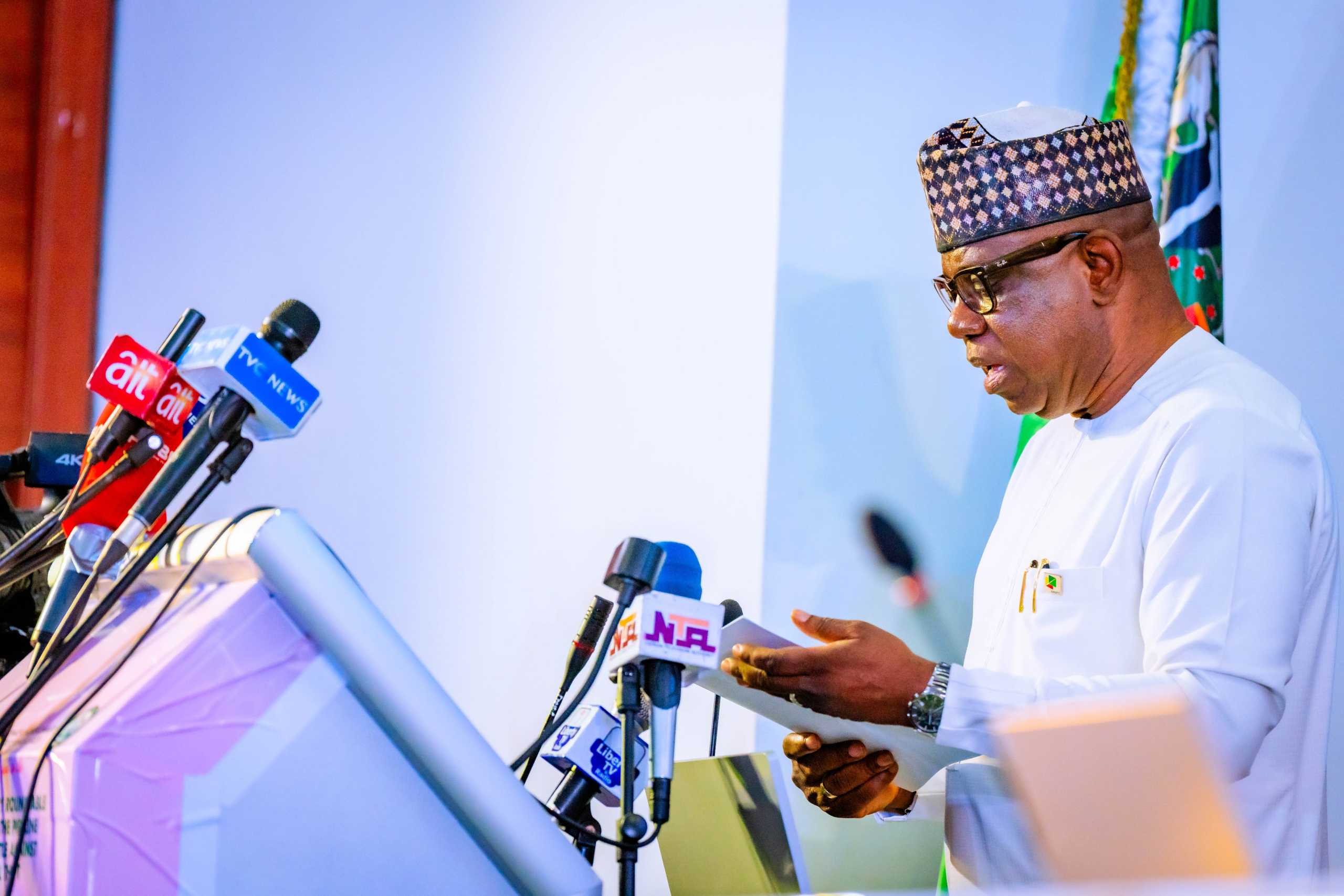
The Nigerian National Petroleum Company Limited (NNPC) has confirmed that national crude oil production has grown from a historic low of 960,000 barrels per day in 2022 to an average of 1.71 million barrels per day and a peak production of 1.84 million barrels per day in 2025, owing to the establishment of the integrated energy security for pipelines in the Niger Delta.
Group Chief Executive Officer of NNPC Ltd, Engr. Bashir Bayo Ojulari, made the disclosure at the Parliamentary Roundtable on the State of Pipelines Security which held at the National Assembly, in Abuja, on Wednesday, April 8th, 2026.
Speaking on the success of the security arrangement, Ojulari explained that it was not accidental, and that it involved an “integrated energy security model that combines legislative and executive policy alignment, actionable intelligence, kinetic deployment capabilities, regulatory oversight, industry cooperation, and community‑embedded surveillance mechanisms”.
He said the resurgence of production due to the effective tackling of the twin menace of oil theft and pervasive pipeline sabotage has led to the restoration of investors’ confidence in the nation’s oil and gas sector.
In his welcome address, the President of the Senate, Sen. Godswill Akpabio, represented by Senator Jimoh Ibrahim, called for collaboration among agencies and stakeholders in resolving all challenges impeding production growth.
On his part, the Speaker of the House of Representatives, who was represented by the Leader of the House, Hon. (Prof.) Julius Ihonvbere, urged the forum to evaluate the progress made so far with a view to ensuring fairness and equity.
The Parliamentary Roundtable on the State of Pipelines Security was convened by the Joint Senate and House of Representatives Committee on Petroleum Resources.
It had in attendance the Senate President, Speaker of the House of Representatives, National Security Adviser, Minister of Defence, and representatives of oil industry regulatory agencies.
The Roundtable also featured presentations by the Chief of Defence Staff, Inspector General of Police, Director General of the Department of State Services, Commandant General of the Nigerian Security and Civil Defense Corps, and private security companies.
-

 Headlines3 months ago
FIFA sends Nigeria’s Super Eagles to 2026 World Cup, awards boardroom scoreline of 3 goals to nil against DR Congo
-

 Aviation3 months ago
Why we increased cargo tariff at Airports– FAAN
-
 Aviation3 months ago
Tension de-escalates at Lagos Airport as FAAN, Cargo agents reach truce over new tariff
-

 Aviation3 months ago
Freight forwarders warn FAAN’s new charges regime could cripple airport operations
-
Aviation3 months ago
FAAN, freight forwarders in stand- off over new tariff regime at Lagos Airport
-

 Business3 months ago
National Single Window goes live in March, 2026