…calls for synergy between training institutions and govt.
The Eyewitness reporter
The natural ocean resources that Nigeria is blessed with is capable of lifting it out of the woods into prosperity if properly harnessed, the Proprietor/Chief Executive Officer, the Certified Institute of Shipping Nigeria (CISN), Prof. Alexander Favour Okwuashi, has said.
Speaking at the 23rd convocation ceremony of the institute, Prof. Okwuashi stated that the Blue Economy, which is the totality of maritime resources, is capable of generating a whopping $53 billion annually for Nigeria and 20 million jobs for the teeming Nigerian youths.
Expounding on the benefits of the Blue Economy, the CISN founder said it is capable of creating opportunities of
up to 200 million jobs for the entire African Region.
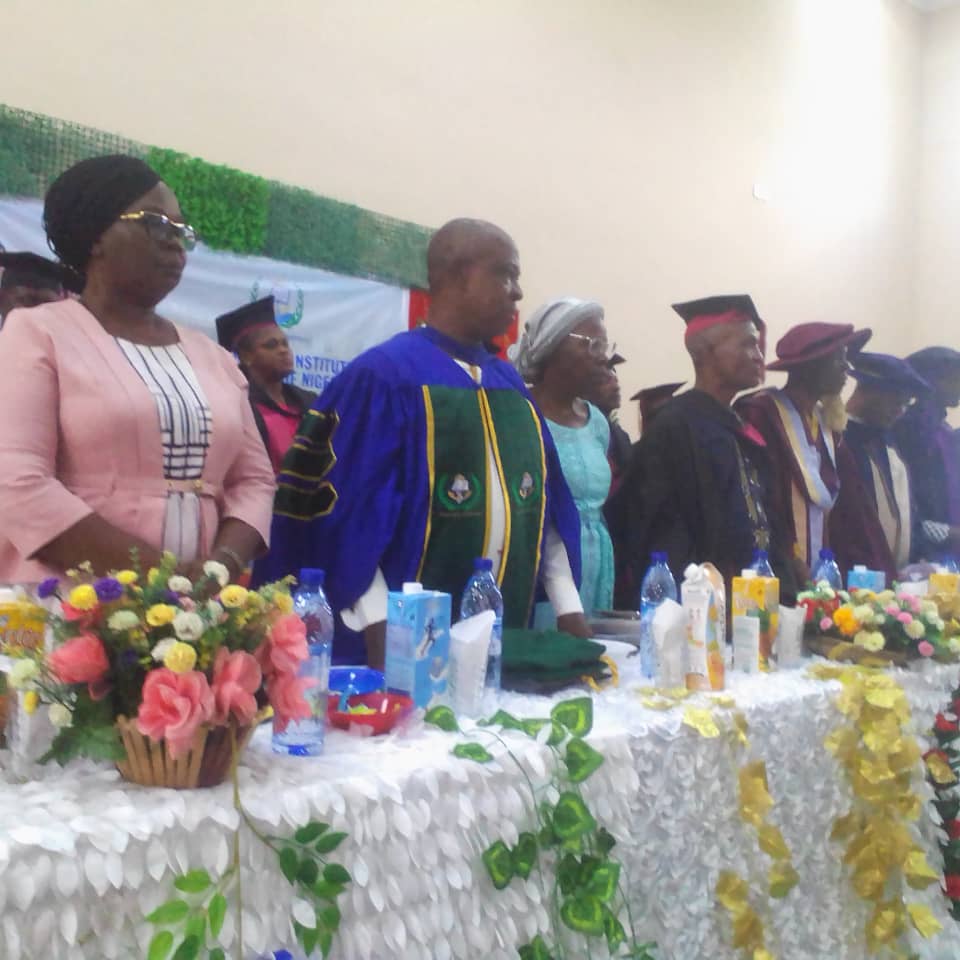
The CISN 23rd Convocation investiture and award ceremony was held at the Princess Vicky Haastrup Multipurpose Auditorium, CISN main campus, Badagry Expressway, Lagos.
The theme of the event is “TRAINING AND RETRAINING OF MARITIME TRANSPORT WORKFORCE TO HARNESS THE GAINS OF THE BLUE SEA AND RELATED ECONOMY.”
Okwuashi averred that the Blue Economy has created big opportunities within the maritime Industry and harped on the need for investments in all areas of the industry.
Highlighting further the gains of the Blue Economy, Okwuashi stated that exploring it in the area of intracity transport will take the stress off the people.
For instance, he said it will take about three to four hours from Badagry to get to Apapa by road but if the waterway is used, it can’t take 45 minutes to get to Apapa. “Those of you going to Lagos from Badagry. From Ibiye, from Agbara to Lagos, under one hour you are there. It takes away the stress, there will be no go-slow. You are not going to suffer any kind of stress as a result of getting involved in it. You will enjoy the marine ecosystem,” he explained.
The CEO of CIS also remarked that there is a lot of job opportunities in fishing, wondering why the majority of Nigerians are afraid of the sea.
He said, however, that when people come to CISN, they will be able to conquer the fear of shipping or the fear of sailing, which is an advantage for enrolling in the institute.
Okwuashi lamented that a lot of fish eaten in Nigeria are shipped to the country by the Russians and the Indians.
He declared that there are a lot of fishes between Badagry and Bakassi Penisula but Nigerians pay millions and hundreds of thousands of dollars to foreigners to buy fish.
“Between Badagry and Bakassi Penisula, there are a lot of fishes. If we can do something from Badagry here to Bakassi Penisula we will not be importing fish. We have a lot to gain and I call on people to invest in fishing to harness the benefits of the Blue Economy,” he stated.
He decried the failure of the Nigerian government and Nigerians to discover and harness the benefits of the shipping market, saying that it is painful that Nigeria with her oil does not have a single carrier to lift it.
“Nigeria is an oil-rich nation but until this moment it pains that we don’t have a crude carrier. How can a country that is an oil-rich nation not have a product carrier? The resources that suppose to come back to this nation to build infrastructure are being taken by foreigners because these large crude carriers that come to take the crude away charge $120 per barrel or tonne. If this thing continues, when will you have resources to buy your own tankers, to build or own infrastructure?” he asked rhetorically.
Presenting his paper, the Head of the Department, Marine Engineering and Technology, Mr. Ifeanyi Innocent Okafor, noted that “over the past 10 years, the maritime industry has seen a steady decline in personnel due to myriad factors, including retirement, career changes, and hiring and funding challenges. According to him, as a result, an inordinate amount of institutional knowledge has disappeared from the maritime sector.
“Over time, the knowledge that has been useful gradually loses close ties to practice as it becomes more tightly integrated with a body of scientific knowledge – a process that is known as ‘academic drift,” Okafor stated.
He opined that monitoring academic drift is critical to ensuring the skills of Maritime professionals are aligned with the changing needs of the industry.
He, therefore, said Maritime Education and Training (MET) must evolve to provide training and re-training that is relevant to practice.”
“While components of the Blue Economy may vary from country to country, depending on how it’s ocean fresh water, as well as coastal resource endowments, a Blue Economy is generally understood to consist of, and include fisheries, coastal tourism, marine transport, offshore renewable energy, marine-based blue economy, Marine mineral resources, waste management, climate change of blue biotechnology,” he stated.
The lecturer pointed out that the oceans, the seas and freshwater ecosystems which form the basis of the blue economy are under serious threat.
According to him, “The oceans, seas, and freshwater ecosystems which form the basis of the blue economy are under serious threats from degradation due to human activities including coastal developments pollution, especially from plastic as well as deteriorating fish sticks due to overfishing. Given the potential contribution of the Blue Economy, the sustainable management of oceans, seas, and freshwater ecosystems including them in a healthy and productive state cannot be to.”
For Nigeria to be placed on the world map of the best Blue Economic nations, Okafor called for synergy between training institutions in the maritime sector, especially CISN with Nigerian Maritime Administration and Safety Agency (NIMASA), Nigerian Ports Authority (NPA), Nigerian Shippers Council (NSC) and the key private sector players.



 Headlines3 months ago
 Aviation3 months ago

 Aviation3 months ago
 Business3 months ago