
Maritime
The choking grip of foreign Shipping Companies on Nigeria’s Maritime Industry

John Johnson
Due to gross maladministration, policy somersault, pettiness, pecuniary considerations, official corruption and ineptitude, Nigeria has inadvertedly ceded the control of her vast shipping fortunes to the rapacious foreign shipping companies.
Despite her huge coastal attributes and opportunities that it is naturally endowed with, Nigeria has no control over her shipping industry which is being gleefully exploited and feasted on by the domineering foreigners.
All efforts by successive Governments to take firm control of the country’s thriving shipping industry through vibrant indigenous fleet expansion that would take control of her large import and export trade have come to naught as the foreign shipping lines have continued and consistently maintained their vice grip on the sector.
Nigeria is a naturally endowed coastal nation with a coastline of more than 800km and an exclusive economic zone of more than 200 nautical miles.
It’s predominantly import- dependent economy is supported by six active ports and six petroleum exportation terminals which stimulate its thriving commercial shipping activities.
With its huge but largely unproductive population that has insatiable appetite for foreign goods, Nigeria shipping industry therefore has a natural pull for foreign shipping lines which filled the void created by the indigenous fleet to take control in the absence of strong and effective regulatory environment.
Engineer Abiodun Ilori, a Master Mariner, said Nigeria should not be carried away by its natural coastal attributes without proper utilization of the inherent opportunities.
“Our industry is not where it should be yet. You can imagine a small country like Norway that has less than five million people has 27,000 ships in the world. For every five ships that ply the waters of the world, one is a Norwegian flagged ship. Those are maritime nations we need to learn from. How did they get there? One Norwegian company has 650 ships.
‘’ I don’t like unnecessary speculations and just talking to make ourselves feel good by saying we have 840 nautical miles adjoining our coast, 10,000 miles of inland waterways. When we gather, that is what we talk about all the time. No one remembers that Norwegian waters are frozen eight months in a year because of the weather. It has never been an excuse for them not to develop their shipping industry’’
*Nigeria’s aborted dream to control her shipping fortunes*
Nigeria made a bold attempt at harnessing her maritime potentials and take control of her immense cargo throughput when in 1957, it floated an indigenous shipping line called Nigerian National Shipping Line(NNSL) which started operations in 1959 with three vessels which steadily grew to 16 vessels by 1964.
Government, through deliberate policies, sought to strengthen and empower the National shipping line and other private indigenous shipping companies to dominate the Nigeria shipping space.
By 1988, the NNSL fleet has grown to 24 vessels. The government, through the then National Maritime Authority(NMA), the forerunner to the Nigerian Maritime Administration and Safety Agency(NIMASA),granted six indigenous shipping Companies a ‘national carrier’ status, including state-owned NNSL.
The then NMA planned to extend this privileged status to more indigenous shipping companies in order to reduce the control of trade by foreign shipping companies.
The Shipping Policy Decree of 1987 which established the then NMA gave approval for 50-50 share between the foreign and indigenous shipping lines for non-conference cargo.
Despite these deliberate efforts by government to empower indigenous shipping lines and the state-owned NNSL to take firm control of the nation’s shipping space, unfortunately the 24 vessels of Nigerian national carriers including the NNSL could only take 11 per cent of the cargoes at the Nigerian ports.
The NNSL and the private companies with national carrier status subsequently suffered from financial problems and lacked the facilities needed to attract cargoes.
In the 1990s, several of the NNSL vessels were seized in different parts of the world for alleged breach of contracts and unpaid bills, leading to its eventual liquidation in September 1995.
Its assets were assumed by its successor, National Unity Line (NUL).
In August 2005 the government put the NUL up for sale with no vessel but had shipping license.
With no one to buy the moribund NUL, a fresh bid to re-launch the National Carrier in 2011 hit the rock.
Subsequent efforts to revamp the dead national carrier, including the current efforts of a hybrid government committee headed by Barrister Hassan Bello, the Executive Secretary of Nigerian Shippers Council, have not yielded any result.
*The foreign Shipping lines bare their fangs*
With the several efforts of government to boost and empower indigenous shipping companies becoming futile and unsuccessful, the foreign shipping lines which have been waiting in the wings eventually swooped on the Nigerian shipping space, taking absolute control of the operations in the sector without competition from the non-existent local fleet.
From the early year 2000 when government has failed in its attempts to encourage indigenous carriers to take a dominant position in the shipping activities in the country, the foreign lines have had a vice hold on the sector, subjecting Nigerian importers to untold hardship through multiple and arbitrary charges.
They have been carrying out their operations with impunity and in flagrant disregard and disobedience to the regulatory authority.
The shipping lines have treated and still treating the directives from the Nigerian Ports Authority(NPA), the landlord and technical regulator, the Nigerian Shippers Council(NSC), the commercial regulator and the Nigerian Maritime Administration and Safety Agency(NIMASA) with scorns and ignominy.
With weak regulatory environment and timid regulators, the foreign shipping lines have continually played gods, imposing arbitrary and multiple charges on their hapless customers who are helpless and harassed.
The atrocities of these shipping companies are being complemented with the equally oppressive regime of charges by the terminal operators who are working hand in gloves to further subject Nigerian importer to modern economic slavery.
Incidentally, some of these shipping companies and the terminals are of the same ownership.
For instance, Mersklines is said to be of the same parentage with the APM Terminal, the owners of the Apapa terminal reputed to be the biggest.
In the same vein, Grimaldi shipping is said to be from the same stable with PTML, the owners of RORO terminal in Tin Can port.
So, with the total control of the most vital supply chain, shipping and terminal operations, the foreign operators are able to build a complete hedge of economic subjugation around the hapless Nigerian importers.
*Shipping Charges as weapons of economic oppression*
Nigerian ports are reputed to be the most expensive to transact business partly due to the arbitrary and multiple charges by the foreign shipping companies and their collaborating terminal operators.
Some of the contentious charges include but not limited to terminal handling charges, container demurrage, Value Added Tax on Cost, Insurance and Freight, Container Deposit and Value Added Tax on container deposits.
Apart from these charges, which the Nigerian Shippers Council in 2010 put conservatively at 40 in numbers, there are other numerous surcharges which the shipping companies willfully impose on Nigerian-bound cargo for flimsy excuses.
According to a study on Impact of Unfair Surcharges and High Local Shipping Charges on National Economies of West and Central African States, Nigeria as a case study, on the Europe-Nigeria trade route, the number of multiple surcharges on Nigeria-bound cargo and the estimated loss to the Nigerian economy due to additional ‘Local Shipping Charges’ on imports exceeded N150 billion in a year.
These surcharges are Bunker Adjustment Factor, Currency Adjustment Factor, War Risk Surcharge, Congestion Surcharge, Peak Season Surcharge.
In 2010, the Nigerian Shippers Council published a list of some 40 unapproved port charges. These include terminal handling charges, container deposit, container clearing, shipping company charges, demurrage charges, cost-on-turnover, transfer documentation charges, transfer charges, rent charges, equipment charges, manifest amendment charges and tally clerk charges. The discovery prompted the then Transport Minister, Senator Idris Umar, to issue an order for the cancellation of about 12 of the unofficial charges.
*Industry regulators as toothless bull dogs*
Stakeholders have lambasted the industry regulators, especially the Nigerian Shippers Council which is the economic regulator who is supposed to curb the operational excesses of the service providers and the Nigerian Ports Authority which is the technical regulator of the providers as toothless bulldogs capable of barking but lack the will powers to bite.
This timidity, they said, has emboldened the service providers in their exploitative operations.
Mrs Jean Chiazor-Anishere, a maritime lawyer, observed that lack of political will on the part of the regulators to enforce the existing laws, regulations and guidelines has encouraged the shipping companies to behave with impunity.
‘The lack of political will to strictly enforce the existing regulations in the sector has in no small measure emboldened these foreign companies in their act of impunity’’, she declared.
The Nigeria Shippers Council under Chief Adebayo Sarumi as its Executive Secretary was so incapacitated and castrated that it could neither bark nor bite.
Like a whimpering child, the Council, who was supposed to enforce the operational guidelines for the shipping companies, looked on helplessly as they carried on their operations with impunity
However, the Council gave a faith hope that it has recovered from its inertia when the incumbent Chief Executive of the Council, Barrister Hassan Bello, assumed office.
There was a spark of life in its activities which was aided by the commercial regulator status granted it by the federal government.
They had then challenged the powers of the Shippers Council to regulate their activities, declare some of their arbitrary charges as illegal and demand for refunds of some of their excessive charges at the Federal High court in 2015 where they lost.
They took the battle to the Appeal court when the upper court affirmed the position of the Council in 2018.
However, the Council has failed to leverage on this court affirmation to force the hands of the shipping companies and their collaborators in terminal operations to obey the rules of the land.
The Council under Hassan Bello has engaged more in advocacy for cheaper and legal shipping charges in a conciliatory manner rather than strict enforcement of regulations guiding the operations of the service providers.
Angry stakeholders have accused Barrister Bello of engaging more in oration and rhetoric on the impunity of the shipping companies than whipping them to line.
Early in the year ,Bello promised the harassed users of shipping services that shipping charges would be reduced by 35 per cent by the second quarter of 2020(April-June) as the agency is concluding negotiations with shipping companies.
“After that, NSC will negotiate with terminal operators and government agencies ,that would be in the third quarter and it would further reduce cost,” he said.
Importers and their agents who spoke to this magazine confirmed that no such reduction in charges has occurred even at the commencement of the third quarter of the year.
Instead, the shipping companies and the terminal operators are become daring every day in their impunity and exploitative behavior
The angry stakeholders said the Council, in its recent engagement with the service providers, has been full of “sound and fury that signifies nothing”
They readily made reference to the scorn and flagrant disobedience of the service providers to the order made by both the Shippers Council and NPA over demurrage waivers that should be granted during the Covid-19 lockdown.
The Nigerian Ports Authority (NPA) in April, had directed that all terminal operators should suspend all applicable terminal storage fees (demurrage) on consignments for an initial period of 21 days effective March 23. It also extended the demurrage-free period by another 14 days from April 13.
In another memo issued on April 8, NPA said it would “grant credit notes commensurate to the rental reliefs granted by the terminal operators to importers within the 21-day free storage period.”
Similarly, the Nigerian Shippers Council (NSC), directed all shipping companies to suspend demurrage charges on cargoes during the period of the COVID-19 lockdown effective March 30th.
Executive Secretary, NSC, Hassan Bello, added that demurrage charges during this period should be refunded to the consignee or his authorised agent.
In 2018, at the height of gridlock on the Lagos port access road, the NPA ordered the shipping companies to establish holding bays to keep their empty containers which were found to be the cause of the gridlock, with the warning to sanction erring companies.
However, four shipping companies Maerskline, Cosco Shipping, APS and Lansal, all foreign companies, were given 10-day suspension by the NPA for violating the directive.
Shockingly, the four erring companies, without fully complying with the directive, were hastily left off the hook by the NPA before the expiration of the period of their suspension.
Such was the timidity of the regulators which the stakeholders blamed for the impunity of the shipping companies.
A source in the agency said regulating shipping rates is out of the NPA purview.
‘’Freight is not under our control as it is a relationship between shipping lines and consignees.
“It should equally be noted that NPA has very limited control over shipping regulations possibly due to reporting patterns of agencies operating in the maritime sector to diverse supervisory ministries.
“Not until the activities of various players in the industry are integrated to operate a single window (one-stop-shop) that we could see reduction in the cost of shipment into Nigeria’’, the source declared in an apparent attempt to justify lack of will power of NPA to call the shipping companies to order.
*What makes the Shipping companies thick?*
Stakeholders agreed that it was not for lack of regulations but the will powers by the relevant authorities to enforce them has been what has continued to embolden the service providers in their oppressive acts.
Also, the absence of competition from the indigenous operators who are less motivated has given undue advantage to the foreign operators.
Chief Issac Jolapamo, the Founding President of Nigerian Indigenous Ship Owners Association(NISA), gave a chilling insight into the politics behind the continued subjugation of Nigerian Shipping industry to the control of the foreigners.
According to him, the foreigners had willing collaborators among some powerful Nigerians who are working hands in gloves to perpetuate the control of the foreigners for their selfish interests.
It warned vthat the country shippind business will be under the vice control of the foreigners as long as the government fails to break the yoke through conscious and deliberate efforts spear headed by a bold and nationalistic leader that will call the bluff of the foreigners.
He declared that the only Nigerian leader who could have done this was former President Olusegun Obasanjo whom he said tried but failed because he did not listen to the right advice.
The respected ship owners lamented that the few indigenious operators who were bold and could posed a threat to the conspiracy agaist the development of the shipping sector have been silenced through economic castration.
He gave a further explanation to what happened.
‘’Most of the shipping companies in Nigeria are foreign controlled and that is why the indigenous ones have no headway.
“It is when Nigeria is ready to break away from their control that is when we can break away from it.
“It is when we are ready.
“We need will- powered government to break away Nigeria from their control.
“Nigerians are their chairmen and board of directors. It is a very tricky situation.
“These people are powerful who have direct access to government.
‘It is when we are ready to do it our own way that is when we can break from their control.
It was due to the selfish interests of our leaders that we have not been able to break the stranglehold.
‘For instance, a tanker shipping company to be owned by the NNPC that was conceived over 40 years ago was not allowed to take off due to the pecuniary and selfish interests of some powerful Nigerians who muzzled the project from conception. They rather wanted foreign tankers to be lifting our oil because of what they could make out of such foreign domination.
“So , the foreign domination in Nigeria is not something one can break easily because they are so entrenched .
“It needs a leader who has guts and is nationalistic with strong political power who can deliver Nigeria from this foreign domination..
“That was what happened in China and other Asian countries which control their own freight markets today.
“The only Nigerian leader who could have broken the foreign domination in Nigerian shipping industry was former President Obasanjo who really tried but failed because he didn’t listen to the right advice.
“These people crippled Cabotage regime before it even started. They knew the effects of a successful Cabotage on their operations so they crippled our refineries and resorted to importation of refined petroleum products.
“They went to CBN and queried the bank why it was paying for imported fuel discharged at Lagos ports and asked that they move the point of discharge to Benin Republic and Ghana.
“Do these countries produce oil?
“They also crippled few of the outspoken indigenous ships owners so they could have their ways.
“It was a deliberate and complicated web of conspiracy between the foreigners and the powerful cabal in Nigeria to allow the Nigeria shipping industry to be subjugated for their selfish interests.
“This has made our regulatory agencies to be toothless bulldog.
“Some of us have struggled to ensure we break this yoke but we have been frustrated and incapacitated, businesswise.
“Now there is nobody to bell the cat, to lead the campaign for the emancipation of Nigerian shipping industry.
“Except the leadership commences a programme that will break the jinx.
“Their agents within the government have effectively frustrated the efforts of some of the indigenous operators whom they consider as threats to their illicit practices.
“The experience is so frustrating.
“That is the same reason they weakened the Nigeria Indigenous Ship Owners Association(NISA) which had been given them a serious challenge.
Mrs Anishere also gave an insight into why the foreign shipping lines are audacious.
“Acts of impunity in this context would refer to the arbitrary hike in the cost paid on freight amongst other monopolistic tendencies, “she said.
She explained that majority of shipping companies in Nigeria unfortunately are owned by foreigners.
According to her; “there are no competitive indigenous ship owners, which is one of the major reasons foreign shipping companies are so powerful and unchallenged”.
“Overtime, our shipping laws and regulations have aided and abetted the unruly behaviours of these foreign shipping companies, thereby making it near impossible for freight forwarders and dockworkers to engage in a level playing ground”.
Chiazor-Anishere also noted that lack of political will to enforce the existing regulations is making the shipping companies behave the way they are doing.
“The lack of political will to strictly enforce the existing regulations in the sector has in no small measure emboldened these foreign companies in their acts of impunity, “Chiazor-Anishere said.
She also maintained that another challenge faced by indigenous shipping companies is the availability of capital.
She said: “World over, shipping is known to be a very capital intensive enterprise.
Ultimately, the indigenous shipping companies do not have the capacity to compete with the foreign companies, hence the monopoly of market”
“They are not doing the oversight function as they should. There is no law that empowered shipping companies to collect container deposit in Nigeria.
“I have written to NSC to show me the law and the statutes but what they are telling me is that there was a contractual agreement and such agreement is a product of a statutes
“I say it ought not to be because the freight forwarders they are dealing with are not touts but freight forwarders that are licensed by the federal republic of Nigeria.
“So, if you think containers will not be returned, take an insurance for containers because the making of container deposits in doing business in Nigeria is enormous.
He, however, noted that when these containers are returned, the deposits are never refunded. According to him; “they come up with the idea that it was delayed and deposit time paid has been exhausted and there is nothing you can do about it because the regulators are not regulating.
“If I have my way, I will take a regulator that will regulate the regulators”.
Aniezechukwu also said that shipping companies collect demurrages at will because they are not being regulated.
“We have so many petitions written to NSC but NSC never asked us. I don’t know the reason why they are not doing what they are supposed to do but I think they don’t have the capacity to do what they are supposed to do.
“Government is an institution itself and Government made them regulators. There is a court decision that the regulators have right and rule. The Federal High Court said that they are statutory regulators of the shipping companies and if they refused to do what they are supposed to do, it’s as a result of their negligence or complacency, “he said.
Emeka Akabogu, a maritime lawyer queried the multiple charges imposed on importers/shippers and said that what constitutes some of the charges are unnecessary if things are done in accordance with global best practices.
Eugene Nweke, a maritime expert observed that the concession of the seaports has not curbed high charges.
“It is every unfortunate that importers have nobody to protect their interest. Apart from increasing terminal and other shipping charges, shipping companies and concessionaires compel importers to pay for demurrage at the ports even when it is the terminal operators that caused the delay”, he lamented.
Nweke also blamed the high propensity for revenue without commensurate provision of enabling environment as an incentive for the shipping companies to impose arbitrary charges on the hapless users of their services.
“There are some questions you ask they will be staring at you. Ideally, shipping companies are supposed to be regulated by the economic regulators. The economic regulator is assumed to be independent but must also project the policies of the government.
“Now where some government agencies that are in contractual agreement with some of these people have not provided enabling ground for them to thrive and want to come back to regulate them, what do you do?
‘The Nigerian Shippers’ Council finds itself in a big quagmire and NPA needs to put in place regarding the contractual agreement between them and the terminal operators.
“How do you reconcile the fact that a carrier berths in your water and it takes two weeks to berth and when it berths, it takes another week to discharge, where is the turnaround time? How do they recoup?
‘Is the government firm? Nigerian Shippers’ Council is out to regulate the entire maritime industry and part of what they are to do is to get the shipping companies to get consistent pricing system.
“But have we as a nation put in place a sustainable pricing or costing system. There are fluctuations here and there, so what do you want Shippers’ Council to do?
“Government should give directives and stand by it. The government has the responsibility of calling any shipping company that thinks it has any backing to order to show that the country is larger than any individual.
All attempts to get the reactions of the foreign shipping companies were roundly rebuffed as they build almost impregnable wall of secrecy around their operations.
But we were able to go round the cocoon of secrecy the weaved round their operation to get their thought.
A source close to some of these foreign companies whispered to our correspondents that the business environment in the country is politically unstable, stifling and unfriendly.
‘’The environment in Nigeria is not business- friendly. Government regulatory environment is concernment more to impose a lot of levies and charges on the operators without providing an enabling environment for your business to thrieve.
“So the only way to survive and break even and also recoup our vast investments is by passing these plethora of charges from NPA, NIMASA and other regulators to the final consumers, hence what you guys regard as arbitrary charges on our customers are inadvertently caused by the stifling regulatory environment”, the source, who denied any collaboration with some powerful Nigerians, declared.
Kayode Farinto, a member of the governing board of the Council for the regulation of Freight Forwarding in Nigeria(CRFFN) seemed to concurred with the argument of the shipping companies.
“I am one of the people that believe that the shipping companies are the major problem in the country. I am shifting grounds in view of what I have seen. The blame doesn’t go to them alone, chunk of it goes to government agencies as well.
“I took my time to do my research and I notice that NIMASA charge lots of money on a vessel, there is what we called gross tonnage of a vessel, which means that the bigger your vessel, the higher the money you pay to NIMASA and they have been collecting this in dollars and with the MD of NPA concerning these charges against Shipping companies.
“For example, NIMASA is charging for Maritime Environmental and Management Protection Levy, NPA is charging Pollution charges and they are the same charges collected from a Shipping line.
“And because Nigeria is a market where every vessel would like to come due to our burgeoning population so, to survive these shipping companies tend to slam charges on whoever has consignment over a vessel.
Speaking further, the Vice President of Association of Nigerian Licensed Customs Agents(ANLCA) said that when a vessel calls on the Nation’s water-way, NIMASA charges 3 three percent Freight on each container, stating that NIMASA collects about $100 for 1 by 20ft container and $200 dollars for 1 by 40ft container.
While other stakeholders believed that failure to pass the Port and Habour bill as well as National Transport Commission bill was part of the reasons the foreign service operators are difficult to tame, others like Yinka Bakare, the President of National Association of Freight Forwarders and Air Consolidators who is also a member of the governing council of CRFFN, alleged that most of these foreign companies are backed by powerful Nigerians and government officials who are giving them the much needed latitude to exploit the Nigerian shippers and importers.
Comrade Adewale Adeyanju , the President General of Maritime Workers Union of Nigeria shared the same sentiment when he said that most of these shipping companies always put Nigerian politicians as their Chairmen or members of the board who will give them cover to perpetrate their impunity.
‘They took unfair advantage of their godfathers in government and business world to further perpetuate their unfair trade practices in the country’’, the angry stakeholders said.
As Chief Jolapamo warns, the end to this domination by the foreign shipping companies may still not be in view as long as there are no deliberate efforts by a bold and willing Nigerian leader to break the stranglehold.
Just like George Floyd said to his white murderers in the United States of America, the Nigeria shippers/Importers who are groaning under the choking grip of their foreign exploiters, are gasping for breath, saying, ‘’we can’t breathe’

Headlines
IWD: SIFAX distributes 500 food packs to Ijora community, empowers staff



Headlines
IWD: Mobereola, NIMASA DG, celebrates women for their contributions to maritime industry

Gloria Odion, Maritime Reporter
The Director General of the Nigerian Maritime Administration and Safety Agency (NIMASA) , Dr Dayo Mobereola, has applauded the contributions of women to the development of the Nigerian Maritime industry.
In a goodwill message to mark the 2026 International Women’s Day with the theme “Give to Gain”, Dr Mobereola celebrated the strength, expertise and invaluable contributions of women to the sector, emphasising that the industry has gained progress, innovation and sustainable growth through their efforts.
According to him “I celebrate your strength, expertise, and invaluable contributions to our maritime industry.
“The theme #GiveToGain reflects your daily impact. Through your professionalism, leadership, and resilience across sea-going, regulatory, technical, and administrative roles, you give excellence and our sector gains progress, innovation, and sustainable growth.”
Mobereola further commended the dedication of women in the industry and reaffirmed his commitment to “a maritime industry where every woman is empowered to lead and thrive”.
International Women’s Day is a global observance that seeks to draw attention to challenges faced by women and the need to ensure gender equity.
This year’s theme “Give to Gain”, focuses on investing in women through resources, education, and mentorship to create a stronger, more equitable society, highlighting the fact that empowering women brings collective benefits; economies, communities, and workplaces all grow when women thrive.
Headlines
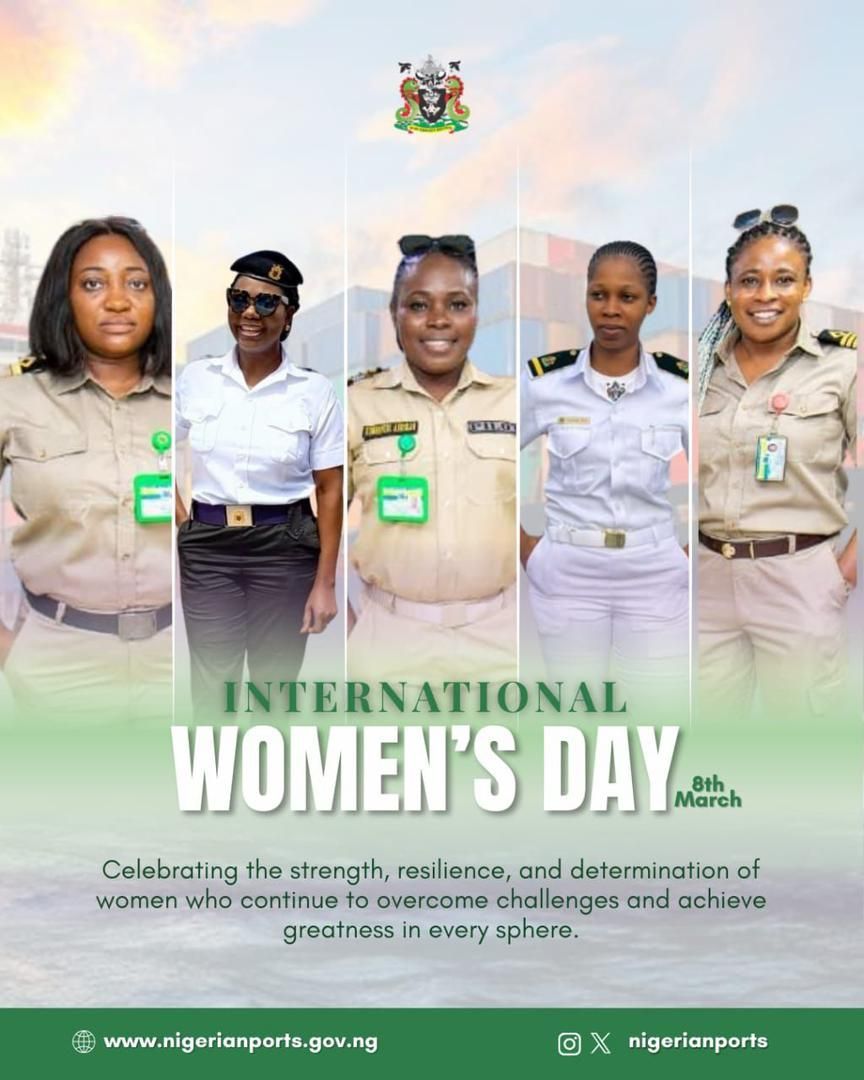
IWD: 60 percent of my aides, technical assistants are women – Danthoso, NPA MD, declares as he celebrates women.
Gloria Odion, Maritime Reporter
The Managing Director of the Nigerian Ports Authority (NPA), Abubakar Danthoso, has said that he was intentional in his prioritizing gender equality in key appointments at the NPA.
While eulogizing the role of women in the maritime industry as part of his message to women during the International Women’s Day celebration, Dr Danthoso, declared that 60 percent of his aides and technical assistants are women.
“Women hold 60 percent of these roles(personal aides and technical assistants) with men making up the remaining 40 percent.
“This intentional step underscores NPA’s commitment to advancing women’s participation and success across the maritime industry.” he stated.
Danthoso said he recognizes the remarkable contributions of to the progress and success of NPA “who continue to drive progress, break barriers, and shape a more equitable future for the sector.”
” The Nigerian Ports Authority proudly celebrates the resilience, dedication, and invaluable contributions of women in the maritime sector—including firefighting, security, piloting, engineering, hydrography, administrative and vessel-support services such as aids to navigation.
” These remarkable women are excelling even in roles that traditionally demand male-kind of strength”
-

 Headlines3 weeks ago
FIFA sends Nigeria’s Super Eagles to 2026 World Cup, awards boardroom scoreline of 3 goals to nil against DR Congo
-

 Headlines2 months ago
Ayobo residents protest deplorable road at LCDA, complain of 10- year neglect by successive local council administrations.
-
 Headlines3 months ago
FG approves 50 percent price slash on Yuletide train services
-
 Customs3 months ago
Relief as Customs grants January 31st, 2026 extension for fast track operators to migrate to AEO
-
 Customs2 months ago
Apapa Customs stretches illicit drug seizures streak with another new year interdiction of 30.1 kg of cocaine on board vessel.
-

 Customs2 months ago
Tinubu pays glowing tribute to Adeniyi, CGC, at 60