
Headlines
PLIs seek possession of NIMASA’s 50 percent equity shares of CVFF from CBN
—propose joint monitoring team to oversee utilisation of funds, track and monitor vessels.
Funso OLOJO
The 12 Primary Lending Institutions (PLIs) appointed by the Nigerian Maritime Administration and Safety Agency (NIMASA) have introduced another dimension to the disbursement of the $700million Cabotage Vessels Financing Funds(CVFF).
The disbursement, which had suffered serial delays and postponements, is expected to commence in August, 2025 among successful bidders from the pool of indigenous ship owners.
As the countdown to the disbursement process began, NIMASA held a one- day Stakeholders’ forum on operationalisation of CVFF in Lagos on Monday, May 12th, 2025.
At the forum, which was meant to unfold the structure and modalities of disbursement to stakeholders, Mr Aburime Ehimare, a senior management staff at Zenith Bank, one of the PLIs chosen to disburse the CVFF, made a strong appeal to NIMASA to allow the PLIs take possession of the 50 percent NIMASA’s equity contribution to the CVFF.
It could be recalled that the equity contributions to the disbursement of the
Funds are shared among three parties to the exercise.
NIMASA will contribute 50 percent, the PLIs will contribute 35 percent while the ship owners wishing to access the funds will contribute the remaining 15 percent.
However, the Zenith Bank make a strong appeal that NIMASA’S 50 percent contribution should be warehoused in a consolidated project account that will domicile with the PLIs.
It could be recalled that the $700m CVFF from where NIMASA would fund its 50 percent equity contribution is domiciled in a Treasury Single Account (TSA) with the Central Bank of Nigeria (CBN).
However, Mr Ehimare said the funds should be warehoused by the PLIs to engender liquidity assurance and transparent disbursement process.
” In this session and previous sessions, we have largely agreed that the PLIs will bear 100 percent credit risk of the CVFF disbursement, including NIMASA’s 50 percent contribution.
” But we want to propose that to make these investments enduring ones for the PLIs and by extension, all stakeholders, the NIMASA’s 50 percent equity contribution should be warehoused in a designated project account with the PLIs before disbursement.
” That will provide liquidity assurance and improve the project distribution timeline and also accelerate the process of disbursement” the banker argued.
Mr Ehimare, who raised four vital points that should be considered to ensure seamless disbursement process and infuse confidence in the PLIs, also made a proposal for the establishment of what he called post – disbursement Stakeholders working group that would be monitoring the implementation of the project.
” There is need to have a post- disbursement stakeholders working group.
” NIMASA needs to consider a joint implementation committee for post disbursement which shall comprise the PLIs, NIMASA and industry experts so that we can monitor the programme and resolve operational challenges as they come so that the intended purpose of the CVFF could be realized.
The Zenith Bank chief also wanted all the parties involved in the CVFF disbursement to agree on security – sharing framework that will define clearly the public process.
” For instance, if there is a vessel liquidation, what will be the sharing formula between NIMASA and the PLIs because, even though we have shared interests in these vessels, their characteristics and unique features are not the same.
” This with ensure sustainability of interests and investments.
Ehimare also made strong appeal on behalf of his bank, the Zenith and other PLIs that NIMASA should avail them its technical competence to ensure that vessels bought with the CVFF money could be properly tracked and monitored by the PLIs.
” For us at Zenith and I am sure I am speaking for the rest of PLIs, we want to make a strong appeal to NIMASA to allow us leverage its regulatory capacity and technical competence to provide vessel tracking data.
” This will help the the PLIs to do their own bits.
‘”There are some areas we do not have core competence as much as NIMASA.
” This was discussed at our previous engagements that as part of our 100 percent credit risks, the banks have to put in place the relevant technology to track all these vessels and monitor the utilisation of the Funds.
” We shall be depending on NIMASA to carry out such technical responsibilities” he appealed.
The 12 PLIs engaged by NIMASA to disburse the CVFF include Fidelity Bank, Stanbic IBTC, United Bank for Africa (UBA), Zenith Bank, Lotus Bank and Union Bank.
Others are First Bank,Jaiz Bank, Sun Trust Bank, Globus Bank and the Bank of Industry(BOI).

Continue Reading
Customs
FOU A bursts 473 smuggling operations in 8 weeks, records major seizures with N5.5billion DPV

– plans relocation to new ultra- modern Iperu headquarters
Gloria Odion, Maritime reporter
The Federal Operations Unit of the Nigeria Customs Service, Zone A, Lagos, has foiled about 473 major smuggling operations across its areas of coverage within the last eight week.
Making this disclosure on Tuesday, May 5th, 2026 was the Comptroller of the Unit, Comptroller Gambo Aliyu while giving account of the performance of the Unit.
According to him, the operations led to the seizure of a wide range of prohibited and contraband items, including 8,794 bags of foreign parboiled rice (equivalent to 15 trailer loads), 22 used vehicles, 1,863 used refrigerator compressors and 328 bales of used clothing.
Others were 1,188 kegs of vegetable oil, 31,705 litres of Premium Motor Spirit (PMS), 485 used tyres, 69 cartons of foreign spaghetti, sugar and other food items, as well as 531 cartons of frozen poultry products.
In a major crackdown on drug trafficking, Comptroller Aliyu disclosed that the Unit launched a special operation codenamed Operation Hawk, targeting illicit drug networks.
This resulted in the seizure of 3,340 parcels of cannabis indica, popularly known as “Ghanaian Loud,” weighing 1,540kg.
He emphasized that the operation reflects the Unit’s resolve to dismantle drug trafficking syndicates and curb the spread of illicit substances.
In a related development, officers at the Gbaji outpost, acting on credible intelligence, intercepted a vehicle along the Lagos-Abidjan corridor conveying hard drugs.
The suspect arrested with the prohibited items, a 71-year-old Nigerian, was found in possession of 6.4kg of cocaine and methamphetamine with an estimated street value of ₦2.35 billion.
Several arrests were made across Lagos, Ogun, Oyo, and Ondo States in connection with these seizures.
Comptroller Aliyu disclosed that the seized narcotics have been handed over to the National Drug Law Enforcement Agency (NDLEA) for further investigation and prosecution, in line with existing inter-agency collaboration frameworks.
The Unit also recorded the seizure of four cylinders of high-grade mercury, a controlled substance under the Minamata Convention, concealed in a vehicle.
The suspect and items has been transferred to the National Environmental Standards and Regulations Enforcement Agency (NESREA) for further action.
Beyond seizures, the Unit achieved significant revenue recovery, recording a Duty Paid Value (DPV) of ₦5,504,039,720 within the review period.
Additionally, ₦97,703,596.55 was recovered through the issuance of Demand Notices on improperly declared consignments.
Comptroller Aliyu highlighted ongoing efforts to modernize operations through the deployment of advanced technologies, including Geographic Information Systems (GIS), satellite imagery, drone surveillance, and predictive analytics.
These tools, he noted, are enhancing intelligence-led enforcement, improving response times, and disrupting smuggling networks across the Zone.
He further disclosed that the Unit will soon commence a phased relocation to its newly commissioned ultra-modern headquarters in Iperu, Ogun State.
The facility is equipped with a state-of-the-art Command and Control Centre designed to support real-time monitoring, data analytics, and improved inter-agency coordination.
Reaffirming the Unit’s dual mandate, Comptroller Aliyu stressed that while enforcement remains a priority, the FOU Zone ‘A’ is equally committed to facilitating legitimate trade and ensuring that compliant traders are not unduly hindered.
He expressed appreciation to the Comptroller-General of Customs, Dr. Bashir Adewale Adeniyi, for his leadership and strategic direction, as well as to stakeholders and the media for their continued support.
The Comptroller reiterated the Unit’s determination to sustain its crackdown on economic sabotage, protect national revenue, and uphold the integrity of Nigeria’s trade environment.
The Comptroller of the Federal Operations Unit (FOU) Zone ‘A’, Nigeria Customs Service (NCS), Comptroller Gambo Aliyu, has reaffirmed the Unit’s commitment to combating smuggling and safeguarding Nigeria’s economy across the South-West region.
Addressing the media on Tuesday, 5 May 2026, Comptroller Aliyu stated that the Unit has strengthened enforcement measures in line with the Federal Government’s fiscal policies and the provisions of the Nigeria Customs Service Act, 2023. He noted that through enhanced surveillance, intelligence sharing, and inter-agency collaboration, the Unit successfully intercepted 473 smuggling attempts within an eight-week period.
Headlines
Greg Ogbeifun confirms chairmanship of 10th AMSAY Conference Anniversary on May 27th.

Gloria Odion, Maritime reporter
The organisers of the Annual Maritime Students and Youth (AMSAY) Conference have announced that renowned ship owner and Chairman of Starzs Investment Company Ltd, Engr Greg Ogbeifun will chair the 10th anniversary of the event scheduled to hold in Lagos on May 27, 2026.
The announcement comes as preparations intensify for what is widely regarded as a landmark edition of the youth-focused maritime conference.
The 10th AMSAY Conference marks a decade of sustained youth engagement, innovation, and impact in Nigeria’s maritime sector.
It is expected to bring together industry leaders, policymakers, stakeholders, and young professionals from across the maritime ecosystem.
Engr. Ogbeifun’s confirmation as Chairman adds significant weight to the anniversary event.
He previously served as the Pioneer Chairman during the maiden edition of the conference in 2016, and his return ten years later is described by the organisers as both symbolic and strategic.
According to the Convener and CEO of Platforms Communications, Mr Sylvanus Obasi, the decision reflects a deliberate effort to connect the conference’s origins with its current status, noting that the AMSAY Conference has evolved significantly over the past decade.
He highlighted that several key initiatives now associated with the conference were not part of its original design.
Among these are the Best Graduating Maritime Students Awards (BEGMASA); the Fola Ojutalayo Annual Maritime Speech-Making Competition (FOAMSC), including the Maritime Career Mentoring Program (M-CAMP).
These programmes, according to him, have become integral components and offshoot of the AMSAY Conference brand.
Speaking further, Obasi stated that the initiatives have delivered measurable impact in youth development and professional capacity building, even as he further described the growth of these programmes as evidence of the conference’s commitment to continuous improvement.
“Bringing Engr. Ogbeifun back after ten years is a strategic move. It gives us the opportunity to reflect on our journey and showcase our achievements.”, the Convener said, adding that the anniversary edition will also provide a platform to draw from Engr Greg’s wealth of experience and industry insight.
Also speaking, the Chairman, Central Planning Committee of AMSAY Conference, Mr Nnamdi Eronini hinted that the 10th AMSAY Conference is expected to feature robust discussions, mentorship engagements, and knowledge-sharing sessions.
He reaffirmed the organisers commitment to advancing the maritime sector through sustained youth engagement and innovation, noting that the event is positioned as a leading platform for shaping the future of Nigeria’s maritime industry.
Customs
Oyo/Osun Customs Command collects 27.2billon revenue in Q1 2026
Funso OLOJO, Editor
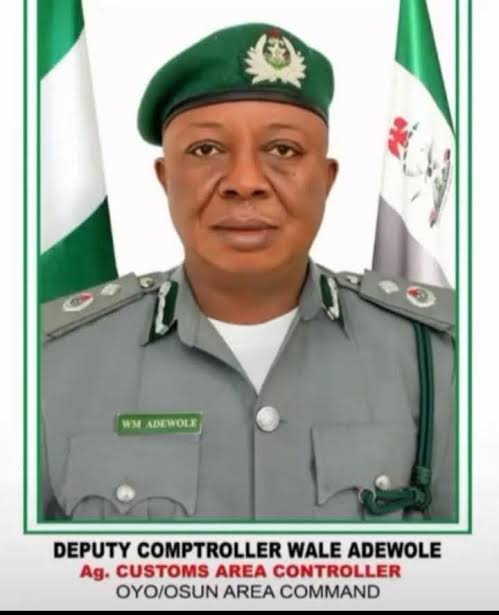
The Oyo/Osun Command of the Nigeria Customs Service (NCS) has posted an impressive 95% increase in revenue collection in the first quarter of 2026 compared to the same period in 2025.
Led by Acting Comptroller Wale Moses Adewole, the command generated ₦27.2 billion between January and March 2026, up from ₦13.97 billion in Q1 2025.
A breakdown of the generated revenue revealed that the command raked in a total sum of N5,977,766,941.65 in January 2026 which was about N2 billion lower (23% down) than the total sum of N7,804,408,776.88 collected in the same period of 2025.
However, despite a dip in January, revenue rebounded strongly in February and March.
In February , the command’s revenue collection jumped up astronomically to a total sum of N8,767,974,864.40 against the very low total revenue of N2,289,193,870 realized in the corresponding period of 2025.
This year’s February revenue is over 383% higher than the revenue collected the same period last year.
February’s performance was the standout, with collections nearly quadrupling year-on-year.
In March 2026, Acting Comptroller Adewole’s administrative ingenuity and thoroughness further shored up the revenue generation of the command in the month under review to a total sum of N12,454,516,158.62.
In the corresponding period of last year, the command’s generated revenue was a patry sum of N3,877,668,667.
This year’s March revenue achievement represents 321% rise over last year’s.
Acting Comptroller Adewole’s administrative reforms and enforcement measures are credited with driving the surge.
Overall, the command’s Q1 results underscore a significant improvement in efficiency and compliance, positioning Oyo/Osun as one of the strongest performing Customs Commands in the country.
-

 Headlines3 months ago
FIFA sends Nigeria’s Super Eagles to 2026 World Cup, awards boardroom scoreline of 3 goals to nil against DR Congo
-
 Aviation3 months ago
Tension de-escalates at Lagos Airport as FAAN, Cargo agents reach truce over new tariff
-

 Headlines3 months ago
Customs agents seek clarification on status of B’Odogwu on National Single Window platform.
-

 Headlines3 months ago
Niger- Delta activist defends Tantita pipeline surveillance contract, warns against sabotage
-

 Headlines3 months ago
Oyetola, NIWA’s top managers celebrate Oyebamiji as he receives Media -Friendly CEO award in Abuja.
-

 Headlines3 months ago
Oyetola leads top government dignitaries to award ceremony of Oyebamiji as most media- friendly maritime CEO