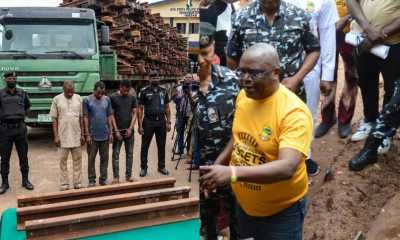
—engages terminal operators to boost enforcement, compliance level
—-alleges underpayment, fraud in payment system.
— raises team to visit terminals for record reconciliation
The eyewitness reporter
The Council for Regulation of Freight forwarding Practice in Nigeria (CRFFN), has expressed worries over the continued dip in its revenue from the Practitioners’ Operating fees(POF).
POF is the internally generated revenue for the council accrued from charges on imported cargo into the country.
It was backed by an Act of Parliament as contained in the CRFFN Act of 2007, section 6 as well as FEC approval.
Initiated in 2021 but officially took off in March 2021, the POF is meant to shore up the revenue base of the council to carry out its statutory responsibilities.
However, two years after its official takeoff, the CRFFN is troubled by the low compliance level of freight forwarders and abysmal enforcement by the terminals operators who are the statutory collectors on behalf of the CRFFN.
However, to shore up the dwindling level of revenue from the POF and ensure high enforcement and compliance level by the terminals operators and freight forwarders, the CRFFN has engaged the operators on the need to identify the challenges bedeviling the collection of the fees.
At a two-day town hall meeting with the terminal operators in Lagos on the 3rd – 4th, of April 2023, the CRFFN complained about the low compliance and enforcement level among the terminal operators.
According to Mrs. Chinyere Uromta, the Acting Registrar and CEO of the CRFFN, the money being generated from the POF is very low due to poor enforcement level by the terminal operators.
“The revenue we are generating from POF is very low. It wasn’t as easy as we thought initially.
“
”While some terminal operators have fully commenced enforcement of POF, we have others who are yet to officially commence.
The CRFFN boss, who went through the layers of approvals, agreements and Memorandum of Understanding ( MOU) signed with the terminal operators to kick start the collection of the fees, lamented the hitches and challenges which have bedeviled the payment and collection system.
“Our technical partners on our request provided two important means of POF verification system for terminal operators which are all computer-based.
“These are Full API Integration and Account Access.
”As much as we preferred that all terminals use the first option, the majority is on the second option which is manual and involves human interface.
”This is one the reasons we are here to discuss how to improve in what we have now and move towards full API Integration as we presently have in PTML” Mrs. Uromta declared.
However, Mr. M. R Lawal, one of the ICT staff of the CRFFN, who explained the mode of payment and collection of POF, revealed that there is a high level of underpayment and fraud in the payment of the POF while he lamented has rubbed the Council of its statutory revenue.
He explained that the freight forwarders are exploiting the high level of laxity among the terminal operators in collecting the POF to short-change the CRFFN.
“Because some of the releasing staff of the terminal operators are not thorough in their confirmation of payment claims by the freight forwarders, they left loopholes in the payment system on the portal which were cleverly being exploited by the freight forwarders who underpay the POF.
Lawal gave an example of some smart freight forwarders with up to 20 containers on their bills of lading but pay POF on only one due to the laxity of the releasing officers at the terminals.
To plug these loopholes and enhance the collection of POF, the CRFFN has raised a technical team with the officials of the federal ministry of transportation who will be visiting each of these terminals monthly, beginning in April, to reconcile their records with the terminal operators on the collection of POF.
According to the guidelines for reconciliation issued by the CRFFN, terminal operators are expected to collate bill of Lading cleared (exited) month by month from July 2020 to March 2023.
The terminal operators are expected to communicate a suitable date for both parties within April for a meeting with the council team.
This meeting is meant to thoroughly examine the documents presented by the terminal operators and to discuss the identified shortcomings to improve on them.
Mr. Lawal lamented that the CRFFN has so far recorded 400,000 bills of lading ( BOLs) since the inception of the POF collection.
This, according to him, fell short of the expectations of the council and led to drastic revenue generation from the POF.
However, to improve the enforcement level among terminal operators, the CRFFN has resolved to establish a help desk in each of the terminals for a seamless interface that will boost revenue collection from POF.
The council, therefore, pleaded with the terminal operators to provide space for this exercise.
It also enjoined the operators to attach Terminal Delivery Order (TDO) to each of the BOL
Alarmed by the level of underpayment and fraud in the payment of the POF, the CRFFN said it was interfacing with the maritime police to checkmate the menace.
It also promised to look into the suggestion made by terminal operators to take the burden of the collection of the POF from them and give it to the customs whom they believed are more suited for revenue collection.








 Customs3 months ago