
Headlines
Dantsoho,NPA MD, plays host to Japanese agency, Vicky Haastrup for strategic collaborations

Funso OLOJO
In continuation of his strategic engagements with institutions and individuals that would drive the operational efficiency of the agency, the Managing Director of the Nigerian Ports Authority (NPA), Abdulahi Datsotho, has played host to Chief Representative of the Japan International Cooperation Agency (JICA) Mr. Yuzurio Susumu at the NPA Headquarters Marina.

The meeting focused on harnessing the technical and allied synergies necessary to actualize the Dantsoho-led Management team’s quest to deepen the eco-friendliness of Nigerian Ports through renewable energy and increased automation.

JICA is an implementing agency of Japanese Official Development Aid (ODA) for the purpose of supporting the socioeconomic development and economic stability of developing regions.,
Similarly, Dr Dantsoho received in audience Olori Vicky Ayodele Haastrup, the wife of His Imperial Majesty, Oba Clement Adesuyi Haastrup, Ajimoko III, Owa Obokun Adimula and Paramount Ruler of Ijesaland at the NPA Headquarters.

Princess Vicky Haastrup, who is also Chairperson Seaport Terminal Operators Association of Nigeria (STOAN) pledged the institution’s support for the Dantsoho-led management team’s renewed effort at advancing the frontiers of trade facilitation.
.

Headlines
In Malmo, Sweden, NIMASA renews capacity development partnership with WMU
Gloria Odion, Maritime Reporter
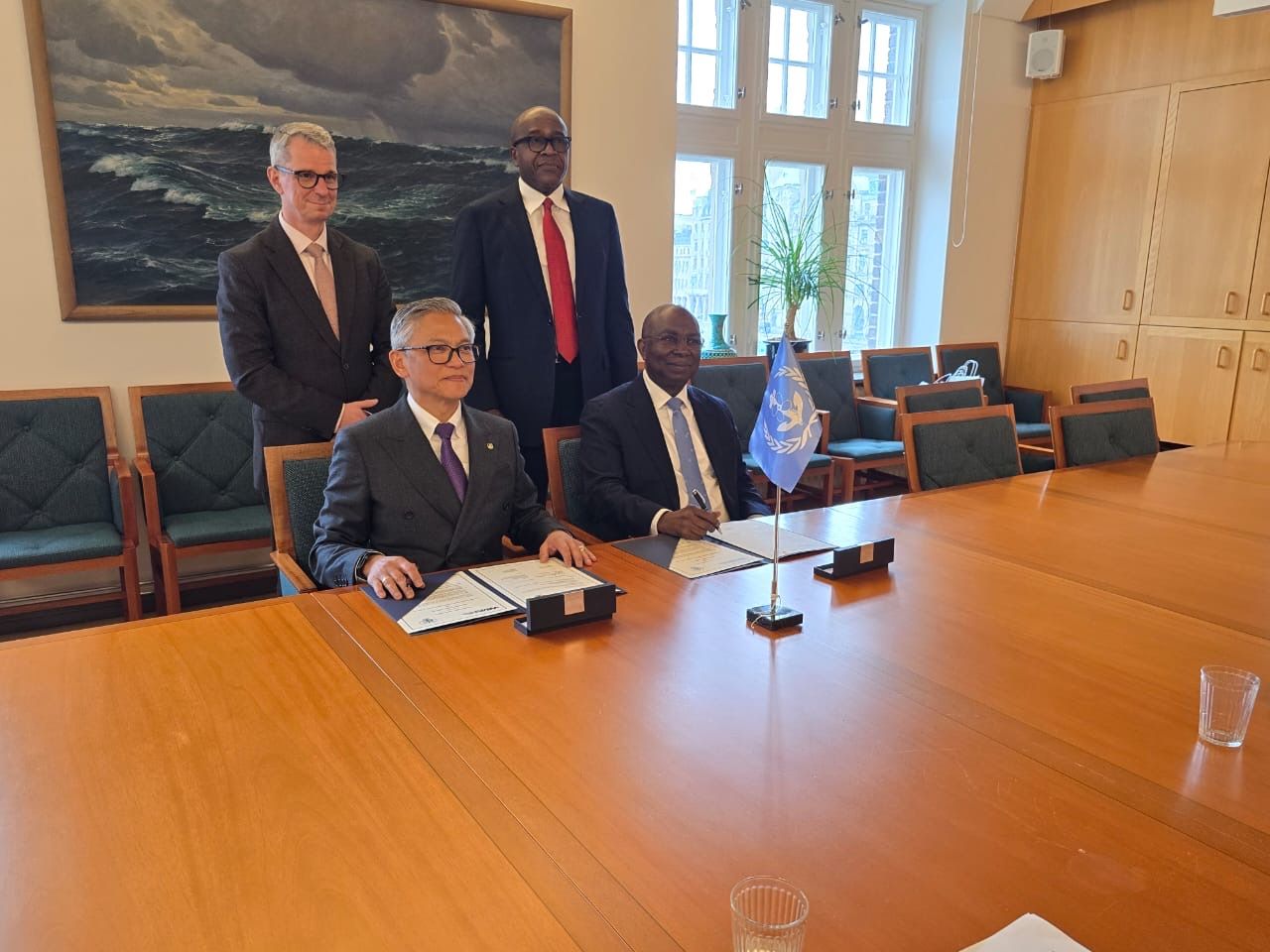
The Nigerian Maritime Administration and Safety Agency (NIMASA), has renewed its strategic capacity development partnership with the World Maritime University (WMU), Malmö, Sweden, through the signing of a four-year Memorandum of Understanding (MoU) aimed at strengthening Nigeria’s maritime human capital and institutional capacity.
Speaking at the MoU signing ceremony, the Director General of NIMASA, Dr. Dayo Mobereola, described the partnership as a critical pillar in NIMASA’s human capital development framework and a strategic investment in Nigeria’s maritime future.
“This collaboration has significantly strengthened our technical and regulatory capabilities over the years.
“Their expertise has also reinforced Nigeria’s participation at the International Maritime Organization and other international maritime platforms,” he stated.
Under the renewed MoU, which was first signed in 2022, NIMASA will sponsor at least ten officers annually for the 14-month Master of Science programme at WMU in Malmö for the 2026–2029 intakes, as well as at least one officer for the Master of Philosophy (MPhil) programme jointly delivered by WMU and the International Maritime Law Institute (IMLI), Malta.
The MoU also provides for distance learning, executive professional development courses, research collaboration and technical assistance to strengthen NIMASA’s capacity in maritime safety, environmental management, seafarer certification and implementation of international maritime instruments.
WMU will further seek additional fellowships from international donors for qualified NIMASA candidates.
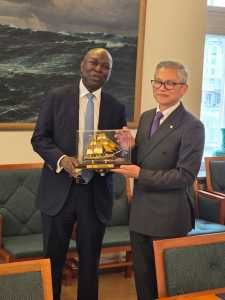
Dr. Mobereola endorsed the MoU on behalf of NIMASA with the President of WMU, Professor Maximo Q. Mejia Jr signing on behalf of the University while Executive Director Finance and Administration, NIMASA ,Chudi Offodile and the Registrar of WMU, Mr. Peter Marriott both signed as witnesses.
Established in 1983 by the International Maritime Organization, WMU was mandated to strengthen global maritime capacity, particularly in developing countries.
The University has since become a leading centre of excellence, and Nigeria has benefited significantly through the training of NIMASA officers who continue to enhance national maritime governance and international engagement.
Economy
Nigeria’s Oil exports face threat as US- Israel attack on Iran escalates, Strait of Hormuz blockade imminent
It links the Arabian/Persian Gulf, or just the Gulf, with the Gulf of Oman and the Arabian Sea beyond.
It is 33km (21 miles) wide at its narrowest point, with the shipping lane just 3km (2 miles) wide in either direction, making it vulnerable to attack.
Despite its narrow width, the channel accommodates the world’s largest crude carriers.
According to the US Energy Information Administration (EIA), about 20 million barrels of oil, worth about $500bn in annual global energy trade, transited through the Strait of Hormuz each day in 2024.The crude oil passing through the strait originates from Iran, Iraq, Kuwait, Qatar, Saudi Arabia and the UAE.
The strait also plays a critical role in the liquefied natural gas (LNG) trade.
On Saturday, February 28th, 2026, an official from the European Union told the Reuters news agency that vessels crossing the strait have been receiving very high frequency (VHF) transmissions from Iran’s elite Islamic Revolutionary Guard Corps (IRGC), saying “no ship is allowed to pass the Strait of Hormuz”.However, the EU official added, Iran has not officially closed the strait.
“Our ships will stay put for several days,” a top executive at a major trading desk told Reuters on condition of anonymity. Countries like Greece have also advised their vessels to avoid transiting through the waterway.
Any instability in this important maritime route could rattle economic stability worldwide.
The strait handles both oil and gas exports and imports.
Kuwait and the UAE import supplies sourced outside the Gulf, including shipments from the United States and West Africa.
The EIA estimated that in 2024, 84 percent of crude oil and condensate shipments transiting the strait headed to Asian markets.
A similar pattern appears in the gas trade, with 83 percent of LNG volumes moving through the Strait of Hormuz destined for Asian destinations.
China, India, Japan and South Korea accounted for a combined 69 percent intake of all crude oil and condensate flows through the strait last year. Their factories, transport networks and power grids depend on uninterrupted Gulf energy.
A spike in oil prices will impact countries such as China, India and several Southeast Asian nations.
How would the Strait’s closure impact oil prices?
According to Iranian state media, the country’s Supreme National Security Council must make the final decision to close the strait, and it has to be ratified by the government.But energy traders have been on high alert in recent weeks amid escalating tensions in the region – home to one of the largest reserves of oil and gas in the world.
Muyu Xu, senior crude oil analyst at Kpler, told reporters that since the war began on Saturday, there has been a sharp drop in vessel traffic through the strait.
“At the same time, the number of vessels idling on either side – in the Gulf of Oman and the Gulf – has surged, as shipowners grow increasingly concerned about maritime security risks following Tehran’s warning of a potential navigation closure,” he said.
“The Strait of Hormuz is critical to the global energy market, as roughly 30 percent of the world’s seaborne crude oil transits the waterway.
” In addition, nearly 20 percent of global jet fuel and about 16 percent of gasoline and naphtha flows also pass through the Strait,” Muyu said.
“On Sunday, March 1st, 2026, an oil tanker was struck off the coast of Oman, signalling a clear escalation of the conflict and a shift in targets from purely military facilities to energy assets.”
Shipping data showed that at least 150 tankers, including crude oil and liquefied natural gas vessels, have dropped anchor in open Gulf waters beyond the Strait of Hormuz.
The tankers were clustered in open waters off the coasts of major Gulf oil producers, including Iraq and Saudi Arabia, as well as LNG giant Qatar, according to the Reuters news agency estimates based on ship-tracking data from the MarineTraffic platform.
Moreover, on Sunday, March 1st, 2026,the United Kingdom Maritime Trade Operations (UKMTO) said it is aware of “significant military activity” in the Strait and said it has received a report of an incident two nautical miles north of Oman’s Kumzar, located in the Strait of Hormuz.
Muyu from Kpler said a broad range of energy infrastructure is now under threat. “This is expected to sharply intensify the oil price rally and could keep prices elevated for a sustained period, potentially longer than during last June’s conflict.”
Ali Vaez, director of the Iran project at the International Crisis Group, told Al Jazeera, “Closure of the Strait of Hormuz would disrupt roughly a fifth of globally traded oil overnight – and prices wouldn’t just spike, they would gap violently upward on fear alone.”
“The shock would reverberate far beyond energy markets, tightening financial conditions, fuelling inflation, and pushing fragile economies closer to recession in a matter of weeks,” he added.
When the US and Israel bombed Iran last June, there was no direct disruption to maritime activity in the region.
What does it mean for the global economy?
Any disruption to energy flows through Hormuz will also impact the global economy, driving up fuel and factory costs.Hamad Hussain, a climate and commodities economist at the United Kingdom-based firm Capital Economics, said that for the global economy, a sustained rise in oil prices would add upward pressure to inflation.
“If crude oil prices were to rise to $100 per barrel and remain at those levels for a while, that could add 0.6-0.7 percent to global inflation,” he said, noting that this would also lead to an increase in natural gas prices.
“This could slow the pace of monetary easing by major central banks, particularly in emerging markets, where policymakers tend to be more sensitive to swings in commodity prices,” he added.
Headlines
Blue Economy: Why Nigeria must awaken the sleeping giant for economic prosperity

Chika Chukwudi
At a time when Nigeria is urgently seeking sustainable pathways to economic stability, poverty reduction, and mass job creation, it has become increasingly clear that the nation must rethink its development priorities.
It is time for the Federal Government to invest more aggressively in the blue economy than any other sector; not as an experiment, but as a strategic national imperative.
A sector with vast untapped potential,Nigeria is geographically positioned as a maritime powerhouse.
Additionally, Nigeria is blessed with extensive inland waterways, including the River Niger and River Benue systems, as well as numerous lakes and dams.
Yet, despite these natural advantages, the maritime sector contributes far below its potential to national GDP.
Ports remain under-optimized, inland waterways underutilized, fisheries underdeveloped, and coastal tourism largely unexplored.
A nation surrounded by water should not be surrounded by economic stagnation.
Job Creation at Unmatched Scale
From artisanal fisheries to industrial aquaculture, from shipbuilding and repairs to maritime logistics, from port management to marine biotechnology, the opportunities span both formal and informal sectors.
Unlike capital-intensive industries that absorb limited skilled labor, the maritime sector can employ millions—fishermen, boat builders, marine engineers, dockworkers, environmental scientists, processors, exporters, and entrepreneurs.
Investing in fisheries and aquaculture alone could significantly reduce Nigeria’s dependence on fish importation while creating rural jobs.
Developing shipbuilding and maintenance hubs would stimulate industrial growth. Expanding coastal tourism would empower local communities.
If properly harnessed, the blue economy can become Nigeria’s largest employer of labor.
A Powerful Tool for Poverty Alleviation
By investing in modern fishing techniques, cold chain logistics, processing facilities, and export frameworks, the government can raise incomes at the grassroots level.
The blue economy directly connects natural resources to livelihoods. It allows small-scale operators to participate in global value chains.
It empowers women in fish processing and marketing. It supports youth entrepreneurship in aquaculture and marine services.
Few sectors distribute wealth as inclusively as the maritime ecosystem.
Economic Diversification Beyond Oil
Meanwhile, countries that invested heavily in maritime trade and ocean-based industries have built resilient economies.
The global shipping industry drives over 80 percent of world trade by volume.
Nigeria, as Africa’s most populous nation, should be a dominant maritime hub; not merely a participant.
Strategic investment in port modernization, maritime security, indigenous shipping lines, and marine renewable energy can generate foreign exchange earnings, attract international investors, and reduce capital flight.
Diversification is no longer optional; it is survival. And the blue economy offers the strongest foundation for that transition.
Strengthening National Security and Regional Influence
Improved naval capacity, port efficiency, and maritime surveillance reduce piracy, illegal fishing, and resource theft in the Gulf of Guinea.
A strong maritime economy enhances Nigeria’s leadership role in West Africa and positions the country as a gateway for regional trade under the African Continental Free Trade Area framework.
Catalyzing Industrial Growth and Infrastructure Development
Shipyards require steel, engineering services, and technical expertise. Ports demand road and rail connectivity. Fisheries require cold storage, packaging, and logistics systems.
Every naira invested in maritime infrastructure stimulates broader economic activity.
Unlike sectors that operate in isolation, the blue economy integrates transportation, manufacturing, trade, energy, tourism, and environmental management into one interconnected growth engine.
A Long-Term, Sustainable Growth Model
When managed responsibly, marine and aquatic resources are renewable. Sustainable fisheries, offshore wind energy, eco-tourism, and marine biotechnology offer growth without exhausting natural capital.
With proper regulation and environmental safeguards, Nigeria can build a blue economy that generates prosperity today without compromising future generations.
A Call for Bold Policy Action
The question is not whether Nigeria should invest in the blue economy. The question is whether Nigeria can afford not to.
Prioritizing maritime education, strengthening maritime institutions, expanding coastal infrastructure, supporting indigenous shipping, and financing aquaculture enterprises should form the core of national economic planning.
The blue economy is not just another sector, it is a sleeping giant. And if awakened through deliberate policy and sustained investment, it can alleviate poverty, generate millions of jobs, stabilize foreign exchange earnings, and secure Nigeria’s economic future.
Nigeria’s prosperity lies not only beneath its soil, but upon its waters.
The time to act is now.
-

 Headlines3 months ago
Ex-NIWA boss, Oyebamiji, emerges most media-friendly CEO in maritime industry
-

 Headlines2 weeks ago
FIFA sends Nigeria’s Super Eagles to 2026 World Cup, awards boardroom scoreline of 3 goals to nil against DR Congo
-

 Headlines3 months ago
MARAN pulls industry’s stakeholders to unveil its iconic book on Maritime industry.
-

 Customs3 months ago
How Comptroller Adenuga is raising revenue profile of Seme command, facilitating regional trade.
-

 Headlines2 months ago
FG approves 50 percent price slash on Yuletide train services
-

 Headlines1 month ago
Ayobo residents protest deplorable road at LCDA, complain of 10- year neglect by successive local council administrations.