Osagie Edward
The Nigerian Maritime Administration and Safety Agency (NIMASA) has ended the year 2025 on an impressive note, recording far-reaching achievements that have strengthened Nigeria’s maritime sector and enhanced the country’s standing in global maritime governance.
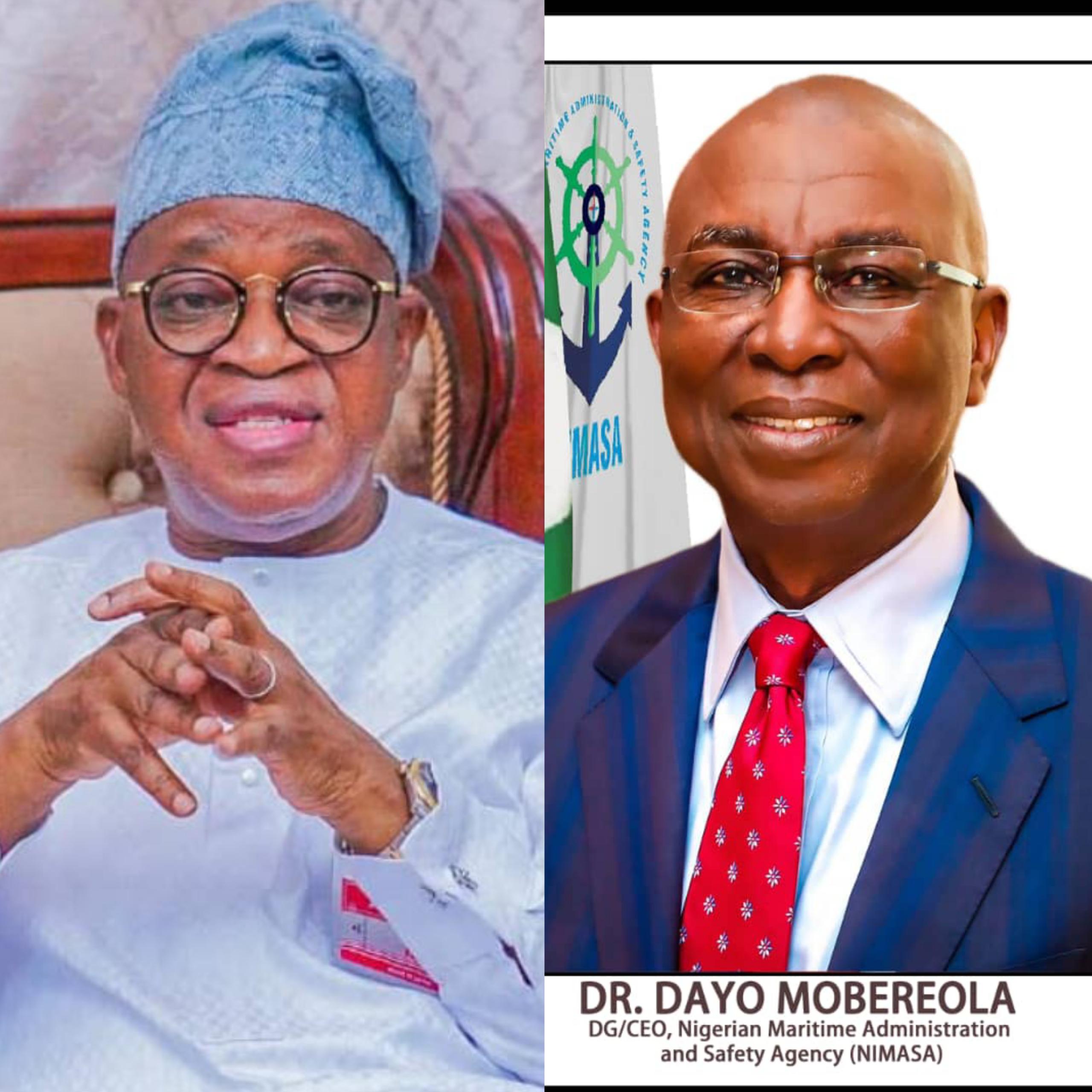
Under the leadership of its Director-General, Dr. Dayo Mobereola, the Agency earned commendations from the Presidency, maritime institutions, labour unions, and a broad spectrum of industry stakeholders.
Throughout the year under review, NIMASA, operating under the supervision of the Federal Ministry of Marine and Blue Economy, sustained a reform-driven agenda focused on maritime safety and security, capacity development, regulatory efficiency, labour harmony, and international engagement.
These deliberate efforts culminated in one of Nigeria’s most significant maritime milestones in recent history — the country’s successful return to the International Maritime Organization (IMO) Council after a 14-year absence.
Presidential Commendation and Global Recognition
President Bola Ahmed Tinubu formally commended the management of NIMASA following Nigeria’s election into Category C of the IMO Council for the 2026–2027 biennium, describing the achievement as a strong affirmation of Nigeria’s growing influence in global maritime governance.
In a State House press release, the President noted that the election reflects the confidence of the international community in Nigeria’s commitment to maritime safety, security, environmental stewardship, and rules-based operations. He specifically applauded the Federal Ministry of Marine and Blue Economy, NIMASA, and Nigeria’s diplomatic team for their professionalism, strategic engagement, and tireless efforts throughout the election process.
President Tinubu further emphasized that Nigeria’s return to the IMO Council aligns seamlessly with his administration’s broader vision to unlock the nation’s vast blue economy potential, strengthen anti-piracy initiatives in the Gulf of Guinea, expand maritime infrastructure, and position Nigeria as a regional shipping and logistics hub.
Landmark IMO Council Victory
Nigeria’s election into the IMO Council on Friday, 28 November 2025, during the IMO General Assembly in London, stands out as the defining highlight of the year.
The victory, led by the Honourable Minister of Marine and Blue Economy, Dr. Adegboyega Oyetola, CON, marked Nigeria’s triumphant return to the Council after more than a decade.
Describing the outcome as a landmark endorsement of Nigeria’s maritime reforms, Dr. Oyetola credited over twelve months of intensive diplomatic shuttles, sustained advocacy, and coordinated stakeholder engagement involving NIMASA and other national institutions.
He noted that Nigeria’s improved maritime security architecture and reforms in the Gulf of Guinea played a decisive role in restoring global confidence.
With this development, Nigeria has been restored to a strategic global platform where it can meaningfully contribute to shaping international shipping policies, maritime safety standards, and sustainable ocean governance.
Hosting the IMO Secretary-General
Another major highlight of the year was NIMASA’s successful hosting of the Secretary-General of the International Maritime Organization, Mr. Arsenio Dominguez, the world’s leading maritime official.
The historic visit underscored Nigeria’s renewed relevance within the global maritime community.
The Honourable Minister of Marine and Blue Economy personally led the engagement, providing strategic leadership and hosting the IMO Secretary-General, while NIMASA, as Nigeria’s nodal agency to the IMO, coordinated technical sessions and stakeholder interactions.
The visit further reinforced international confidence in Nigeria’s maritime reforms and institutional capacity.
Sustaining Zero Piracy in Nigerian Waters
Working in synergy with national and international security architecture, NIMASA successfully sustained zero piracy incidents in Nigerian waters during the year under review.
The Agency’s Deep Blue Project proved instrumental in this achievement. Port and Flag State during the period under review have been effective and surpassed the globally acceptable standards.
During his visit, the IMO Secretary-General witnessed a live demonstration by the Deep Blue security team and reportedly stated that other maritime nations have much to learn from Nigeria’s maritime security framework.
Commitment to Capacity Development
In the area of human capacity development, Dr. Mobereola and his management team demonstrated uncommon commitment to maritime education.
The issue of sea time for beneficiaries of the Nigerian Seafarers Development Program NSDP is enjoying deserved attention as the backlog is being cleared
At the Maritime Academy of Nigeria (MAN), Oron ,in a historic first, the NIMASA Director-General Dayo Mobereola personally attended the Academy’s graduation ceremony, becoming the first NIMASA chief executive to do so.
Speaking at the event, the Rector of MAN, Dr. Okonia, commended the NIMASA management for its sustained support for maritime education and seafarer development, noting that the Agency’s interventions have continued to strengthen the training pipeline for Nigerian seafarers and improve the quality of maritime manpower available to the industry.
Labour Harmony and Stakeholder Confidence
NIMASA’s performance in 2025 also attracted strong commendation from maritime labour unions, particularly the Maritime Workers Union of Nigeria (MWUN).
The President-General of MWUN, Comrade Francis Bunu, praised the Agency for its constructive engagement with maritime labour, improved regulatory oversight, and commitment to policies that promote workers’ welfare, industry stability, and indigenous participation.
Comrade Bunu recently commended Dr. Mobereola for facilitating the successful unionization and signing of a Collective Bargaining Agreement (CBA) between MWUN and some shipping companies operating in Nigeria. The agreement established clear working conditions for union members and was widely seen as a milestone in promoting industrial harmony.
The MWUN President-General described Dr. Mobereola as “one DG ever produced by NIMASA who is thorough, proactive, disciplined, and deeply knowledgeable in maritime administration,” noting that these qualities were instrumental in achieving the agreement.
Beyond the CBA, MWUN also lauded NIMASA’s role in combating piracy in Nigerian waters and the Gulf of Guinea, improvements that have enhanced safety and boosted investor confidence.
The union further pledged its full support for Nigeria’s IMO Council engagement and participated in initiatives to improve seafarers’ welfare, including the launch of a reviewed minimum wage framework.
In terms of the cabotage vessel financing fund , the NIMASA management under the supervision of the Honorable Minister of marine and blue economy, His Excellency Adegboyega Oyetola have successfully cracked a major bottleneck hindering the disbursement of the funds and 2026 is looking very promising.
Staff Welfare and Institutional Strengthening
Internally, the management of NIMASA recorded significant progress in staff welfare and motivation.
Promotions, structured training programmes, and targeted capacity-building initiatives were implemented to enhance career growth, professionalism, and institutional efficiency.
These measures contributed to improved morale and strengthened the Agency’s ability to deliver on its statutory mandate.
Positioned for a Stronger 2026
As 2025 draws to a close, NIMASA’s achievements under Dr. Mobereola’s leadership reflect a year of renewed credibility, strengthened partnerships, and measurable progress for Nigeria’s maritime sector.
The Agency’s alignment with the Federal Government’s blue economy agenda and its growing international recognition position it strongly for even greater impact in the years ahead.
With sustained reforms, robust stakeholder collaboration, and proactive global engagement, NIMASA enters 2026 well-positioned to consolidate gains and further advance Nigeria’s standing as a leading maritime nation.
DG’s Message of Renewed Hope
In a New Year message to stakeholders, the Director-General of NIMASA, Dr. Dayo Mobereola, expressed sincere appreciation for the cooperation, partnership, and steadfast support received throughout the past year.
He noted that stakeholders’ contributions were instrumental to the progress recorded across Nigeria’s maritime sector and expressed optimism for even stronger collaboration in the year ahead.
According to him, 2025 was a momentous year for Nigeria’s maritime industry, marked by significant achievements and renewed international confidence.
“As we look forward to 2026, it is our firm resolve to consolidate on these gains and deliver even greater outcomes for the sector and the nation at large,” he said.
Expressing confidence in collective effort, Dr. Mobereola added, “I am confident that, working together, we will make this possible.”
He concluded by wishing stakeholders and their loved ones a peaceful, productive, and fulfilling Year 2026.
Osagie Edward is Head Public Relations at the Nigerian Maritime Administration and Safety Agency (NIMASA)




 Headlines2 months ago
 Headlines1 month ago
 Customs3 months ago
 Headlines3 months ago
 Customs2 months ago
 Headlines3 months ago