Connect with us

Headlines

Oyetola warns inadequate funding of Ministry of Marine and Blue Economy may hobble sectoral reforms, impede growth

presents N10.5bn 2026 budget 
Funso OLOJO, Editor
The Minister of Marine and Blue Economy, Adegboyega Oyetola, has warned that the lean 2026 budget for the Ministry of Marine and Blue Economy, may stunt the growth trajectory of the sector and limit the expected reforms.
Oyetola lamented that the Ministry, which is critical to the economic growth of the country, is being underfunded, a development he feared may lead to underperformance of the sector.
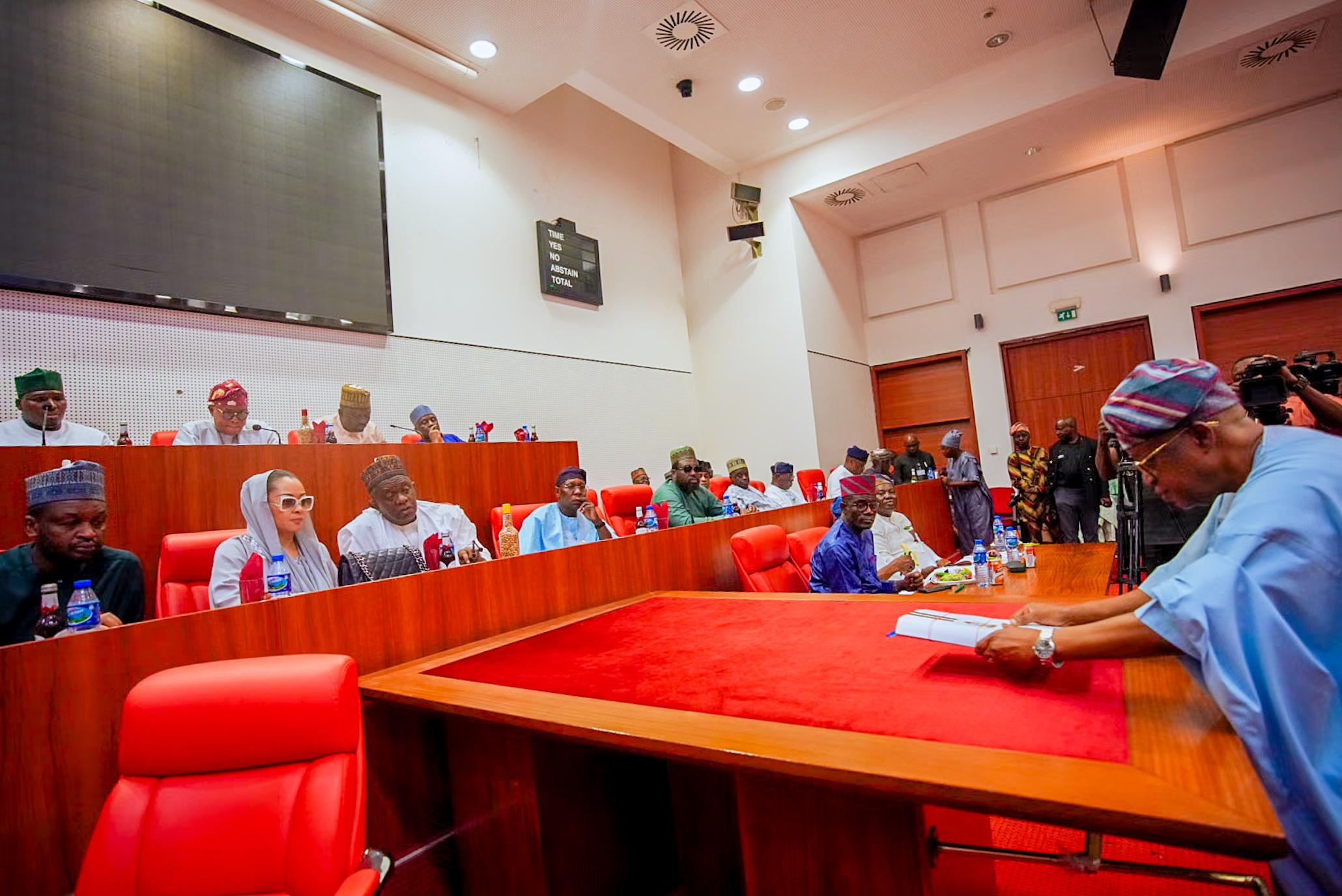
The Minister made the observation on Tuesday, February 10th, 2026 while presenting a ₦10,499,984,667.10 budget proposal for the Federal Ministry of Marine and Blue Economy for the 2026 fiscal year to the National Assembly.
Oyetola make a budget defence before a joint sitting of the Senate Committee on Marine Transport and the House of Representatives committees on Ports and Harbours; Maritime Safety, Education and Administration; Shipping Services; Inland Waterways; and Ocean and Fisheries.
He lamented that the allocation was grossly insufficient to effectively execute the ministry’s wide-ranging mandate critical to Nigeria’s trade, transport efficiency and food security.
The Minister said the proposed budget, which comprises ₦8.24 billion for capital expenditure, ₦453.86 million for overheads and ₦1.81 billion for personnel costs, would only sustain minimal operational continuity rather than deliver meaningful reforms or sectoral growth.
He  explained that the ministry oversees interconnected subsectors, including ports, shipping, inland waterways, fisheries and aquaculture, which collectively handle over 90 per cent of Nigeria’s international trade by volume, national food and nutrition security, and economic competitiveness.
Oyetola equally noted that while agencies such as the Nigerian Ports Authority(NPA), Nigerian Maritime Administration and Safety Agency(NIMASA) and Nigerian Shippers’ Council(NSC) were self-funding and made significant remittances to the Consolidated Revenue Fund, their operations were being severely constrained by excessive deductions at source by the Office of the Accountant-General of the Federation.
According to him, these deductions had weakened liquidity and reduced the operational flexibility of key agencies responsible for maritime safety, port efficiency and regulatory oversight, with far-reaching consequences including port congestion, higher logistics costs, delayed cargo movement, revenue losses and inflationary pressures.
He stressed that what appeared to be an accounting issue had become a national economic concern.
Oyetola also said that the 2026 budget of the Council for the Regulation of Freight Forwarding in Nigeria (CRFFN) was wrongly placed by the Budget Office under the Federal Ministry of Transportation despite the fact that it is an agency under the Federal Ministry of Marine and Blue Economy.
HE  lamented that the misalignment undermined clarity in oversight and policy coherence within the maritime logistics value chain.
On inland waterways, the Minister appealed for increased funding to curb accidents and loss of lives.
He said water transport is globally recognised as significantly cheaper than road transport.
 He noted that Nigeria’s heavy reliance on road haulage for over 80 per cent of freight movement had worsened road deterioration and increased the cost of goods, arguing that safer and more efficient inland waterways would ease pressure on roads and lower logistics costs.
On fisheries and aquaculture, Oyetola said Nigeria’s annual fish demand of over 3.6 million metric tonnes far exceeded domestic production of about 1.4 million metric tonnes, sustaining imports valued at more than one billion dollars annually.
He added that post-harvest losses of up to 30 per cent further reduced supply, despite fish being one of the most affordable sources of animal protein for Nigerian households.
He assured that the Ministry is working hard to increase local fish production and reduce importation.
The minister disclosed that in 2025, the ministry’s revised capital budget of ₦3.53 billion recorded an actual cash release of just ₦202.47 million, representing about 1.7 per cent, while overhead releases stood at 35 per cent.
He said engagements were ongoing with the Ministry of Budget and Economic Planning to address the funding gaps in line with the Federal Government’s drive to diversify the economy through the marine and blue economy.
The Chairman of the Senate Committee on Marine Transport, Senator Wasiu Eshilokun, assured that the National Assembly would carefully examine the proposals, noting the strategic importance of the marine and blue economy to national development and economic resilience.

Continue Reading
Click to comment

Leave a Reply

Your email address will not be published. Required fields are marked *

Headlines

Tinubu swears in new IGP, Tunde Disu on Wednesday as Police council endorses his appointment

Funso OLOJO,  Editor
President Bola Ahmed Tinubu will on Wednesday, March 4th, 2026 swear- in the new Inspector – General of Police (IGP), Olatunji Rilwan Disu following the endorsement of his appointment by the Nigeria Police Council.
According to the Presidential spokesman, Bayo Onanuga, the  ceremony will take place during the Federal Executive Council meeting, scheduled for the same day.
The Council’s meeting, which took place at the State House, was presided over by President Bola Ahmed Tinubu and had in attendance Vice President Kashim Shettima, state governors and the Chairman of the Police Service Commission, retired DIG Hashimu Argungu, in accordance with the constitution.
Others in attendance were the Secretary to the Government of the Federation, Senator George Akume; the National Security Adviser, Nuhu Ribadu; the Chief of Staff, Femi Gbajabiamila; the Minister of Police Affairs, Senator Ibrahim Gaidam; the FCT Minister, Nyesom Wike; and the head of service, Mrs Esther Didi Walson-Jack.
The President appointed Disu as the new police chief, following the resignation of the former Inspector-General of Police, Kayode Egbetokun.
Governor of Lagos State, Babajide Sanwo-Olu, who spoke glowingly about the Acting Inspector-General of Police, commended Disu for his exemplary services as a policeman, especially when he served as the Commander of the Rapid Response Squad in Lagos State between 2015 and 2021, where his tenure earned him and the RRS recognition for excellence in crime control.
Governor of Nasarawa State, Abdullahi Sule, commended the President’s appointment of Disu, noting that it was based on his excellent career record.
Minister of the Federal Capital Territory and former Governor of Rivers State, Nyesom Wike, also lauded Disu for his professionalism.
Disu served in Wike’s home state of Rivers as Assistant Commissioner, Criminal Investigation Department, and Officer-in-charge, anti-kidnapping unit, between 2014 and 2015.
He later served as Commissioner of Police in the FCT Command when Wike became the minister.
Wike commended him for his efficiency as a crime fighter and for ensuring the command’s strategic impact in addressing security concerns within the territory.
Governor Peter Mbah of Enugu State seconded the motion endorsing Disu’s appointment.
Disu was born on April 13, 1966, in Lagos State and joined the Nigeria Police Force on May 18, 1992, as a Cadet Assistant Superintendent.
He rose through the ranks with multiple qualifications in public administration, forensic investigation, criminology, security, legal psychology, and entrepreneurship-credentials that reflect his commitment to knowledge-driven, modern policing.
The Acting Inspector-General has held critical operational, investigative, and strategic command positions nationwide.
His last position was as Assistant Inspector-General of Police in charge of the Special Protection Unit and the Force CID Annex, Lagos.
Continue Reading

Headlines

Maersk’s suspension of shipping operations through Strait of Hormuz raises anxiety among Nigerian importers 

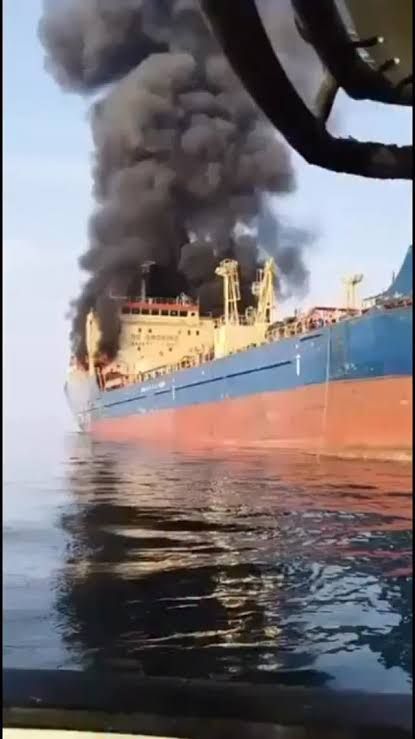
Attack on vessel in the Strait of Hormuz
Funso OLOJO, with agency report
The on- going hostilies in the Middle East have continued to stifle international trade as most of the shipping companies have suspended voyage through the troubled Strait of Hormuz.
The joint attacks by the military forces of the United States of America (USA) and Israel on the Islamic Republic of Iran, which resulted in the assassination of its Supreme leader, Ayatollah Ali Khomenei and over 40 top military officers of the Islamic country,have put a strain on shipping operations along the busy vessel route of Strait of Hormuz as the Houthis militias, who are sympathetic to Iran, have threatened to attack vessels on the route.
Strait of Hormuz accounts for one third of the world shipping passage while the route accommodates the world largest crude tankers , despite its narrow width.
As a result of the threats, which have raised safety concerns on the vessels, cargos and crews, major shipping lines have halted their operations along the route.
Maersk, the world’s largest container shipping company, has halted passage of cargo vessels through the Strait of Hormuz for “safety” reasons.

“We are suspending all vessel crossings in the Strait of Hormuz until further notice,” the Danish group said in an online advisory.“The safety of our crews, vessels and customers’ cargo remains our key priority,” it said.

Iran’s Revolutionary Guard had earlier announced the Strait’s closure.

Major Middle Eastern oil and gas exporters rely on it to move supplies to international markets while importing nations depend on its uninterrupted operation.
China, one of the biggest destinations of Nigerian importers, make use of the route for import of the crude oil from the Middle East, especially Iran and export of its manufactured goods to the developing countries, especially Nigeria.
This development has raised anxiety among Nigerian importers who expressed concerns over the implications of the disruption on the route one the cost of imports, especially from China.
Continue Reading

Headlines

NRC hosts Rotary Club on mobile train

Gloria Odion, Reporter 
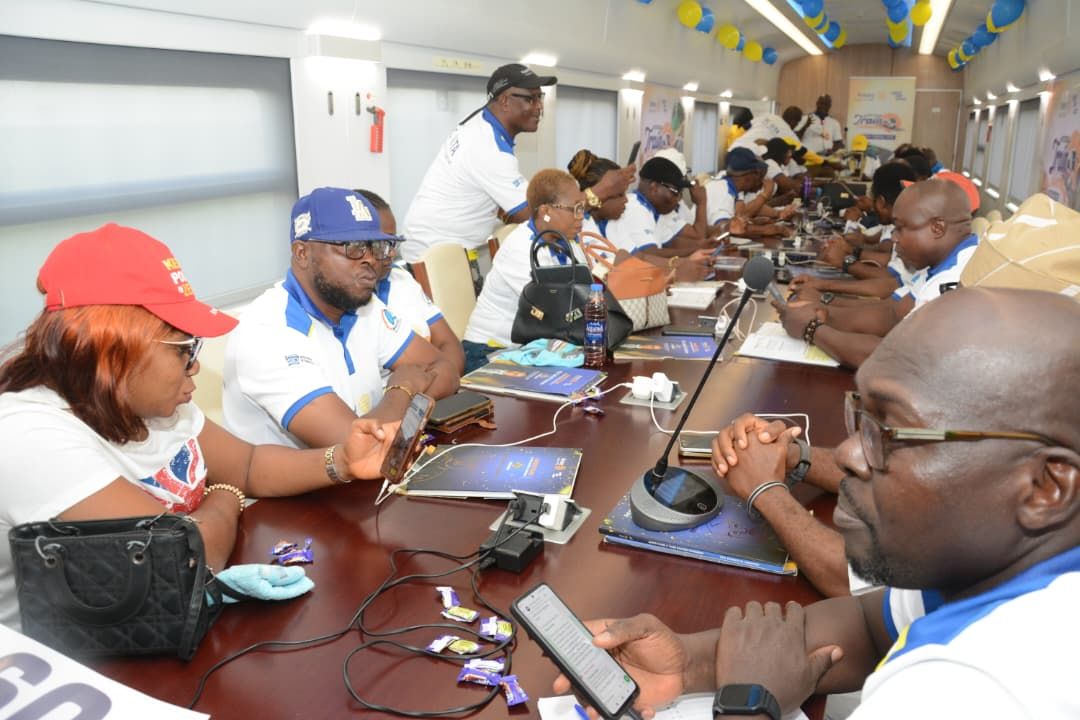
The Nigerian Railway Corporation (NRC) has played host to the Rotary Club of Ota by hosting Nigeria’s first-ever Rotary fellowship on a moving train, setting a remarkable benchmark for innovation in civic and humanitarian engagement.
The groundbreaking event brought together members of the club aboard a moving train for fellowship, leadership interaction, and strategic discussion centered on service to humanity, climate action, and sustainable community development.
The fellowship was led by the President of the Rotary Club of Ota, Mr. Charles Umukoro, alongside members of the club’s executive and general membership.
A major highlight of the occasion was the visit of the Railway District Manager, Engr. Rasheed Adedeji, who warmly welcomed the Rotarians on board.
His presence underscored the significance of the event and further strengthened the cordial relationship between the railway management and the Rotary Club.
In a symbolic moment reflecting shared values of service and partnership, Engr. Rasheed Adedeji was formally inducted as a member of the Rotary Club of Ota following his welcome address, adding prestige and deeper institutional collaboration to the landmark fellowship.
The moving-train fellowship was widely described as symbolic of progress, innovation, and forward movement—values that align closely with the transformation agenda of the Nigerian Railway Corporation.
The Nigerian Railway Corporation said it was committed to supporting initiatives that promote national development, environmental sustainability, and community advancement, while showcasing the railway as a safe, modern, and strategic platform for engagement.
Continue Reading

Trending