Connect with us

Headlines

Dryad Global cautions “not yet Uhuru” despite decline in piracy in Gulf of Guinea
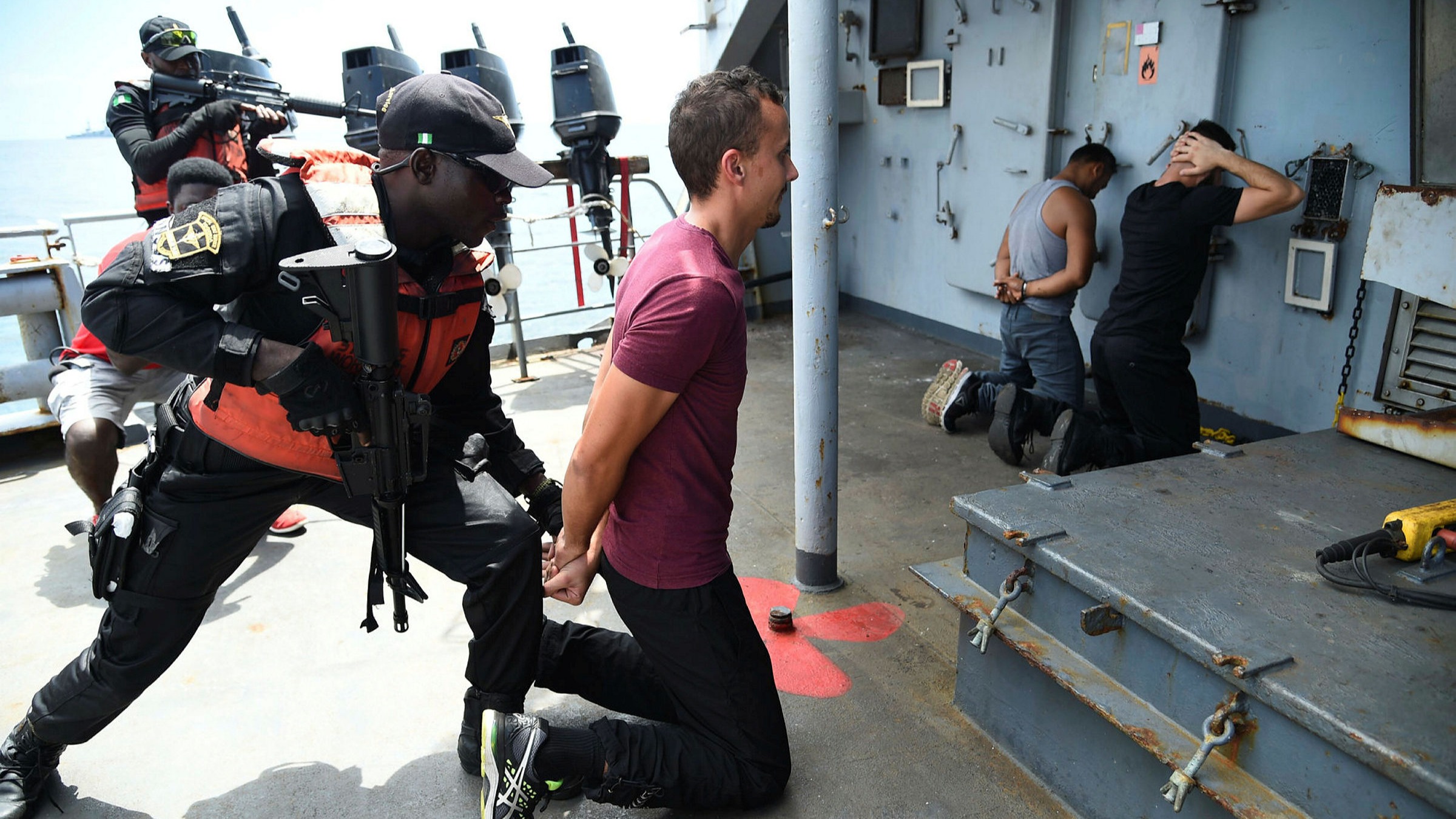
Pirates attack in Gulf of Guinea
A maritime risk management company, Dryad Global, has advised the global maritime community, especially the coastal states in the Gulf of Guinea, not to be carried away by the euphoria of the decline in the pirate attacks in the region, urging them to be cautious in their enthusiasm.
The International Maritime Bureau ( IMB) has declared that the Gulf of Guinea witnessed a sharp drop of about 54 per cent in the activities of pirates in the Gulf of Guinea in 2021, the lowest ever recorded in about 17 years.
However, Dryad Global said the stakeholders should not be taken in by these statistics, cautioning that the drop doesn’t mean the pirate threats in the Gulf of Guinea are over.
“A decline last year in piracy in the Gulf of Guinea, which has for some time been the epicentre of maritime crime, should be treated with caution and does not mean the threat has disappeared” Dryad Global declared

While Dryad welcomed the significant decline in 2021 of incidents in the region, often involving the violent armed boarding of vessels and the kidnap and ransom of crews, it questioned whether the risk to ships and crews has been reduced.

In 2021, overall incidents of piracy and maritime crime throughout West Africa declined by 54% compared to 2020,  Dryad noted in a recent analysis of maritime security in West Africa.

 Incidents of actual and attempted attacks and vessels being fired upon declined by more than 75% and the overall numbers of vessels boarded throughout the region have fallen by 32%.
 Incidents of vessels being boarded and crews kidnapped have declined by 66%.
The International Maritime Bureau (IMB) attributed “vigorous action” by authorities as one reason for the drop in piracy.
Last year the IMB Piracy Reporting Centre received 132 incidents of piracy and armed robbery against ships around the world.
Incidents comprised 115 vessels boarded, 11 attempted attacks, five vessels fired on and one vessel hijacked.

The overall reduction in reported incidents in 2021 is attributed to a decline in activity in the Gulf of Guinea region which saw reported incidents decrease from 81 in 2020 to 34 in 2021.

 Kidnappings at sea dropped 55% in 2021. The Gulf of Guinea continues to account for all kidnapping incidents globally, with 57 crew members taken in seven separate incidents, the IMB noted.

“In assessing trend data alone across the past 11 months, it would be easy, but false, to conclude that a reduction in numbers is indicative of a decline in the threat from piracy and maritime crime in West Africa,” writes Dryad Global’s Head of Intelligence,  Munro Anderson.

Anderson believes that only when capability, opportunity, and intent are disrupted that a sustained reduction in threat is likely to be achieved.

When looking at the reasons for the drop in piracy off West Africa, Dryad sees a significant development being the launch of Nigeria’s highly anticipated ‘Integrated National Security and Waterways Protection Infrastructure programme’, also known as the ‘Deep Blue Project’ (DBP).

This is the first integrated maritime security strategy in West Africa aimed at countering piracy.
Launched on 10 June 2021, it will see the phased deployment of 16 armoured vehicles for coastal patrol, two special mission vessels, 17 fast interceptor boats, two special mission aircraft for surveillance of the country’s exclusive economic zone, three special mission helicopters for search and rescue operations, and four unmanned aerial vehicles.

Further significant development within Nigeria is the launching of the ‘Suppression of Piracy and other Maritime Offenses (SPOMO) Act’ passed by its National Assembly in 2019, providing a dedicated legislative framework through which to support the prosecution of maritime crime and piracy.

Nigeria has to date shown a willingness to publicly signpost the successful implementation of the SPOMO Act.

 Ubong Essien, Special Assistant on Communication and Strategy to the Director-General of NIMASA, stated that the recent conviction of 10 people for the hijacking of the FV Hailufeng II on 15 May 2020 brought the number of pirates that have been convicted under the SPOMO Act to 20.
With an approximate 16-month timeframe for conviction, the success of such operations within 2021 may not be known until a much later date, Dryad pointed out.

“The DBP and corresponding legislative reform have placed Nigeria in a definitive position of leadership in the fight against piracy and maritime crime within the Gulf of Guinea.

“However, despite the commendable efforts of Nigeria, the absence of data indicating a tangible and sustained engagement of assets in the interruption of offshore acts of piracy suggests that the launch of the DBP and the implementation of the SPOMO Act is far from solely responsible for the dramatic decline in piracy throughout the region,” Anderson writes.

In seeking to explain the steep decline in piracy throughout the Gulf of Guinea, Dryad looked at the role of intent, which it said is primarily driven by poverty.

 Additional factors include unemployment, weak governance, corruption, community violence and militancy, established subgroup hostility to the state and the presence of established organised crime.
All of these drive disenfranchised young men from riverine and coastal communities towards serious organised crime and piracy.

Anderson believed that additional security resources seldom deter pirates and in Somalia, groups of disenfranchised young men were only incentivised away from piracy following the launch of onshore programmes of economic development and reform.

“Throughout 202,  there has been little substantive improvement in these core conditions throughout the disparate communities of Niger Delta states.

“A situation further compounded by the impact of the COVID pandemic on national resources and international assistance.
 2021 has seen an increase in riverine criminality involving attacks on local populations and riverine communities and a new militant grouping under the aegis of the Bayan-Men has unleashed a campaign of violence and disorder against multinational oil companies within the region, motivated by a perceived lack of community incentive and involvement,” Dryad noted.

“Consequently, without improvement in the conditions onshore that create a fertile setting for piracy, it is near impossible to argue that there has been any alteration or deterrence against individuals’ intent to engage in piracy” Dryad declared.

Piracy is essentially a form of serious organised crime and one of its hallmarks is its ability to occupy the ‘grey space’ between legitimate and legal enterprise and criminal network, with members often occupying official positions in business or local government.

Within the southern Delta states, this ‘grey space’ of legitimacy is deeply ingrained, Anderson believed.
“Ingrained corruption and ineffectual governance have given rise to a vast network of criminality that spans narcotics and pharmaceutical product smuggling, illegal fuel bunkering, militancy, and piracy.”

With the launch of the $195 million, Deep Blue Project came a substantial level of political focus, both domestic and international.

“Such a focus is highly likely to have had a detrimental impact on the freedom of movement and operations of those who occupy the described grey space of legitimacy in the southern Delta states.
” With Nigeria calling for an end to war risk premiums for vessels operating in its waters, there is a great deal of political investment in the success of the DBP, and it is highly likely that this investment has translated into a hostile operating environment for any would-be ‘sponsor’ of offshore piracy,” Anderson noted.

“It could be argued that the intensity of the political focus, which has created an increasingly hostile environment for would-be piracy sponsors, has reduced piracy, via the ‘back door’ and regardless of cause, the effect is to be welcomed.

” However, such assumptions would be false. The criminality of this nature has a fluidity that is likely to adapt and overcome political pressure and will most likely lead to a return to high volumes of piracy as political focus wanes.”

In conclusion, Dryad believed the decline in piracy in 2021 should not be seen as indicative of any fundamental or lasting change brought about by any one state or initiative.

“Claims of radically reduced risks within such a short timeframe and calls for the ending of war risk premiums are premature.
” Whilst regional counter-piracy efforts in 2021 are to be commended, they require long term investment, both politically and financially, with onshore investment arguably of greater importance than offshore assets.”

Similarly, the IMB urged seafarers to continue exercising caution and vigilance in spite of a drop in attacks.

 The IMB Piracy Reporting Centre warned the threat to seafarers persists and continues to urge crews and vessels plying Gulf of Guinea waters to be cautious.
 This is because perpetrators are violent and the risk to crews remains high. Evidence of this was the kidnapping of six crew members from a container vessel in mid-December.

Continue Reading
Click to comment

Leave a Reply

Your email address will not be published. Required fields are marked *

Headlines

Open Letter to President Bola Ahmed Tinubu on the need to assent to the Nigerian Shipping and Ports Economic Regulatory Agency(NSPERA) bill

By Elder Asu Beks

Mr President,on behalf of the  Maritime Elders Forum and  entire maritime stakeholders, i respectfully send you  season’s greetings.
There is no doubt, Mr President, that 2025 has been one of the most turbulent and challenging years in the history of our nation.
 From the wave of insecurity ,which you have tackled squarely,to the far reaching  economic reforms  which has translated to the tax reform bills , are all  pointers to the fact that you are taking the challenges head on.
Mr President , your modest achievements in the Oil and Gas sector are also there for all to see.
From the bold decision to abolish fuel subsidy to the increase in daily production levels to an average 1.8m bpd ,from about 1mbpd daily output as at May ,2023, and the complete disapperance of fuel queues, it is certain, Mr President, that you are building a legacy of renewed hope, unprecedented in the life of our nation.
 We cannot thank you enough, Mr President.
 For us in the maritime sector, the most profound of your score card remains  the creation of a specialised Ministry of Marine and Blue Economy.
The demand for a Ministry to oversee Nigeria’s vast  maritime domain is as old as Nigeria’s Independence.
For us as critical stakeholders, this couldnt have come at a better time.
 In just two years of the creation of this specialised Ministry, Nigerians are already reaping bountifully from this innovative move.
Only last month,Nigeria won an election into the elusive category ” C” of the International Maritime Organisation, (IMO).
This victory  is coming after  nine unsuccessful  attempts, spanning 14 years.
With this victory , which couldn’t have been posible without  your fatherly role,our fortunes as one of the greatest maritime nations in sub saharan Africa  has  been solidified.
 Mr President, another milestone recorded under your watch ,since the creation of the Ministry of Marine and Blue Economy is the introduction of the game changing National Single Window platform which comes into effect  in the first  quarter of 2026.
The National Single Window is a trade facilitation tool designed  to eliminate multiple entries by various regulatory bodies in business transactions in our seaports.
In other words, it is a digitalized platform that allows importers and exporters to submit all necessary documents, permits , and data to multiple government agencies through a single entry point.
Mr President, with these developments, you have etched your name as “the President who saw  tomorrow” by demonstrating in concrete terms, the enormous  potentials which this sector holds as your administration continues to look at a Nigeria beyond oil.
In this regard, Mr President ,we the  Maritime Elders Forum urge you ,without delay  to  sign into law, the Nigerian Shipping and Port Regulatory Agency (NPERA) Bill .
The NPERA Bill aims to transform the Nigerian Shippers Council, (NSC) into a powerful, independent economic regulator for Nigeria’s Ports,creating a strong  frame work for tariffs,fair competition and efficiency after port concession.
The Bill, a brain child of  Dr Tajudeen Abass, Speaker, Federal House of Representatives, is  aimed  to fill the vacuum created by an absence of  a  regulatory  agency in such a critical sector of our national economy ,as against other sectors such as  banking, petroleum , energy and  communication.
This critical Bill seeks to repeal the old Nigerian Shippers Council Act and empower the Council to manage port economic activities, boosting the Blue Economy.
Mr President, the laudable objectives of this Bill include;establishing an independent  regulation to create a strong legally backed economic regulator for our ports; Control tariffs, charges and regulate port charges  in such a manner as to prevent arbitrariness  and ensure fairness; to promote fair competition by improving overall port operations and attract investment; Support the Blue Economy to align with our national goals for developing Nigeria’s Marine Economy.
 Your Excellency Sir, this Bill was given an accelerated hearing ,and was passed by both chambers of the National Assembly on April 10, 2025 upon which it was forwarded to you for assent.
 Mr President sir, the delay or your failure to assent to this  Bill is coming at huge cost and has resulted in significant economic losses for Nigeria, primarily by perpetuating an unregulated and inefficient port system that has led to huge financial leakages that deter investment.
 Mr President, sir, it is estimated that the nation is losing billions of dollars dailly to the absence of a strong legal frame work for port economic regulation.
We have on good authority, Mr President, that this obvious lack or absence of a regulated ports industry is also taking a huge toll on local and foreign investments as an estimated $250b is said to be lost annually, aside arbitrary charges by terminal operators and Shipping Lines .
 In a nutshell, Mr President, the envisaged benefits of this brand new Ministry of Marine and Blue Economy has been eroded on account of the absence of a legal regulatory frame work.
As it stands, sir ,a Ministry of Marine and Blue Economy without an Economic Regulator is akin to a football game without a referee.
it means anything goes and the out come of a game without an official umpire could be better imagined.
 Mr President sir, consequently ,the time to sign the NPERA Bill is now.
Thank you Mr President for listening to this passionate appeal.
 Let this be your new year present to Maritime Stakeholders.
ELDER ASU BEKS, CONVENER, MARITIME ELDERS FORUM, LAGOS
Continue Reading

Headlines

Tantita intercepts stolen crude on escort of  Delta Marine Police, arrests four suspects 

Funso OLOJO 
Tantita Security Services Limited, a pipeline surveillance operations company, has intercepted a tanker vessel, MT Thor, laden with suspected stolen crude oil.
The interception, which occurred on December 15th, 2025, around the Koko–Excravos axis of Delta State, happened while the vessel was allegedly being escorted by personnel of the Police Marine Unit, Delta State, who reportedly claimed they were acting on directives from the Force Intelligence Department (FID), Abuja.
Four suspects have been apprehended in connection with the incident and are currently facing investigation for possible prosecution.
The arrest was announced during the handover of the suspects at Koko Port in Delta State by Tantita Security Services Limited (TSSNL), a firm engaged in pipeline surveillance operations.
Speaking at the handover of the vessel and the suspects at Koko Port, Delta state, the Executive Director of Operations at Tantita, Captain Warredi Enisouh, said the suspects were apprehended with an unspecified quantity of suspected illegally sourced petroleum products aboard the vessel.
According to a situation report made available by the Special Prosecution Team (SPT) of the Inter-Agency Task Force on Petroleum Product Theft, Tantita alerted the Head of Investigation of the SPT after intercepting MT Thor, which was allegedly laden with crude oil obtained through illicit means.
Preliminary investigations by law enforcement agencies revealed that the vessel, now classified as an exhibit in an ongoing criminal investigation, is linked to a jetty operated by Ebenco Global Services Limited.
Investigation officers disclosed that documents and correspondence connected to the jetty were obtained and are currently under review.
“The owner of the jetty, Mr. Ebenezer, was contacted by investigators and reportedly provided additional documents, including court orders, which are also being analysed as part of the investigation.
“On December 16, a joint investigation team led by the Head of Investigation of the SPT conducted a Joint Inspection Visit in Koko.
The team first met at Tantita’s corporate headquarters in Warri for a briefing, which was also attended by the jetty owner.
“During the inspection, investigators attempted to obtain samples from MT Thor but were unable to do so immediately as the vessel had not yet arrived at the jetty, having been towed from an earlier location by security operatives.
“While awaiting the vessel’s arrival, the team inspected other containers suspected to be carrying crude oil within the premises of Ebenco Global Links Limited, where samples were taken from a storage barge.
“MT Thor eventually berthed at about 8:30 p.m. on 16 December, prompting the joint team to adjourn sampling and other procedures until the following day.
 As of 17 December 2025, investigators were reported to be en route to Koko to continue sample collection and complete investigation formalities,” the report read.
Receiving the suspects, the Head of the Special Prosecution Team of the Inter-Agency Task Force, Omar Sini, reaffirmed the Federal Government’s resolve to dismantle crude oil theft networks in the Niger Delta, assuring that all findings would be thoroughly examined and prosecuted in line with the law.
Continue Reading

Headlines

Mobereola, NIMASA DG, reflects on year 2025 with satisfaction, says 2026 holds promising opportunities for maritime industry 

Funso OLOJO
The Director -General of the Nigerian Maritime Administration and Safety Agency (NIMASA) Dr. Dayo Mobereola, has expressed his satisfaction over the achievements recorded in the maritime industry in the outgoing year of 2025, while looking forward to a promising 2026 with hope.
In his Christmas message to the stakeholders in the maritime industry, Dr Mobereola noted that the 2026 ended well with the election of Nigeria into the category C of the International Maritime Organization (IMO) after 14 years of failed attempts as well as zero occurrence of piracy attacks on Nigeria’ waters.
“The year 2025 has been a good one for our industry as once again, we have not recorded a single piracy attack in our waters in a whole calendar year, Nigeria was also able to deposit three Instruments of Accession to IMO Conventions that were signed by President Bola Tinubu ,we have been able to maintain industrial harmony in the sector all of which culminated to Nigeria’s election into the category C Council of the International Maritime Organization.
“We couldn’t have done this without our stakeholders who have contributed in various ways in the course of their operations during the year. We see you, we thank you and we felicitate with your during this yuletide season”Mobereola observed.
He however assured that the Agency will re-double efforts in ensuring that 2026 is even better for every stakeholder.
While calling on industry operators to brace up for the new year with hope of better times, Dr. Mobereola noted that “at NIMASA, we appreciate the weight of our renewed responsibility by virtue of Nigeria’s membership of the IMO Council because to whom much is given, much is definitely expected.

” You can therefore be sure of an increased momentum in our resolve to sustain maritime safety, security, environmental protection and adherence to relevant conventions and protocols with renewed vigour.”

The DG concluded by acknowledging the support of President Bola Ahmed Tinubu, Adegboyega Oyetola, Minister of Marine and Blue Economy, industry stakeholders, management and staff of NIMASA as well as all Nigerians and wished everyone a Merry Christmas and a prosperous New Year.

Continue Reading

Trending