Connect with us

Customs

CTN as panacea for insecurity,  importation of contraband goods through ports.

Since the collapse of scanners at the nation’s  seaports and land borders,  the Nigeria Customs Service has been using manual method(100 percent examination)  to inspect cargoes but experts believe that  re-introduction of CTN at the ports would minimise the high incidence of insecurity through curbing of importation of arms and ammunitions through our ports into the country.

Eyewitness reporter writes

In 2015, the Nigerian Shippers Council was desirous to re-introduce the Cargo Tracking Note (CTN) into the nation’s maritime industry.

But this was met with stiff opposition especially from local Manufacturers who thought it will add to cost of doing business at the ports.

But, the  Council at that time was interested in the overall national security and safety of Nigerians because it is believed that the CTN will help check importation of arms, ammunition and hazardous materials into the country.

Two years after the council bowed to pressure and suspended the laudable projects, arms and ammunitions were being imported freely into the country but few are being intercepted in and outside the nation’s seaports, a situation the council want to avert through the CTN but was thwarted by stakeholders.

For instance,  in January 2017, the Federal Operations Unit (FOU), Zone A of the Nigeria Customs Service (NCS) intercepted 49 boxes containing 661 pieces of pump action rifles.

The ammunitions were intercepted by officers of the federal operations unit (FOU), Zone A, Ikeja, in a Mark truck with registration number BUG 265 XG, the 40 feet container with number; PONU/825914/3 along Mile 2 Apapa Road, in Lagos.

Thee boxes were concealed with steel and other merchandise goods.

Also in  May,  2017, another 440 pump action rifles were intercepted at the Tin Can Island Command, Lagos.

According to the then Zonal Co-ordinator of the Zone, Monday Abue, the cargo was shipped into the country from Turkey and concealed in POP.

On the 7th of September, 2017 another 1,100 rifles were further intercepted in a 20ft container  with No GESU2555208 during examination, while the Bill of Lading falsely indicated wash hand basins and water closets.

A week after, another container with about 475 pump action rifles with container number, CMAU189817/8 carrie about 475 pump action rifles.

However,  2018 was not spared as the Customs Service intercepted live ammunitions at the Tin-Can island port.

The Tin-Can Island Command of the service said the live ammunitions were concealed in a vehicle and container at the Lagos Port.

It was gathered that the interception were done in two different operations on the 9th and 10th of July respectively.

According to the Public Relations Officer of the command, Uche Ejiesieme , the first incident at the Terminal ‘C’, involved 1 x 40ft container No. TGHU 60143419, which on scheduled examination was found to contain 150 rounds of live ammunition and jack knives while  149 rounds of 38mm calibre live ammunition, 92 rounds of 9mm calibre live ammunition, 2 rounds Of 7.62MM calibre live ammunition,  11 cartridges of live ammunition,12 expenses empty shells of various calibre and one empty magazine were uncovered in another vehicle.”

This is part of the few interceptions that were made by the service while  many more may have eluded the eagle eye of the customs service.

But, stakeholders have argued that the CTN, if it had been  implemented in 2015 ,would have detected the contrabands before it was loaded on vessels to Nigeria.

Even,  the Central Bank of Nigeria agreed that the CTN would not only checkmate under declaration and share trade information but will also assist the Nigeria Customs Service to risk mitigation on imports, enhance and block revenue leakages at the ports.

Speaking, a frontline Importer, Ikechukwu Shedrack ,said the CTN would serve as a security measure to ensure safety and security of goods shipped from one part of the world to another.

“It is meant to be implemented worldwide. The regulation requires shippers to have a Cargo Tracking Note (CTN) accompanying all shipments.

“The CTN will help enhance security at a time Nigerian government is have difficulties in replacing obsolete scanners at the ports. It will give information of cargoes to be imported even before loading and it will help know what should be imported and what not to be imported into the country, especially if it were to be arms and ammunitions it will be intercepted at point of loading”

“Aside under declaration, the CTN will also bring trade information.

Research had also shown that the CTN, when reintroduced, is different from the old ways of monitoring cargoes as it has four distinct features from the previous tracking device.

It is noteworthy that, as can be seen from the agreement, four important features distinguish the current ICTN Scheme from the abolished version.

That is, the current scheme will be implemented at no cost to the shipper/consignee, at all and the current scheme is web based and therefore paperless,thus making the delay associated with obtaining Cargo Tracking Note and associated documentation by Shippers, under the abolished version of the scheme completely eliminated as the shipper needs not do anything apart from declaring in advance (i.e. at the loading port), information relating to the cargo.

Also,  the one hundred and fifty dollars ($150) per container CTN fee charged under the abolished version, paid by the shippers, which led to the stakeholders vehement protest against the scheme and its eventual abolishment, was radically modified and reduced to a token administrative fee of twenty five dollars ($25) per container, thereby making it the lowest in our West and Central African Sub-region.

This became necessary not only in view of Nigeria’s volume of trade but also to substantially downplay the insinuated revenue generation motive of the old version of the scheme in favour of the actual and more important Trader Information Generation motive which has tremendous potential to impact positively on the nation’s effort in Trade Facilitation, National Planning and National Security;

The NSC-TPMS Sharing Ration of the collectible Administrative fee was negotiated and reviewed from 60-40, under the abolished scheme, to 65-35 thereby raising the share accruable to the government.

Also,  all vessels loading and unloading or in transit (Export/Import and Transit) departing from Nigeria Ports or having Nigerian Ports as final destination or transiting through Nigerian ports shall, before any movement, obtain a Movement Reference Number (MRN).

The MRN will be allocated to the vessels by Nigerian Shippers’ Council irrespective of the origin of the vessel of cargoes.

 The Executive Secretary of the Nigerian Shippers Council, Barr. Hassan Bello had then disclosed that the CTN would be reintroduced to help curb importation of arms and ammunition into the country.

He said, “The Cargo Tracking Note would soon be reintroduced at a very negligible cost. CTN is a security thing because when we have it, there won’t be smuggling of firearms and all other contrabands.

” Smuggling of contraband won’t happen because everything coming in will be tracked, we will know the weight of the cargo, values and materials used.”

Bello stated further that the CTN would also help the Standards Organisation of Nigeria (SON) and National Agency for Food Drugs Administration and Control (NAFDAC) to fight substandard products and fake drugs respectively.

 “SON and NAFDAC will benefit by knowing whether products being imported are fake or not.

“I am calling on all the port stakeholders such as manufacturers, shippers and the rest to support this. That is why the Nigerian Shippers Council wants to develop the port community system because what the port needs is unity.

” There is need for everyone to come together on a platform to know what the other is doing. It is good for data collection for planning and for you to know your customers,” said Bello.
But the desire of the Shippers’Council to reintroduce the controvesial CTN was not to be at that period as it  was again aborted as stakeholders effectively shut down the move despite the efforts of the council to convince them.
But the country may once again have a shot at the CTN few years after  it was shot down by the sceptical stakeholders.
Following the resurgence of insecurity in the country which has assumed a verocious dimension, the Federal government has asked the Nigerian Shippers’Council to resuscitate the move to reintroduce the controvesial CTN to track all imports in order to identify and curtail importation of arms and ammunitions into the country through the ports.
Continue Reading
Click to comment

Leave a Reply

Your email address will not be published. Required fields are marked *

Customs

Dera Nnadi bows out of Customs in a blaze of glory 
Geraldine Samuel, Reporter 
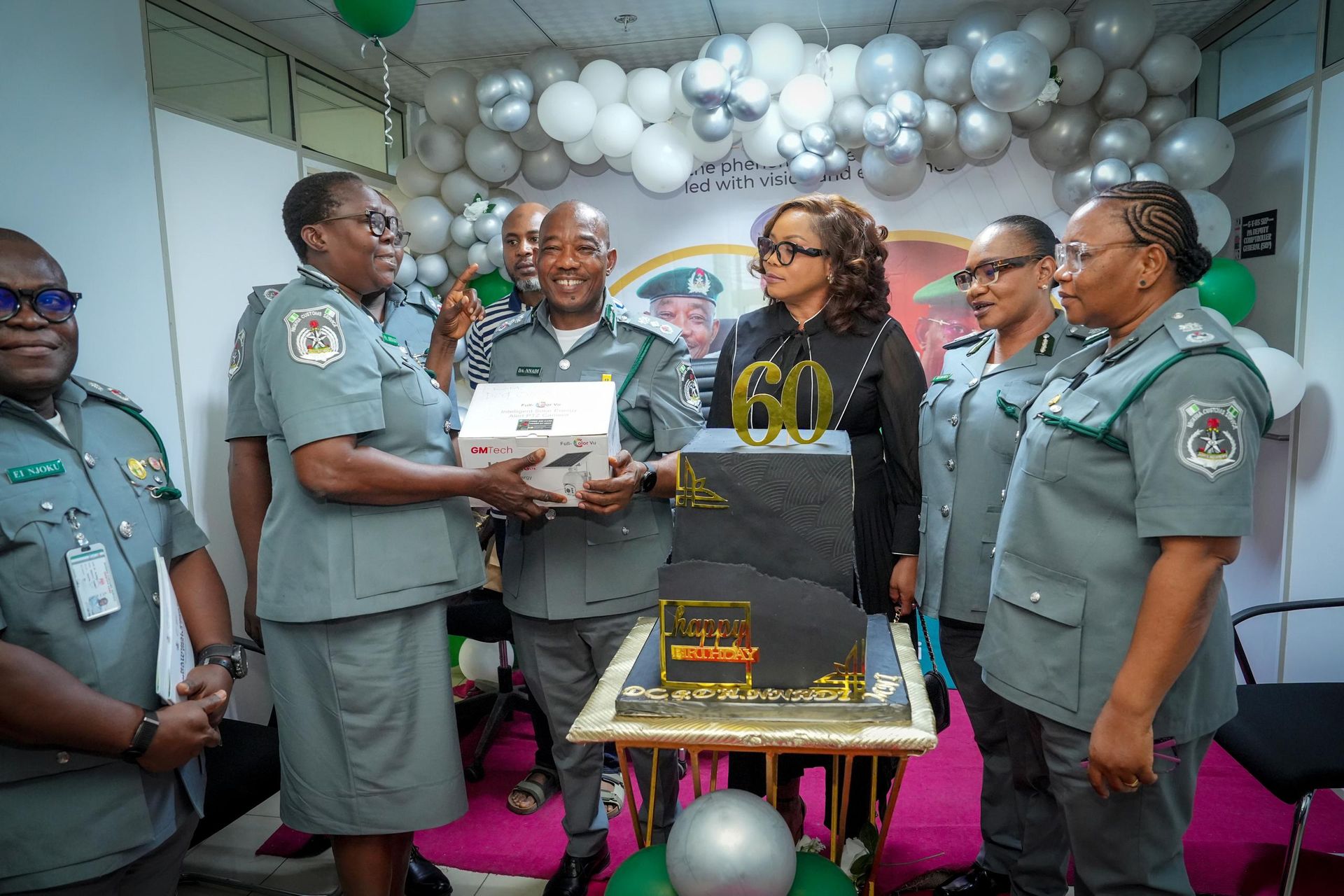
Dera Nnadi, a Deputy Comptroller- General of Customs(rtd), has dropped anchor of service in the Nigeria Customs and graceful bowed out of the agency in a blaze of glory.
In a commemorative retirement ceremony conducted by his appreciative colleagues at the Customs’ Headquarters, Abuja on March 3rd, 2026, Nnadi was pulled out of the Service he has diligently served amidst glowing tributes.
Incidentally, his pull- out ceremony coincided with his 60th birthday.
Leading the management staff, men and officers of the service in paying moving tributes to the retiring Nnadi was the Comptroller- General of Customs, Adewale Adeniyi, who described DCG(rtd) Nnadi as an exemplary officer whose professionalism, discipline, and commitment to duty significantly strengthened the values and operational effectiveness of the NCS.
According to the CGC, the retirement ceremony provided an opportunity not only to celebrate a successful career but also to appreciate the sacrifices and dedication of officers who devote their lives to safeguarding the nation’s economic and border security interests.
 He noted that Nnadi’s career reflects the core ideals of the Nigeria Customs Service, particularly in leadership, revenue generation and trade facilitation.
“Today is a moment of celebration and reflection. It is also an opportunity for us to thank Almighty God for the grace that has sustained our colleague throughout his years of service,” the CGC said.
The CGC also highlighted the personal and professional bond he shares with the retiree, noting that their relationship extends beyond official duties to family ties.
 He expressed confidence that DCG Nnadi still possesses the energy and experience to continue contributing meaningfully to national development through academic and other professional engagements.
Members of the Service’s management team also paid glowing tributes to the retired DCG, commending his leadership qualities, integrity and mentorship.
 Officers who served under him described him as a dependable leader who provided guidance and encouragement to younger personnel while strengthening the Service’s institutional capacity.
Responding to the honour, DCG Dera Nnadi (Rtd) expressed appreciation to the Comptroller-General of Customs, the management team, officers and Men of the Service for their support and cooperation throughout his career.
He described his years in the NCS as a fulfilling journey of growth, learning and service to the nation.
The ceremony featured the presentation of awards, gift items and commemorative photographs in honour of the distinguished officer.
Continue Reading

Customs

Customs takes charge of implementation of National Single Window project 

– rallies stakeholders for successful take-off 
Funso OLOJO, Editor 
As the preparations for the official launch of National Single Window(NSW) project on March 27th, 2026 gather momentum, the Nigeria Customs service may have been designated as the lead agency to drive the modernisation project.
This much was confirmed by the Director of the Project, Tola Fakolade who  acknowledged the pivotal leadership of the NCS in the implementation process.
At one of the stakeholders sensitisation programmes in Abuja on March 3rd, 2026, Fakolade declared “Our number one stakeholder is the NCS,”
“We have maintained a strong and constructive working relationship.
Customs’ participation and institutional experience are critical to the success of this project.” the project coordinator confirmed.
Confirming the lead role of the NCS, the Deputy Comptroller-General of Customs in charge of ICT and Modernisation, DCG Oluyomi Adebakin, described the NSW as a major milestone in the Service’s ongoing modernisation drive.
She revealed that the NCS has been actively engaged in preparatory work for months to ensure that the framework being developed reflects operational realities and supports seamless implementation.
“This is a national project, but Customs is at the centre of its execution,” DCG Adebakin said.
 “The success of the Single Window depends on collective understanding and cooperation. We must all appreciate its value because we cannot effectively promote what we do not fully understand.”
She reassured officers and stakeholders that the initiative is designed to strengthen institutional capacity rather than replace human resources, explaining that technology will enhance efficiency, transparency, and speed in cargo clearance and trade documentation processes.
Reaffirming the critical role of the service in the implementation of the NSW project, the Comptroller- General of Customs, Adewale Adeniyi, at the Abuja stakeholders engagement with airlines and shipping companies held on March 4th, 2026, emphasised the importance of collaboration in ensuring the successful rollout of the initiative.
He noted that the support of critical stakeholders has played a significant role in the achievements recorded in the Service’s modernisation journey so far.
Adeniyi disclosed that President Bola Ahmed Tinubu has mandated the Service to take a bold step forward towards a successful launch of the National Single Window, a move aimed at positioning Nigeria as a major player in global trade.
 He added that airline and shipping line operators remain vital partners in ensuring a seamless transition to the new system.
He further assured stakeholders that adequate support structures are being put in place to ease the migration process.
“A help desk with well-trained personnel will be available to address any operational challenges that may arise during the rollout”, the Comptroller-General stated.
The NCS described  the National Single Window as a strategic reform that aligns with Customs’ mandate of trade facilitation, revenue generation, and inter-agency coordination.
With the NCS spearheading coordination and stakeholder engagement, the NSW project is expected to transform Nigeria’s trade environment, enhance revenue generation, and strengthen the country’s position in the global trading community.
Continue Reading

Customs

Seme Customs in revenue windfall as it collects N3.5 billion in February.
Funso OLOJO,Editor 
The Seme command of the Nigeria Customs Service has continued to sustain its revenue momentious
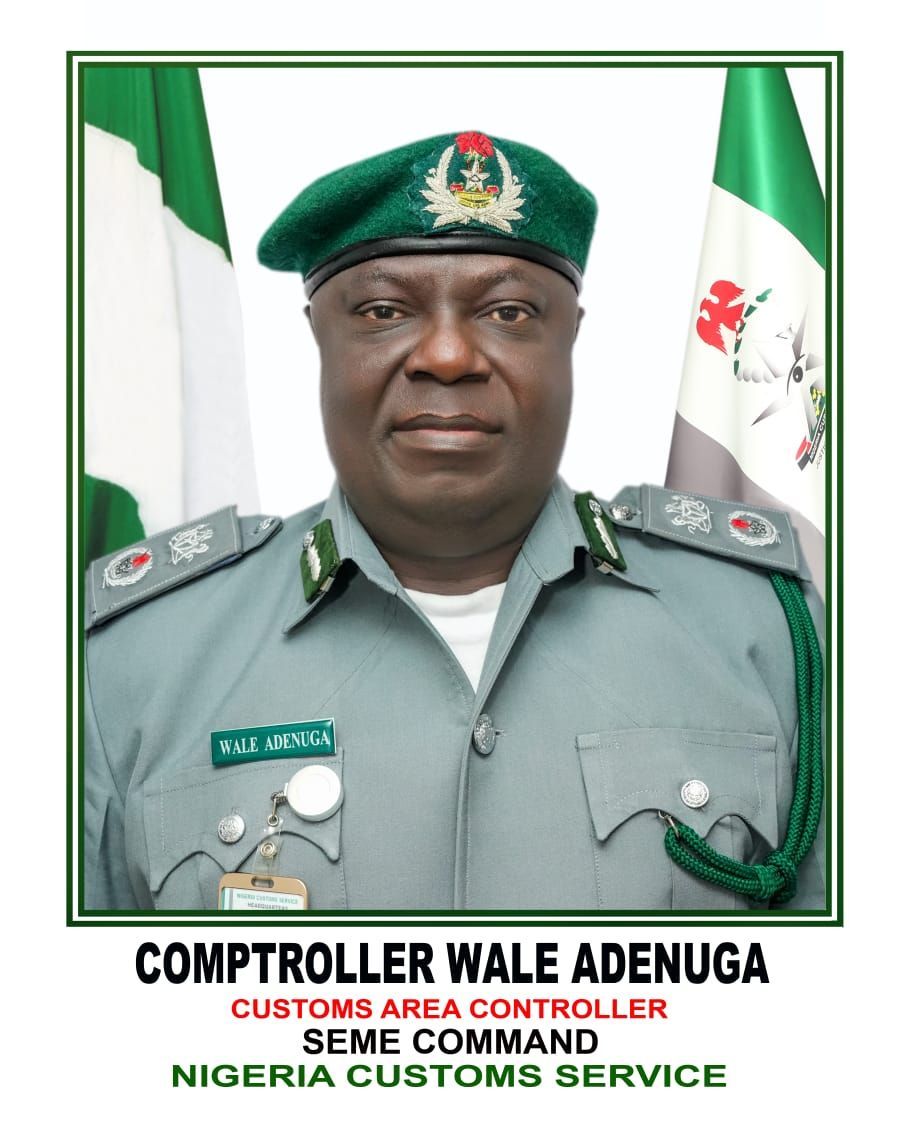
trajectory under the leadership of its Area Controller, Comptroller Wale Adenuga.
According to revenue statistics made available to our reporter by the command, it has garnered a princely sum of N3,480,970,924.67 in revenue for the month of February 2026, with the month still ongoing.
Comptroller Adenuga made this disclosure during an interactive session at a stakeholders’ engagement meeting with cross-border traders ,farmers and stakeholders organised by the Nigerian Shippers’ Council in collaboration with the ECOWAS Commission, ECOWAS Agricultural Trade Programme and GIZ International.
The event, held in Badagry on Wednesday, February 25th, 2026, was themed “Empowering Cross-Border Traders through Trade Information Desk for Agricultural Traders”.
Comptroller Adenuga noted the revenue figure represents a remarkable improvement over the N743,698,652.16 recorded in February 2025 which he attributed to the seamless trade facilitation process adopted at the Command.
 “For this February that has not yet ended, we have already generated N3,480,970,924.67 as against N743,698,652.16 revenue generated in February 2025″ Adenuga told the stakeholders.
He said the feat was a reflection of
the flow of trade which he believed was getting better as people are building greater confidence in the Seme–Krake corridor.
Comptroller Adenuga assured traders and stakeholders that the significant reduction in checkpoints along the Seme–Gbaji axis is the direct result of strong collaborative efforts with other security agencies operating within the corridor.
 He disclosed that only Agbara and Gbaji remain the officially Customs approved and sanctioned checkpoints along this Lagos-Abidjan corridor.
The Customs Chief further attributed the noticeable decline in crime rates along the Seme-Gbaji axis to the positive outcomes of monthly joint border security meetings involving all agencies at the border post.
These regular inter-agency engagements, according to him, have strengthened better cooperation, improved intelligence sharing and more effective responses to security challenges, thereby creating a safer and more enabling environment for cross-border trade.
Adenuga declared that while revenue generation and trade facilitation remain key priorities, the Command’s mandate extends firmly to combating illicit activities.
The CAC highlighted recent enforcement successes, including the interception of a Toyota Highlander vehicle conveying 22 packages of cocaine with an estimated street value exceeding N1 billion, a feat he claimed was made possible based on very  credible information shared by the CGC.
In addition, during February 2026 alone, the Command has seized 1,000 bags of 50kg parboiled rice, underscoring its unwavering commitment to suppressing smuggling and protecting Nigeria’s economic borders.
Comptroller Adenuga reiterated the vigilance and commitment of the operatives of the Command in working closely with stakeholders, traders, farmers, sister security agencies and regional partners to improve the momentum of trade and security along the Lagos-Abidjan corridor.
Continue Reading

Trending