Connect with us

Headlines

11 years after, US hints at removing Condition of Entry slammed on vessels originating from Nigeria

scores FG high on maritime security 
Funso OLOJO 
There seems to be a brightened hope in the horizon for vessels originating from Nigeria to the United States as the United States Coast Guard (USCG) has hinted on lifting the Condition of Entry (COE) slammed on vessels departing from some terminal designated as non- compliant with the International Ships and Ports Facility Security (ISPS) Code.
It could be recalled that in June 2014, the  United States through the USCG slammed Conditions of Entry (COE) on vessels originating or calling from some Nigerian Port terminals to the United States which did not comply with the ISPS code
However, the USCG team, which visited Nigeria on peer review of the compliance level of these terminals with the security details of the ISPS code, returned a favourable verdict, saying Nigeria’s compliance to the Port security measures in the ISPS code remains one of the best in the world.
The head of the American team, Joe Prince Larson, while visiting the headquarters of the Nigerian Maritime Administration and Safety Agency(NIMASA) to brief the  elated Director General of the Agency, Dr Dayo Mobereola on the team’ s visit to the Port terminals across the country, declared  that Nigeria has made a considerable progress in the implementation of the ISPS code.
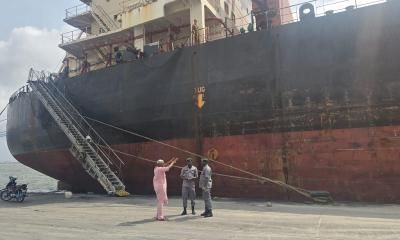
The team had earlier conducted assessment visits to the Dangote Port and Lekki Free Trade Zones in Lekki, Lagos State, as well as private port facilities operated by Matrix and Julius Berger in Warri, Delta State.

While delivering an interim assessment report to NIMASA Management, Larson noted that Nigeria’s compliance with the ISPS Code ranks amongst the best globally.

He added that his team would report their findings to the leadership of the US Coast Guard accordingly and expressed confidence that NIMASA had the capacity to maintain the high standards attained to date.

According to Mr. Larson, “We had the pleasure of visiting Matrix and Julius Berger in Warri, Delta State before proceeding to the Lekki Deep Seaport and Dangote Port in Lagos, with the overall assessment being very positive. 

“We noted that there is a clear and deep understanding on the implementation of the ISPS Code in Nigeria with the level of compliance observed to be at par with some of the best maritime nations globally.

“We would report our findings back to US Coast Guard headquarters accordingly.” 

 Dr Mobereola spoke about the Agency’s commitment to sustaining the improved compliance levels at the nation’s ports while noting the effect this has on how Nigeria is perceived internationally.

He added that the Agency would continue to support efforts under the Minister of Marine and Blue Economy, Adegboyega Oyetola, to improve standards in the Nigerian maritime industry.

“I must express my happiness at the positive feedback we have received from the USCG delegation as it serves as reward for the Federal Government’s commitment to the development of the sector, and the work of the Agency, under the supervision of the Federal Ministry of Marine and Blue Economy, to ensure international standards are adhered to in the area of port security”, he noted.

The USCG has consistently partnered with NIMASA to conduct on-the-spot assessments of the compliance level of Nigerian ports with the ISPS Code.

These evaluations, which commenced last year as part of a three-year plan, are geared towards providing actionable insights and data-based decisions to lift the Condition of Entry (CoE) placed on vessels departing Nigeria for the United States of America.  

Most of the terminals concessioned to private operators in 2006 were cleared by the U.S Coast Guard and exempted from the Condition of Entry imposed in 2014.

They include APM Terminals Apapa, Apapa Bulk Terminal Limited, Greenview Development Nigeria Limited, Tin Can Island Container Terminal (TICT), ENL Consortium, Port and Cargo Handling Services, PTML, and West Africa Container Terminal (WACT) among others.

However, private oil jetties and terminals are mostly found culpable in the security breach and consequently slammed with Conditions of Entry.

The International Ship and Port Facility Security Code (ISPS Code) is a comprehensive set of measures to enhance the security of ships and port facilities.

 It was developed in response to the perceived threats to ships and port facilities in the wake of the 9/11 attacks in the United States.

 The ISPS Code is implemented through chapter XI-2 Special measures to enhance maritime security in the International Convention for the Safety of Life at Sea (SOLAS), 1974.

The Code has two parts, one mandatory and one recommendatory.

In essence, the Code takes the approach that ensuring the security of ships and port facilities is a risk management activity and that, to determine what security measures are appropriate, an assessment of the risks must be made in each particular case.

 The purpose of the Code is to provide a standardised, consistent framework for evaluating risk, enabling Governments to offset changes in threat with changes in vulnerability for ships and port facilities through determination of appropriate security levels and corresponding security measures.

 

Continue Reading
Click to comment

Leave a Reply

Your email address will not be published. Required fields are marked *

Headlines

Indigenous maritime investors seek partnership with NIWA for mutual development of inland waterways 

Gloria Odion, Maritime Reporter 
A coalition of indigenous maritime tourism and transportation investors has pledged to unlock strategic investment opportunities aimed at developing Nigeria’s vast but largely untapped maritime tourism economy for the benefit of littoral communities in Lagos and across the country.
The group, Allied Concessionaires and Blue Economy Alliance, made the commitment during a courtesy visit to the Lagos Area Manager of the National Inland Waterways Authority (NIWA), Engineer Sarat Braimah, on Tuesday at the NIWA Lagos Area Office.
Speaking during the visit, Chairman of the coalition, Bolaji Olasade, explained that the alliance is made up of reputable and experienced maritime tourism and transportation operators committed to redefining waterfront recreation and hospitality by integrating safe and efficient water transportation systems.
 He noted that the initiative is designed to create jobs, boost coastal tourism, and expand economic opportunities within Lagos and beyond.
“We came to formally introduce our coalition, which is not a conventional association but a consortium of visible and tested operators, mostly concessionaires, who are willing and ready to collaborate with NIWA to grow and develop inland waterways tourism infrastructure.
“We are also focused on opening up littoral communities through destination marketing and the promotion of resorts,” Olasade stated.
He added that the group seeks to reposition Nigeria’s brown water and blue economy sectors by transforming the country’s waterfront hospitality and tourism landscape into a globally competitive industry.
In her remarks, the Secretary of the coalition, Barrister Dorcas Aderemi, emphasized that the Nigerian marine and blue economy sector can only thrive when the inland waterways ecosystem is strategically aligned for sustainable investment and funding.
She called for a structured public-private partnership model between the private sector and NIWA to fast-track development and enhance inland waterways utilization.
According to her, such collaboration would not only stimulate economic growth and job creation but also significantly boost government revenue and national development.
The group commended Engineer Braimah for her leadership and commitment to industry growth, particularly her zero-tolerance stance on boat transportation accidents and security infractions on inland waterways in Lagos.
They also congratulated her on her recent Nelson Mandela Pan-African Leadership Award, describing it as a testament to her dedication to national service.
Responding, Engineer Braimah welcomed the delegation and expressed appreciation for their interest in partnering with NIWA.
She assured them of the Authority’s willingness to collaborate in unlocking opportunities within the inland waterways corridor in Lagos and across Nigeria.
“We are pleased to receive you and have listened carefully to your intentions to collaborate with us.
“We recognize that NIWA cannot achieve its mandate alone without the private sector, especially serious investors with genuine financial commitments to the industry.
“We will communicate your proposals to our headquarters in Abuja to explore how your group can leverage existing opportunities,” she said.
The Area Manager further highlighted the need to modernize inland water transportation by introducing new boats and ferries to gradually phase out outdated watercraft, thereby enhancing safety, efficiency, and value across the waterways transportation and hospitality sectors.
She concluded by urging the coalition to remain united, avoid internal conflicts, and focus on delivering meaningful impact, particularly for littoral communities that must be actively engaged and empowered to benefit from maritime tourism and transportation opportunities within their environment.
Continue Reading

Headlines

Lekki Port boosts Nigeria’s trade surge as NPA releases 2025 operational performance 

Funso OLOJO, Editor 
The Lekki Deep Sea Port played a significant role in the trade surplus recorded by the Nigerian ports Authority (NPA) in 2025 with a staggering 129.3m  metric tons of cargo throughout over the 2024 figures of 103.6m metric tons, representing 24.8 percent increase.
According to the operational performance report released by the NPA,  Lekki Port was identified as the leading port in Nigeria, handling 40.6 percent of the nation’s total cargo throughput.
Onne Port followed with 19.1 percent, and Apapa Port handled 16.7 percent.
In addition to volume, Lekki Port attracted the largest vessels, with an average Gross Registered Tonnage (GRT) of 55,712, slightly higher than Onne Port at 53,022 GRT.
Apapa and Tin Can Island Port received ships averaging 33,251 GRT and 36,909 GRT, respectively, while Delta Ports handled vessels averaging 17,414 GRT.
The report underscores a structural shift in vessel traffic: although Tin Can Island Port recorded the highest frequency of ship arrivals accounting for 22.7 percent of total ship calls, Lekki and Onne are increasingly receiving the industry’s “heavyweight” vessels, enhancing Nigeria’s capacity to handle larger, more valuable cargoes.
Overall, total ship calls rose by nearly 12 percent to 4,477 vessels, reflecting broad-based growth across all operational metrics.
The report revealed that total cargo throughput surged by 24.8 percent rising from approximately 103.6 million metric tons in 2024 to over 129.3 million metric tons in 2025.
The report emphasized that the Managing Director of the Nigerian Ports Authority (NPA), Dr. Abubakar Dantsoho, described the growth as one of the most significant annual increases in Nigeria’s maritime history, noting that the milestone strengthens the country’s position as a more competitive and strategic player in regional and global trade.
While imports continue to dominate overall cargo traffic, the report highlights a steady rise in outward trade, with exports accounting for 39.0 percent of total cargo throughput.
 Inward traffic represented 59.2 percent, and transshipment contributed 1.8 percent.
Analysts view the growth in export volumes as a direct validation of the Federal Government’s economic diversification initiatives, aimed at reducing dependence on crude oil and promoting non-oil sector exports.
Containerized cargo, a key indicator of export trade activity, grew significantly.
Total container traffic increased by 25.7 percent, surpassing 2.1 million Twenty-foot Equivalent Units (TEUs).
Of this, export containers grew by 3.1 percent, while import-laden containers surged by 32.8 percent.
The report also noted a remarkable 205.8 percent increase in transshipment containers, signaling Nigeria’s emergence as a pivotal regional logistics and trade hub.
Liquid bulk cargo, including fuel and chemicals, remained the dominant commodity at 54.7 percent, while containerized cargo accounted for 24 percent.
 Analysts note that the increasing size and sophistication of vessel traffic, coupled with container growth, points to a maritime sector gradually aligning with global shipping standards.
The report also highlights the rising importance of transshipment cargo, particularly for containerized goods destined for other West and Central African ports.
The 205.8 percent surge in transshipment containers positions Nigeria as a strategic regional hub, attracting international shipping lines and increasing revenue for the Nigerian Ports Authority.
The 2025 NPA Operational Performance Report signals a transformative phase in Nigeria’s maritime industry.
Export-led growth, rising container traffic, and the strategic role of Lekki Port illustrate that the nation is not only handling more cargo but is also diversifying the type of goods moving through its ports.
“This is a pivotal moment for Nigeria’s trade ecosystem,” maritime analysts said.
 “The growth in exports and transshipment reflects the success of policy reforms aimed at reducing reliance on oil revenues, while enhancing the competitiveness of Nigerian ports in regional trade.”
With the nation’s ports showing resilience and dynamism, the report reinforces the Federal Government’s efforts to expand non-oil exports, attract investment into port infrastructure, and integrate Nigeria more fully into global supply chains.
As Nigeria continues to welcome larger vessels and diversify its cargo base, the 2025 NPA report positions Lekki Port and the broader port network as central to the country’s economic diversification strategy, regional trade prominence, and global maritime ambitions.
Looking ahead, Dantsoho expressed confidence that the next phase of growth will be driven by the Federal Government–approved bold port modernization programme and the implementation of the National Single Window system.
The comprehensive port modernization project is designed to overhaul ageing infrastructure, deepen berths, rehabilitate quays, expand cargo-handling capacity, and deploy advanced digital solutions across Nigeria’s port network.
The initiative is expected to improve vessel turnaround time, reduce cargo dwell time, enhance safety standards, and significantly boost operational efficiency across all terminals.
Continue Reading

Headlines

Tinubu swears in new IGP, Tunde Disu on Wednesday as Police council endorses his appointment

Funso OLOJO,  Editor
President Bola Ahmed Tinubu will on Wednesday, March 4th, 2026 swear- in the new Inspector – General of Police (IGP), Olatunji Rilwan Disu following the endorsement of his appointment by the Nigeria Police Council.
According to the Presidential spokesman, Bayo Onanuga, the  ceremony will take place during the Federal Executive Council meeting, scheduled for the same day.
The Council’s meeting, which took place at the State House, was presided over by President Bola Ahmed Tinubu and had in attendance Vice President Kashim Shettima, state governors and the Chairman of the Police Service Commission, retired DIG Hashimu Argungu, in accordance with the constitution.
Others in attendance were the Secretary to the Government of the Federation, Senator George Akume; the National Security Adviser, Nuhu Ribadu; the Chief of Staff, Femi Gbajabiamila; the Minister of Police Affairs, Senator Ibrahim Gaidam; the FCT Minister, Nyesom Wike; and the head of service, Mrs Esther Didi Walson-Jack.
The President appointed Disu as the new police chief, following the resignation of the former Inspector-General of Police, Kayode Egbetokun.
Governor of Lagos State, Babajide Sanwo-Olu, who spoke glowingly about the Acting Inspector-General of Police, commended Disu for his exemplary services as a policeman, especially when he served as the Commander of the Rapid Response Squad in Lagos State between 2015 and 2021, where his tenure earned him and the RRS recognition for excellence in crime control.
Governor of Nasarawa State, Abdullahi Sule, commended the President’s appointment of Disu, noting that it was based on his excellent career record.
Minister of the Federal Capital Territory and former Governor of Rivers State, Nyesom Wike, also lauded Disu for his professionalism.
Disu served in Wike’s home state of Rivers as Assistant Commissioner, Criminal Investigation Department, and Officer-in-charge, anti-kidnapping unit, between 2014 and 2015.
He later served as Commissioner of Police in the FCT Command when Wike became the minister.
Wike commended him for his efficiency as a crime fighter and for ensuring the command’s strategic impact in addressing security concerns within the territory.
Governor Peter Mbah of Enugu State seconded the motion endorsing Disu’s appointment.
Disu was born on April 13, 1966, in Lagos State and joined the Nigeria Police Force on May 18, 1992, as a Cadet Assistant Superintendent.
He rose through the ranks with multiple qualifications in public administration, forensic investigation, criminology, security, legal psychology, and entrepreneurship-credentials that reflect his commitment to knowledge-driven, modern policing.
The Acting Inspector-General has held critical operational, investigative, and strategic command positions nationwide.
His last position was as Assistant Inspector-General of Police in charge of the Special Protection Unit and the Force CID Annex, Lagos.
Continue Reading

Trending