
Headlines
NRC engages Daddy Showkey to entertain stranded rail passengers on Warri- Itakpe route

Funso OLOJO
In its determination to make rail transportation a preferred choice of movement among Nigerians, the Nigerian Railway Corporation(NRC) has deployed a mechanism to entertain passengers on its train services.
Recently, the Corporation engaged the services of a popular reggae artist, John Odafe Asimoh, otherwise known as Daddy Showkey, to entertain the passengers on its train service along Warri- Itakpe route who had a short delay while the train was fueling.
On account of this, the Managing Director of the Corporation, Dr Kayode Opeifa, recently invited the artist to the Corporation’ s headquarters in Lagos to share his experiences on the route.
Opeifa said the corporation is determined to make the trains the preferred mobility alternative across the country.
He listed the provision of passenger coaches and wagons as top priority of the management in its determination to provide convenient mobility alternative that is affordable, safe and secured to Nigerians.
Opeifa expressed the Corporation’ s gratitude to Daddy Showkey for converting an issue into an opportunity, assuring that the management is doing all it can towards ensuring hitch-free train operations that would attract Nigerians’ patronage.
He appealed to esteemed passengers to take advantage of the existing customer care portal to enable better service through their observations and suggestions.
Opeifa commended Nigerians for appreciating the services of the corporation and patronizing train services as an alternative to getting to their destinations safely and at more affordable rates.
“It is gratifying that celebrities such as Daddy Showkey find time to take a ride in our train.”
Responding, Daddy Showkey said that though his invitation to meet with the management of the corporation was a pleasant surprise, he was not entirely surprised as it reaffirmed his conviction that President Bola Ahmed Tinubu made the right choice in appointing Dr Kayode Opeifa as the Managing Director of the corporation.
He said: “I have confidence in Dr Kayode Opeifa’s competence in driving positive change in the railway corporation, judging from his past track records as the Commissioner for Transportation in Lagos State.”
He noted that though his experience during the trip from Warri on the train was a mixed bag, it showed him clearly that the route is very lucrative as passengers are yarning for increased frequency in train service to accommodate more passengers and farm produce.
However, Daddy Showkey said it is thrilling to travel by rail. He was accompanied by his manager, Morrison Ovedja.

Headlines
NRC hosts Rotary Club on mobile train


Headlines
In Malmo, Sweden, NIMASA renews capacity development partnership with WMU
Gloria Odion, Maritime Reporter
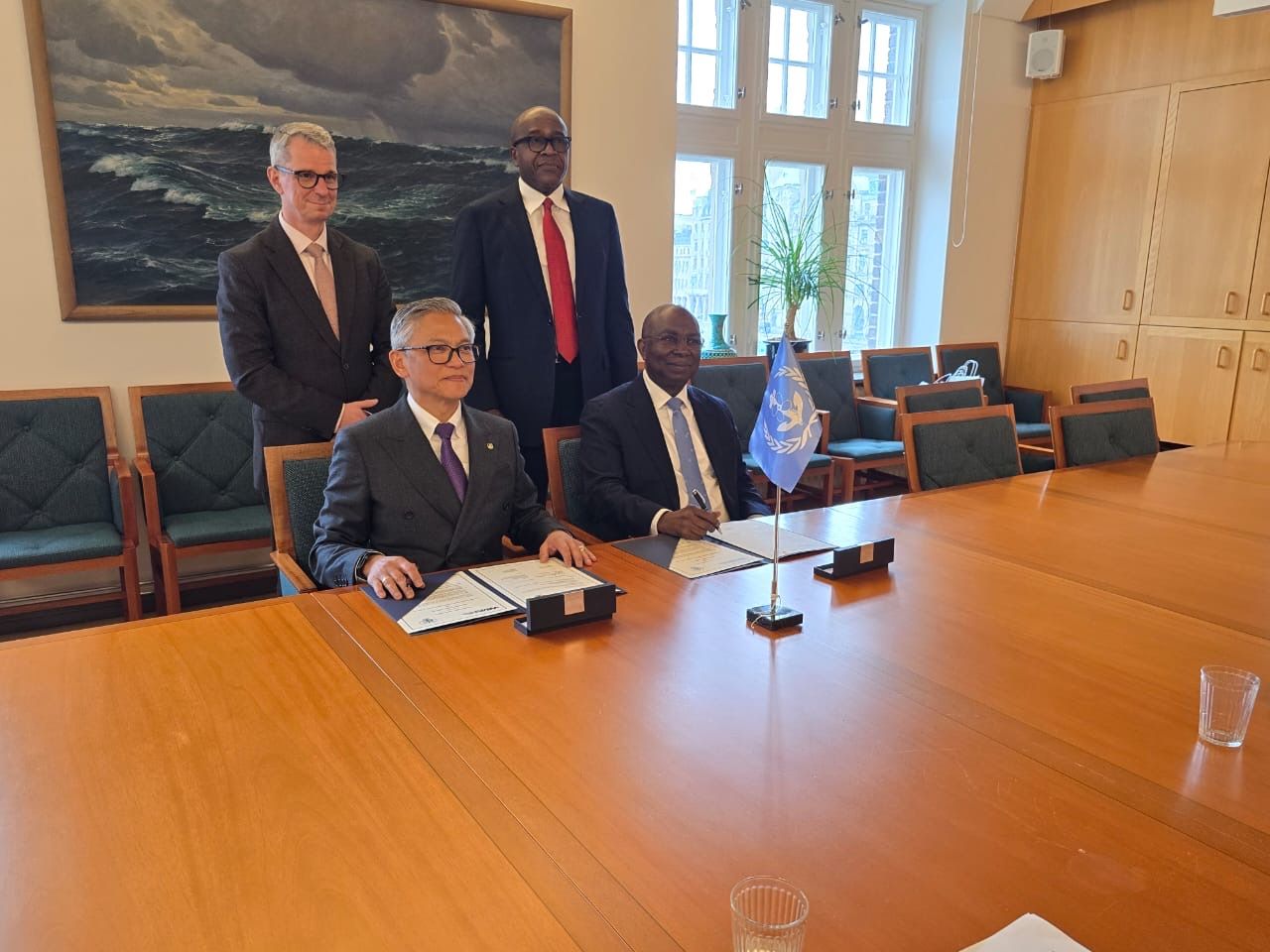
The Nigerian Maritime Administration and Safety Agency (NIMASA), has renewed its strategic capacity development partnership with the World Maritime University (WMU), Malmö, Sweden, through the signing of a four-year Memorandum of Understanding (MoU) aimed at strengthening Nigeria’s maritime human capital and institutional capacity.
Speaking at the MoU signing ceremony, the Director General of NIMASA, Dr. Dayo Mobereola, described the partnership as a critical pillar in NIMASA’s human capital development framework and a strategic investment in Nigeria’s maritime future.
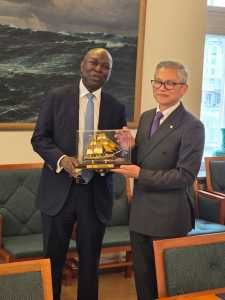
“This collaboration has significantly strengthened our technical and regulatory capabilities over the years.
“Their expertise has also reinforced Nigeria’s participation at the International Maritime Organization and other international maritime platforms,” he stated.
Under the renewed MoU, which was first signed in 2022, NIMASA will sponsor at least ten officers annually for the 14-month Master of Science programme at WMU in Malmö for the 2026–2029 intakes, as well as at least one officer for the Master of Philosophy (MPhil) programme jointly delivered by WMU and the International Maritime Law Institute (IMLI), Malta.
The MoU also provides for distance learning, executive professional development courses, research collaboration and technical assistance to strengthen NIMASA’s capacity in maritime safety, environmental management, seafarer certification and implementation of international maritime instruments.
WMU will further seek additional fellowships from international donors for qualified NIMASA candidates.
Dr. Mobereola endorsed the MoU on behalf of NIMASA with the President of WMU, Professor Maximo Q. Mejia Jr signing on behalf of the University while Executive Director Finance and Administration, NIMASA ,Chudi Offodile and the Registrar of WMU, Mr. Peter Marriott both signed as witnesses.
Established in 1983 by the International Maritime Organization, WMU was mandated to strengthen global maritime capacity, particularly in developing countries.
The University has since become a leading centre of excellence, and Nigeria has benefited significantly through the training of NIMASA officers who continue to enhance national maritime governance and international engagement.
Economy
Nigeria’s Oil exports face threat as US- Israel attack on Iran escalates, Strait of Hormuz blockade imminent
It links the Arabian/Persian Gulf, or just the Gulf, with the Gulf of Oman and the Arabian Sea beyond.
It is 33km (21 miles) wide at its narrowest point, with the shipping lane just 3km (2 miles) wide in either direction, making it vulnerable to attack.
Despite its narrow width, the channel accommodates the world’s largest crude carriers.
According to the US Energy Information Administration (EIA), about 20 million barrels of oil, worth about $500bn in annual global energy trade, transited through the Strait of Hormuz each day in 2024.The crude oil passing through the strait originates from Iran, Iraq, Kuwait, Qatar, Saudi Arabia and the UAE.
The strait also plays a critical role in the liquefied natural gas (LNG) trade.
On Saturday, February 28th, 2026, an official from the European Union told the Reuters news agency that vessels crossing the strait have been receiving very high frequency (VHF) transmissions from Iran’s elite Islamic Revolutionary Guard Corps (IRGC), saying “no ship is allowed to pass the Strait of Hormuz”.However, the EU official added, Iran has not officially closed the strait.
“Our ships will stay put for several days,” a top executive at a major trading desk told Reuters on condition of anonymity. Countries like Greece have also advised their vessels to avoid transiting through the waterway.
Any instability in this important maritime route could rattle economic stability worldwide.
The strait handles both oil and gas exports and imports.
Kuwait and the UAE import supplies sourced outside the Gulf, including shipments from the United States and West Africa.
The EIA estimated that in 2024, 84 percent of crude oil and condensate shipments transiting the strait headed to Asian markets.
A similar pattern appears in the gas trade, with 83 percent of LNG volumes moving through the Strait of Hormuz destined for Asian destinations.
China, India, Japan and South Korea accounted for a combined 69 percent intake of all crude oil and condensate flows through the strait last year. Their factories, transport networks and power grids depend on uninterrupted Gulf energy.
A spike in oil prices will impact countries such as China, India and several Southeast Asian nations.
How would the Strait’s closure impact oil prices?
According to Iranian state media, the country’s Supreme National Security Council must make the final decision to close the strait, and it has to be ratified by the government.But energy traders have been on high alert in recent weeks amid escalating tensions in the region – home to one of the largest reserves of oil and gas in the world.
Muyu Xu, senior crude oil analyst at Kpler, told reporters that since the war began on Saturday, there has been a sharp drop in vessel traffic through the strait.
“At the same time, the number of vessels idling on either side – in the Gulf of Oman and the Gulf – has surged, as shipowners grow increasingly concerned about maritime security risks following Tehran’s warning of a potential navigation closure,” he said.
“The Strait of Hormuz is critical to the global energy market, as roughly 30 percent of the world’s seaborne crude oil transits the waterway.
” In addition, nearly 20 percent of global jet fuel and about 16 percent of gasoline and naphtha flows also pass through the Strait,” Muyu said.
“On Sunday, March 1st, 2026, an oil tanker was struck off the coast of Oman, signalling a clear escalation of the conflict and a shift in targets from purely military facilities to energy assets.”
Shipping data showed that at least 150 tankers, including crude oil and liquefied natural gas vessels, have dropped anchor in open Gulf waters beyond the Strait of Hormuz.
The tankers were clustered in open waters off the coasts of major Gulf oil producers, including Iraq and Saudi Arabia, as well as LNG giant Qatar, according to the Reuters news agency estimates based on ship-tracking data from the MarineTraffic platform.
Moreover, on Sunday, March 1st, 2026,the United Kingdom Maritime Trade Operations (UKMTO) said it is aware of “significant military activity” in the Strait and said it has received a report of an incident two nautical miles north of Oman’s Kumzar, located in the Strait of Hormuz.
Muyu from Kpler said a broad range of energy infrastructure is now under threat. “This is expected to sharply intensify the oil price rally and could keep prices elevated for a sustained period, potentially longer than during last June’s conflict.”
Ali Vaez, director of the Iran project at the International Crisis Group, told Al Jazeera, “Closure of the Strait of Hormuz would disrupt roughly a fifth of globally traded oil overnight – and prices wouldn’t just spike, they would gap violently upward on fear alone.”
“The shock would reverberate far beyond energy markets, tightening financial conditions, fuelling inflation, and pushing fragile economies closer to recession in a matter of weeks,” he added.
When the US and Israel bombed Iran last June, there was no direct disruption to maritime activity in the region.
What does it mean for the global economy?
Any disruption to energy flows through Hormuz will also impact the global economy, driving up fuel and factory costs.Hamad Hussain, a climate and commodities economist at the United Kingdom-based firm Capital Economics, said that for the global economy, a sustained rise in oil prices would add upward pressure to inflation.
“If crude oil prices were to rise to $100 per barrel and remain at those levels for a while, that could add 0.6-0.7 percent to global inflation,” he said, noting that this would also lead to an increase in natural gas prices.
“This could slow the pace of monetary easing by major central banks, particularly in emerging markets, where policymakers tend to be more sensitive to swings in commodity prices,” he added.
-

 Headlines2 weeks ago
FIFA sends Nigeria’s Super Eagles to 2026 World Cup, awards boardroom scoreline of 3 goals to nil against DR Congo
-

 Customs3 months ago
How Comptroller Adenuga is raising revenue profile of Seme command, facilitating regional trade.
-

 Headlines3 months ago
MARAN pulls industry’s stakeholders to unveil its iconic book on Maritime industry.
-

 Headlines1 month ago
Ayobo residents protest deplorable road at LCDA, complain of 10- year neglect by successive local council administrations.
-
 Headlines2 months ago
FG approves 50 percent price slash on Yuletide train services
-

 Customs3 months ago
Relief as Customs grants January 31st, 2026 extension for fast track operators to migrate to AEO