Connect with us

Headlines

CRFFN survival hangs in balance as court nullifies collection of POF from Customs Agents

–lacks powers to regulate Customs licensed agents
–ministerial directive of 2017 on collection of POF is illegal 
Funso OLOJO/ Gloria Odion 
The thin thread of survival which the Council of Regulation of Freight Forwarding in Nigeria(CRFFN) is delicately hanging onto is currently being threatened as the Lagos High Court has nullified the collection of Practitioners Operating Fee(POF) by the Council.
It would be recalled that due to the paucity of funding by government to support the CRFFN, the government created an ingenious way which the CRFFN could be generating revenue internally through the collection of practicing fees from freight forwarding industry practitioners called POF.
However, in 2017, the then Minister of Transportation, Rotimi Ameachi made a declaration that all freight forwarders operating in the Nigerian Ports should pay a fee called the POF to be collected by the CRFFN.
The directive further tied the access of any freight forwarder to the Port and taking delivery of his goods to the payment of the fee.
However, in 2018, the National Council of Managing Directors of Licenced Customs Agents(NCMDLCA) approached a Lagos High Court in order to stop the collection of the controversial POF which commenced in 2017.
In the suit No. FHC/CS/765/2018, filed before Justice D.E Osiagor of the Lagos High Court, the Council of Managing Directors sought the following reliefs:
“A  declaration that the business of Licensed Customs Agents(LCA) is not under the control and regulation of the Ministry of Transportation and Council for the Regulation of Freight Forwarding in Nigeria(CRFFN).
“A declaration that Licensed Customs Agents and the Business of Licensed Customs Agents, and the right of Licensed Customs Agents to enter the Port to conduct and carry out business of Licensed Custom Agent is created and regulated by the Customs and Excise Management Act.
“A declaration that Licensed Customs Agents and the Business of Licensed Customs Agents and Freight Forwarders and the Business of freight Forwarding are functionally and operationally different bodies and business under the control, regulation and supervision of different and separate Government Ministries and parastatal.
“A declaration that the Ministerial Directive mandating that  Council For the Regulation of Freight Forwarding in Nigeria to Commence collection of Practitioners Operating Fees(POF) and that the Payment of Practitioners Operating Fees is a requirement for release and delivery of cargo from the sea-Ports, AirPort and Land Borders Station is ultra vires, the power of Minister of Transportation and therefore null and void.
“A declaration mandating the Nigeria Customs Service(NCS) to ensure that all Licenses issued or renewed by the Nigeria Customs Service(NCS) to ensure that all Licenses issued are renewed by Nigeria Custom Service(NCS) will first be cleared by Council For the Regulation of Freight Forwarding in Nigeria(CRFFN) by conforming payment of Registration, Annual Subscription and Practitioners Operating Fess as it affect the business of Licensed Customs Agents is ultra vires the power of the Minister of Transportation and thus null and void.
“A declaration that the Ministerial Directive mandating that Security Gate-Passes for access to Seaport and International Cargo Airport and Land Border Ports be issued by Council For the Regulation of Freight Forwarding in Nigeria is ultra vires the Ministerial power and thus null and void.
In the originating summon disposed to by Mr Lucky Eyis Amiwero, the National President of Council of Managing Directors, the association sought an order of the court for the following:
“AN order revoking and quashing the Ministerial Directive of the 2nd Defendant issued and published in Vanguard Newspaper issued on Tuesday, August 1, 2017 at page 29 only relates to the business and operation of Licensed Customs Agents.
“AN order that Licensed Customs Agents be allowed access to the Seaport, Cargo Air ports to carry on their legitimate business upon presentation of valid license as registered Licensed Customs Agents.
The defendants in the suit were the Honorable Minister of Transportation, the Nigerian Ports Authority(NPA) and the Council For the Regulation of Freight Forwarding(CRFFN) in Nigeria.
In his landmark ruling on May,26th, 2025, Justice D.E Osiagor granted all the reliefs and orders sought by the Plaintiff,the Council of Managing Directors.
The Judge therefore made the following declarations
“The regulation of Licensed Customs Agents is governed squarely by the Customs and Excise Management Act, which provides a comprehensive legal frame for the licensing and oversight of Customs operation in Nigeria specifically:
“THE MINISTER CHARGED WITH THE RESPONSIBILITY OF REGULATING , LICENSING LICENSED CUSTOMS AGENT IS THE MINISTER OF FINANCE AND NOT TRANSPORT
“It follows that only the Minister of Finance, acting through the Nigeria Custom Service is statutorily authorized to regulate the business and operation of Licensed Customs Agents.
“The Honorable Minister of Transportation is not recognized under the Customs Act as having any supervisory or regulatory role in this regard.
“The (CRFFN) Act established a Council to regulate Freight Forwarders- A profession distinct from License Customs Agents.
“Under Section 4 the (CRFFN) is empowered to determine qualification, register Freight Forwarders, and Set standard for practice
“License Customs Agent(LCA) is a distinct profession from Freight forwarders.
“The Regulatory reach of (CRFFN) does not extend to Customs Agents under the Customs Act, therefore, any attempt to subject Licensed Customs Agents to (CRFFN) regulation, include payment of Practitioners Operating Fees(POF) lacks legal foundation
“Licensed Customs Agents(LCA) are not subjected to the regulation of (CRFFN), include payment of Practitioners Operating Fees(POF)  lack legal foundation
“The Minsters Directives that only person cleared by CRFFN including payment of registration, subscription and Practitioners Operating Fees(POF) may  access the Port or renew Customs Licenses, is ultra vires,imposing unauthorized regulatory condition on Customs Agents(LCA) who are neither under the supervision of(CRFFN)
“The Honorable Minster of Transportation lacks the Legal authority to issue directive regulating the business and operation of Licensed Customs Agents. The directive is ultra vires, null and void as the encroachment upon the statutory function of the Minister of Finance.
“Licensed Customs Agents(LCA) are governed by CEMA, which vest regulatory control in the Nigeria Customs Service and the Minister of Finance.
“However, mandates that these Licensed Customs Agent(LCA) must first be cleared by the (CRFFN) a separate regulatory body established under a different statute, for purposes of obtaining port access of Custom License renewal.
“This create a direct and irreconcilable conflict of Laws, Customs Agent already Licensed under CEMA, are being subjected to a second, unauthorized layer of regulation.
“This duplicity undermines legal certainty and introduces regulatory confusion, in breach of Section 153 and 156 of CEMA, which vest exclusive Licensing authority in the Minister of Finance.
“It follows therefore that the Licensed Customs Agents(LCA) should not be subjected to overlapping and conflicting obligation stemming from separate and different statutory authorities without express legal backing.
“Secondly, the directive imposes the payment of Practitioners Operating Fees(POF) as a condition for port access and license renewal, even though there is no statutory obligation under CEMA for such payment.
” This amount to an unlawful financial imposition on class of professional who are already operating under a different statutory scheme, imposing financial obligation without clear legislative authority constitutes an abuse of executive power and violates the principle of legality.
“The directive further mandates that the issuance of security gate-passes for access to Port shall be subjected to  the (CRFFN) certification and payment of fess, this directly weakens/ impairs the ability of the Licensed Customs Agents to carry out their statutory duties at the Port, by conditioning their access on compliance with unauthorized requirements .
“The directive places the livelihood of these Licensed Customs Agents(LCA) at risk, and exposes them to arbitrary denial of access to the operational zones of their profession. Such regulatory overreach amount to constructive exclusion from lawful business and infringes the constitutional right to freedom of trade and profession guaranteed  under section
16(1)(b) and Section 17(3)(a) of the 1999 Constitution( as amended).
“Hence administrative actions that violate statutory or constitutional right must be struck down.
“Fourthly, the Ministerial directives is ultra vires, the power of the Minister of Transportation, it is settled law that an act done in excess of statutory authority is null and void and cannot have legal effect.
“The Directive creates legal Jeopardy for Licensed Customs Agent(LCA) by compelling them to comply with illegitimate demands, there placing them in a position of conflict with their primary regulator- the Nigeria Customs Service(NCS)”
” Licensed Customs Agents shall not be subjected to regulatory control by (CRFFN) or required to pay  fees or obtain clearance from (CRFFN) as a condition for access to  Ports or renewal of  their Licenses under Customs Act; the two questions for determination are resolved in favor of the Plaintiff/licensed Customs Agents(LCA)” declared Justice Osiagor in his final ruling.
Following this ruling, stakeholders expressed fears over the survival of the CRFFN which has been struggling due to inadequate funding and gross maladministration deeply steeped in alleged misappropriation of its scarce resources.
The challenge of the regulator of the freight forwarding industry was further compounded by government declaration which removed some MDAs, including the CRFFN, from collection of annual financial hand outs.
” Now that the court has restricted the scope of the collection of the POF, which is its main source of funding as its internally generated revenue(IGR), the survival of the struggling council is hanging on a thread” a concerned freight forwarder observed.
Continue Reading
Click to comment

Leave a Reply

Your email address will not be published. Required fields are marked *

Headlines

Tinubu swears in new IGP, Tunde Disu on Wednesday as Police council endorses his appointment

Funso OLOJO,  Editor
President Bola Ahmed Tinubu will on Wednesday, March 4th, 2026 swear- in the new Inspector – General of Police (IGP), Olatunji Rilwan Disu following the endorsement of his appointment by the Nigeria Police Council.
According to the Presidential spokesman, Bayo Onanuga, the  ceremony will take place during the Federal Executive Council meeting, scheduled for the same day.
The Council’s meeting, which took place at the State House, was presided over by President Bola Ahmed Tinubu and had in attendance Vice President Kashim Shettima, state governors and the Chairman of the Police Service Commission, retired DIG Hashimu Argungu, in accordance with the constitution.
Others in attendance were the Secretary to the Government of the Federation, Senator George Akume; the National Security Adviser, Nuhu Ribadu; the Chief of Staff, Femi Gbajabiamila; the Minister of Police Affairs, Senator Ibrahim Gaidam; the FCT Minister, Nyesom Wike; and the head of service, Mrs Esther Didi Walson-Jack.
The President appointed Disu as the new police chief, following the resignation of the former Inspector-General of Police, Kayode Egbetokun.
Governor of Lagos State, Babajide Sanwo-Olu, who spoke glowingly about the Acting Inspector-General of Police, commended Disu for his exemplary services as a policeman, especially when he served as the Commander of the Rapid Response Squad in Lagos State between 2015 and 2021, where his tenure earned him and the RRS recognition for excellence in crime control.
Governor of Nasarawa State, Abdullahi Sule, commended the President’s appointment of Disu, noting that it was based on his excellent career record.
Minister of the Federal Capital Territory and former Governor of Rivers State, Nyesom Wike, also lauded Disu for his professionalism.
Disu served in Wike’s home state of Rivers as Assistant Commissioner, Criminal Investigation Department, and Officer-in-charge, anti-kidnapping unit, between 2014 and 2015.
He later served as Commissioner of Police in the FCT Command when Wike became the minister.
Wike commended him for his efficiency as a crime fighter and for ensuring the command’s strategic impact in addressing security concerns within the territory.
Governor Peter Mbah of Enugu State seconded the motion endorsing Disu’s appointment.
Disu was born on April 13, 1966, in Lagos State and joined the Nigeria Police Force on May 18, 1992, as a Cadet Assistant Superintendent.
He rose through the ranks with multiple qualifications in public administration, forensic investigation, criminology, security, legal psychology, and entrepreneurship-credentials that reflect his commitment to knowledge-driven, modern policing.
The Acting Inspector-General has held critical operational, investigative, and strategic command positions nationwide.
His last position was as Assistant Inspector-General of Police in charge of the Special Protection Unit and the Force CID Annex, Lagos.
Continue Reading

Headlines

Maersk’s suspension of shipping operations through Strait of Hormuz raises anxiety among Nigerian importers 
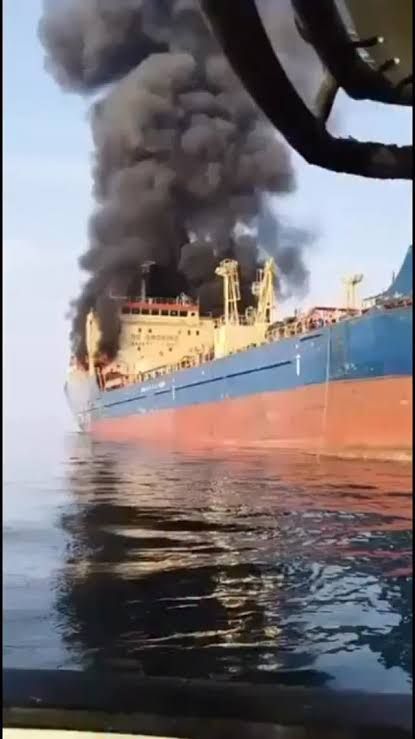
Attack on vessel in the Strait of Hormuz
Funso OLOJO, with agency report
The on- going hostilies in the Middle East have continued to stifle international trade as most of the shipping companies have suspended voyage through the troubled Strait of Hormuz.
The joint attacks by the military forces of the United States of America (USA) and Israel on the Islamic Republic of Iran, which resulted in the assassination of its Supreme leader, Ayatollah Ali Khomenei and over 40 top military officers of the Islamic country,have put a strain on shipping operations along the busy vessel route of Strait of Hormuz as the Houthis militias, who are sympathetic to Iran, have threatened to attack vessels on the route.
Strait of Hormuz accounts for one third of the world shipping passage while the route accommodates the world largest crude tankers , despite its narrow width.
As a result of the threats, which have raised safety concerns on the vessels, cargos and crews, major shipping lines have halted their operations along the route.
Maersk, the world’s largest container shipping company, has halted passage of cargo vessels through the Strait of Hormuz for “safety” reasons.

“We are suspending all vessel crossings in the Strait of Hormuz until further notice,” the Danish group said in an online advisory.“The safety of our crews, vessels and customers’ cargo remains our key priority,” it said.

Iran’s Revolutionary Guard had earlier announced the Strait’s closure.

Major Middle Eastern oil and gas exporters rely on it to move supplies to international markets while importing nations depend on its uninterrupted operation.
China, one of the biggest destinations of Nigerian importers, make use of the route for import of the crude oil from the Middle East, especially Iran and export of its manufactured goods to the developing countries, especially Nigeria.
This development has raised anxiety among Nigerian importers who expressed concerns over the implications of the disruption on the route one the cost of imports, especially from China.
Continue Reading

Headlines

NRC hosts Rotary Club on mobile train

Gloria Odion, Reporter 
The Nigerian Railway Corporation (NRC) has played host to the Rotary Club of Ota by hosting Nigeria’s first-ever Rotary fellowship on a moving train, setting a remarkable benchmark for innovation in civic and humanitarian engagement.
The groundbreaking event brought together members of the club aboard a moving train for fellowship, leadership interaction, and strategic discussion centered on service to humanity, climate action, and sustainable community development.
The fellowship was led by the President of the Rotary Club of Ota, Mr. Charles Umukoro, alongside members of the club’s executive and general membership.
A major highlight of the occasion was the visit of the Railway District Manager, Engr. Rasheed Adedeji, who warmly welcomed the Rotarians on board.
His presence underscored the significance of the event and further strengthened the cordial relationship between the railway management and the Rotary Club.
In a symbolic moment reflecting shared values of service and partnership, Engr. Rasheed Adedeji was formally inducted as a member of the Rotary Club of Ota following his welcome address, adding prestige and deeper institutional collaboration to the landmark fellowship.
The moving-train fellowship was widely described as symbolic of progress, innovation, and forward movement—values that align closely with the transformation agenda of the Nigerian Railway Corporation.
The Nigerian Railway Corporation said it was committed to supporting initiatives that promote national development, environmental sustainability, and community advancement, while showcasing the railway as a safe, modern, and strategic platform for engagement.
Continue Reading

Trending