Connect with us

Headlines

MARAN decries $500m annual loss by Nigerian Shippers to War Risk charges on in-bound cargo.

— accuses international shipping cartel of criminal extortions
Funso OLOJO 
The Maritime Reporters Association of Nigeria( MARAN) has condemned the persistent collection of War Risk Premium on Nigeria – bound cargo by international shipping cartel which runs into a whooping sun of $500m annually.
In a press statement by the association, the group decried what it described as international gang -up against Nigeria by the foreign ship owners whom  it accused of fleecing Nigerian Shippers through this charges despite the security improvements on Nigerian waters.
To demonstrate its opposition to the continued collection of these inordinate charges, MARAN has embarked on an advocacy through its 3rd Annual Maritime Lecture (MAMAL 2025) where it intends to highlight the extortions of Nigerian Shippers and expose what it regarded as a deep- seated fraud by the international shipping cartel.
MARAN, while acknowledging the relentless efforts of the Nigerian Maritime Administration and Safety Agency(NIMASA) to end this international gang -up against Nigeria and end the imposition of the charges, the association lamented that the extortion still continues unabated.
The group observed that shipowners and importers, who bear the brunt of these unjustifiable premiums, are left wondering why a nation with demonstrable secure waters is still being treated as a war zone by the international shipping community.
Alhaji Aminu Umar, Managing Director of Sea Transport Services Nigeria Limited and President of the Nigerian Chamber of Shipping, rightly points out the need for NIMASA to engage the Joint War Committee, the body responsible for waiving or imposing WRI.
“However, despite their efforts, the WRI remains firmly in place, raising concerns about the sincerity of the international shipping companies who engage business with Nigerian Shippers and the dirty politics involved in international trade as described by the President of the Nigeria Shipowners Association (NISA), Mr. Sola Adewunmi.
MARAN noted that for years, the justification for WRI on Nigerian-bound cargo stemmed from the very real threat of piracy and Niger Delta militancy.
” However, as confirmed by the International Maritime Bureau (IMB) in 2021, Nigeria has been officially removed from the list of piracy-prone countries.
“The International Bargaining Forum (IBF) further validated this progress in 2023, delisting Nigeria from high-risk maritime nations” the group observed.
MARAN also recalled that the Minister of Marine and Blue Economy, Adegboyola Oyetola, has also repeatedly affirmed that there hasn’t been a single pirate incident in Nigerian waters for over three years, attributing this peace to the multi-billion naira Deep Blue Project spearheaded by NIMASA.
The association however expressed concern that despite this improvement on security in the Gulf of Guinea and Nigerian waters, foreign insurance companies like Lloyd’s of London and various P&I clubs continue to levy these war risk surcharges.
“This isn’t just an inconvenience; it’s a monumental financial drain.
” In the past three years alone, Nigeria has coughed up an eye-watering $1.5 billion in WRI premiums.
“To put this into perspective, a Very Large Crude Carrier (VLCC) can incur a WRI surcharge of approximately $445,000 per voyage, while a new container vessel might face a hefty $525,000.
“Shipping giants like Maersk even tack on additional “transit disruption surcharges” of up to $450 per container.
” This translates directly to higher costs for Nigerian importers and exporters, ultimately passed on to the ordinary citizen, who pays inflated prices for goods” the journalists group noted.
MARAN stated that it was against this backdrop of frustration and economic detriment which the War Risk charges have caused the country that makes the association wants to bring the criminal extortions being perpetrated by international shipping cartel against Nigeria to global attention through its forthcoming annual lecture.
“The 3rd Annual Maritime Lecture (MAMAL 2025), slated for August 28, 2025, at the Eko Hotel and Suites in Lagos, is set to be a groundbreaking event that directly confronts this international fraud” the association declared.
With the theme “Addressing the Burden of War Risk Insurance on Nigerian Maritime Trade,” MAMAL 2025 aims to be more than just a discussion forum.
 It’s a rallying cry to the Federal Government and all affected stakeholders to acknowledge the severe economic implications of these unjust charges.
MARAN President, Mr. Godfrey Bivbere, has unequivocally condemned WRI as an international fraud burdening the economy of Nigeria and other developing countries in the Gulf of Guinea.
MAMAL 2025 promises to dissect every facet of this issue, from the perceived threats to the profound implications of persistent Extra War Risk Insurance (EWRI).
It will scrutinize the roles of classification societies like Lloyd’s of London and critically examine the contributions of core stakeholders, including NIMASA, the Nigerian Navy, and other maritime and security operators.
More importantly, MAMAL 2025 will draw over 500 key stakeholders, including maritime security experts, shipowners, terminal operators, international shipping lines, diplomats, insurers, regulators, and legal experts.
This broad engagement, driven by MARAN’s respected voice in the industry, offers a genuine opportunity for a united front against this exploitative practice.
While NIMASA talks to the UN, MARAN is bringing together the very people and organizations directly impacted, creating a platform for collective action and a more forceful demand for change.
” The continued imposition of War Risk Insurance on Nigerian-bound vessels is an affront to the nation’s efforts in securing its maritime domain and a significant impediment to its economic growth.
“It’s time for a definitive resolution, and MAMAL 2025, driven by the persistent advocacy of MARAN, appears to be the most promising avenue for achieving it” the statement concluded.

Continue Reading
Click to comment

Leave a Reply

Your email address will not be published. Required fields are marked *

Headlines

Tinubu swears in new IGP, Tunde Disu on Wednesday as Police council endorses his appointment

Funso OLOJO,  Editor
President Bola Ahmed Tinubu will on Wednesday, March 4th, 2026 swear- in the new Inspector – General of Police (IGP), Olatunji Rilwan Disu following the endorsement of his appointment by the Nigeria Police Council.
According to the Presidential spokesman, Bayo Onanuga, the  ceremony will take place during the Federal Executive Council meeting, scheduled for the same day.
The Council’s meeting, which took place at the State House, was presided over by President Bola Ahmed Tinubu and had in attendance Vice President Kashim Shettima, state governors and the Chairman of the Police Service Commission, retired DIG Hashimu Argungu, in accordance with the constitution.
Others in attendance were the Secretary to the Government of the Federation, Senator George Akume; the National Security Adviser, Nuhu Ribadu; the Chief of Staff, Femi Gbajabiamila; the Minister of Police Affairs, Senator Ibrahim Gaidam; the FCT Minister, Nyesom Wike; and the head of service, Mrs Esther Didi Walson-Jack.
The President appointed Disu as the new police chief, following the resignation of the former Inspector-General of Police, Kayode Egbetokun.
Governor of Lagos State, Babajide Sanwo-Olu, who spoke glowingly about the Acting Inspector-General of Police, commended Disu for his exemplary services as a policeman, especially when he served as the Commander of the Rapid Response Squad in Lagos State between 2015 and 2021, where his tenure earned him and the RRS recognition for excellence in crime control.
Governor of Nasarawa State, Abdullahi Sule, commended the President’s appointment of Disu, noting that it was based on his excellent career record.
Minister of the Federal Capital Territory and former Governor of Rivers State, Nyesom Wike, also lauded Disu for his professionalism.
Disu served in Wike’s home state of Rivers as Assistant Commissioner, Criminal Investigation Department, and Officer-in-charge, anti-kidnapping unit, between 2014 and 2015.
He later served as Commissioner of Police in the FCT Command when Wike became the minister.
Wike commended him for his efficiency as a crime fighter and for ensuring the command’s strategic impact in addressing security concerns within the territory.
Governor Peter Mbah of Enugu State seconded the motion endorsing Disu’s appointment.
Disu was born on April 13, 1966, in Lagos State and joined the Nigeria Police Force on May 18, 1992, as a Cadet Assistant Superintendent.
He rose through the ranks with multiple qualifications in public administration, forensic investigation, criminology, security, legal psychology, and entrepreneurship-credentials that reflect his commitment to knowledge-driven, modern policing.
The Acting Inspector-General has held critical operational, investigative, and strategic command positions nationwide.
His last position was as Assistant Inspector-General of Police in charge of the Special Protection Unit and the Force CID Annex, Lagos.
Continue Reading

Headlines

Maersk’s suspension of shipping operations through Strait of Hormuz raises anxiety among Nigerian importers 

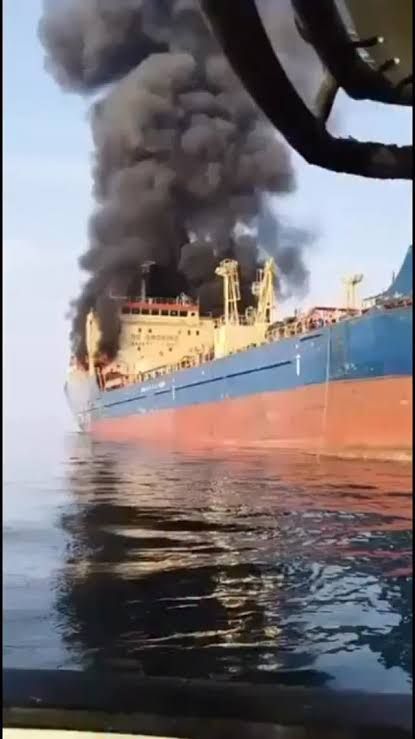
Attack on vessel in the Strait of Hormuz
Funso OLOJO, with agency report
The on- going hostilies in the Middle East have continued to stifle international trade as most of the shipping companies have suspended voyage through the troubled Strait of Hormuz.
The joint attacks by the military forces of the United States of America (USA) and Israel on the Islamic Republic of Iran, which resulted in the assassination of its Supreme leader, Ayatollah Ali Khomenei and over 40 top military officers of the Islamic country,have put a strain on shipping operations along the busy vessel route of Strait of Hormuz as the Houthis militias, who are sympathetic to Iran, have threatened to attack vessels on the route.
Strait of Hormuz accounts for one third of the world shipping passage while the route accommodates the world largest crude tankers , despite its narrow width.
As a result of the threats, which have raised safety concerns on the vessels, cargos and crews, major shipping lines have halted their operations along the route.
Maersk, the world’s largest container shipping company, has halted passage of cargo vessels through the Strait of Hormuz for “safety” reasons.

“We are suspending all vessel crossings in the Strait of Hormuz until further notice,” the Danish group said in an online advisory.“The safety of our crews, vessels and customers’ cargo remains our key priority,” it said.

Iran’s Revolutionary Guard had earlier announced the Strait’s closure.

Major Middle Eastern oil and gas exporters rely on it to move supplies to international markets while importing nations depend on its uninterrupted operation.
China, one of the biggest destinations of Nigerian importers, make use of the route for import of the crude oil from the Middle East, especially Iran and export of its manufactured goods to the developing countries, especially Nigeria.
This development has raised anxiety among Nigerian importers who expressed concerns over the implications of the disruption on the route one the cost of imports, especially from China.
Continue Reading

Headlines

NRC hosts Rotary Club on mobile train

Gloria Odion, Reporter 
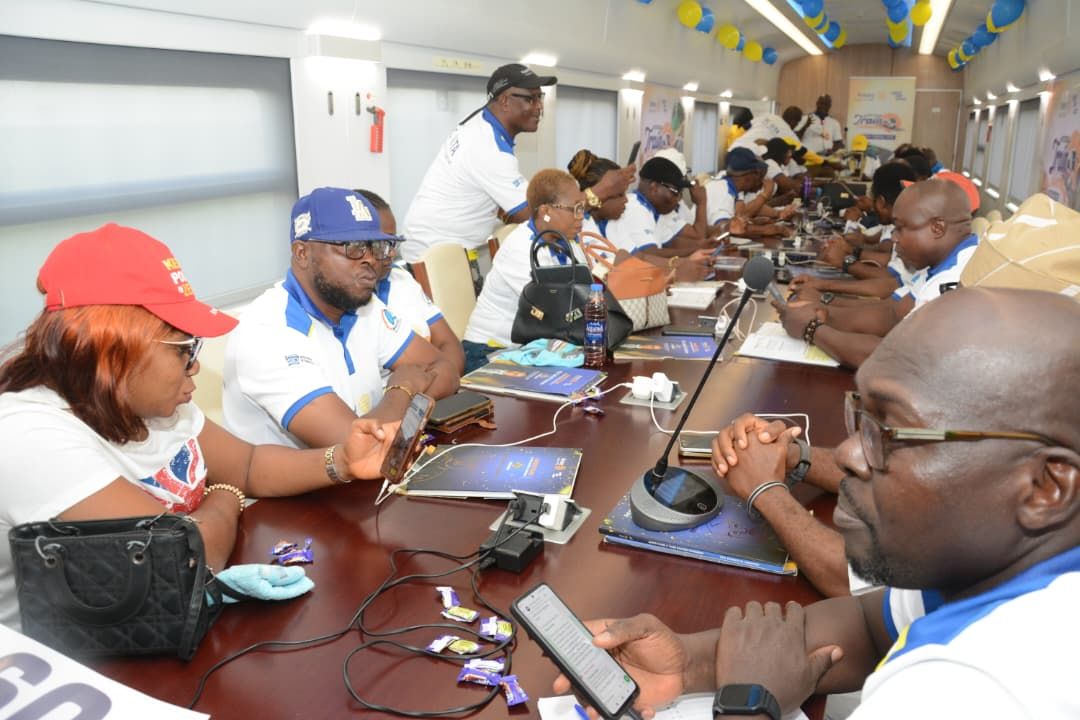
The Nigerian Railway Corporation (NRC) has played host to the Rotary Club of Ota by hosting Nigeria’s first-ever Rotary fellowship on a moving train, setting a remarkable benchmark for innovation in civic and humanitarian engagement.
The groundbreaking event brought together members of the club aboard a moving train for fellowship, leadership interaction, and strategic discussion centered on service to humanity, climate action, and sustainable community development.
The fellowship was led by the President of the Rotary Club of Ota, Mr. Charles Umukoro, alongside members of the club’s executive and general membership.
A major highlight of the occasion was the visit of the Railway District Manager, Engr. Rasheed Adedeji, who warmly welcomed the Rotarians on board.
His presence underscored the significance of the event and further strengthened the cordial relationship between the railway management and the Rotary Club.
In a symbolic moment reflecting shared values of service and partnership, Engr. Rasheed Adedeji was formally inducted as a member of the Rotary Club of Ota following his welcome address, adding prestige and deeper institutional collaboration to the landmark fellowship.
The moving-train fellowship was widely described as symbolic of progress, innovation, and forward movement—values that align closely with the transformation agenda of the Nigerian Railway Corporation.
The Nigerian Railway Corporation said it was committed to supporting initiatives that promote national development, environmental sustainability, and community advancement, while showcasing the railway as a safe, modern, and strategic platform for engagement.
Continue Reading

Trending